

By: Saidu Jalloh
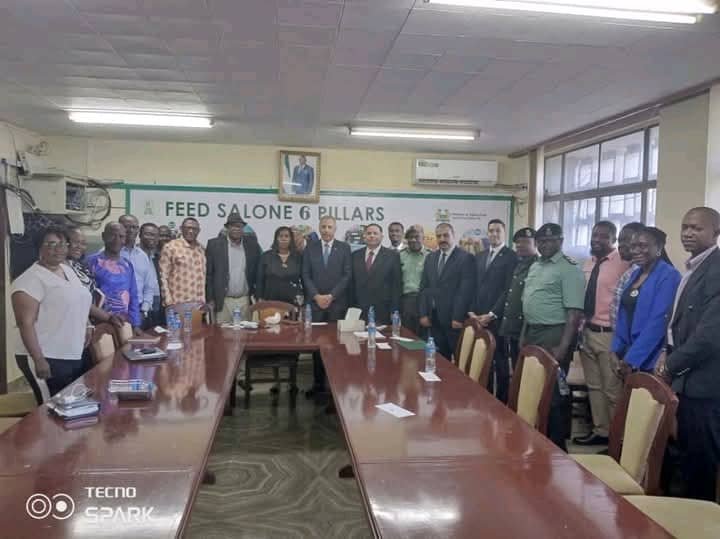
An Egyptian delegation, led by Sierra Leone’s Ambassador to Egypt, Mr. Sadiq Silla, paid a courtesy visit to the Ministry of Agriculture and Food Security (MAFS) at the Youyi Building in Freetown on Monday. The visit aimed to explore potential investment opportunities under the Feed Salone initiative and strengthen bilateral cooperation between the two nations.
During the meeting, Ambassador Silla explained that the visit followed President Dr. Julius Maada Bio’s recent official trip to Egypt, where discussions focused on deepening bilateral relations and advancing agricultural development, particularly in the areas of livestock, oil palm production, and irrigation.
Ambassador Silla revealed that “The Future of Egypt,” a state-owned organization, had expressed a strong interest in partnering with Sierra Leone’s Ministry of Defence to invest in key agricultural value chains. He noted that the visiting team had already toured several promising agricultural sites across the country, acknowledging Sierra Leone’s significant potential to drive growth in the food sector.
The Team Lead from The Future of Egypt, Major General Khaled Salah, reiterated Egypt’s commitment to supporting Sierra Leone’s agricultural transformation. He emphasized that the organization specializes in large-scale agricultural development, including irrigation and mechanization critical areas for enhancing Sierra Leone’s food security.
In his remarks, the Director General of Agriculture, Professor Abdulai Jalloh, praised Egypt’s progress in modern agriculture, particularly in irrigation, which is crucial for Sierra Leone, especially as the country faces the challenges of climate change. Prof. Jalloh assured the delegation of MAFS’s full technical cooperation and highlighted the Ministry’s strong support for private-sector partnerships to improve food security and boost agricultural productivity.
Additionally, the Director of the Livestock and Veterinary Services Division, Mr. Saidu Bamayange, discussed Sierra Leone’s potential in livestock production. He noted that local cattle breed currently average around 250 kilograms due to challenges such as poor feed quality and endemic diseases like Peste des Petits Ruminants (PPR). He also pointed out that poultry production is hampered by feed shortages, particularly maize, which is often affected by the Fall Armyworm. Despite these challenges, Mr. Bamayange emphasized that Sierra Leone has vast arable land and reliable water resources, making it ideal for large-scale agricultural expansion.
In her closing remarks, Senior Permanent Secretary Madam Nancy Tengbeh assured the visiting delegation and the Ministry of Defence of MAFS’s readiness to provide full institutional and technical support to facilitate future collaboration.