

By: Saidu Jalloh
In a momentous ceremony filled with jubilation, thousands of students and staff at Njala University warmly welcomed Dr. Kandeh Yumkella, Chairman of the Energy Governance Coordinating Group (EGCG) and the Presidential Initiative on Climate Change, Renewable Energy, and Food Security (PI-CREF). Dr. Yumkella visited the site of a 1-megawatt solar power plant currently under construction a project that promises to transform energy access for both the university and surrounding communities.
Amidst enthusiastic chants, banners of appreciation, and a palpable sense of celebration, the Njala community hailed the initiative as a “transformational” breakthrough. The project, part of the World Bank-funded Regional Emergency Solar Power Intervention Project (RESPITE) and championed by President Julius Maada Bio, aims to end decades of unreliable electricity supply.
Representing President Bio, Dr. Yumkella described the energy initiative as a strategic national effort to provide sustainable, affordable, and uninterrupted electricity throughout Sierra Leone. He commended the World Bank’s support and noted that the university had secured sufficient land to facilitate the construction.
“This is not just about light bulbs,” Dr. Yumkella stated. “It’s about lighting the path to excellence in education, research, and innovation. President Bio is committed to ensuring that every corner of Sierra Leone, especially academic institutions, has access to reliable energy.”
Scheduled for completion by the first quarter of 2026, the solar facility will provide electricity to Njala University and potentially the broader Mokonde community, catalyzing regional development. The contractor affirmed that work is progressing smoothly and pledged timely delivery. Upon completion, the project is expected to save the university over $40,000 monthly in electricity costs.
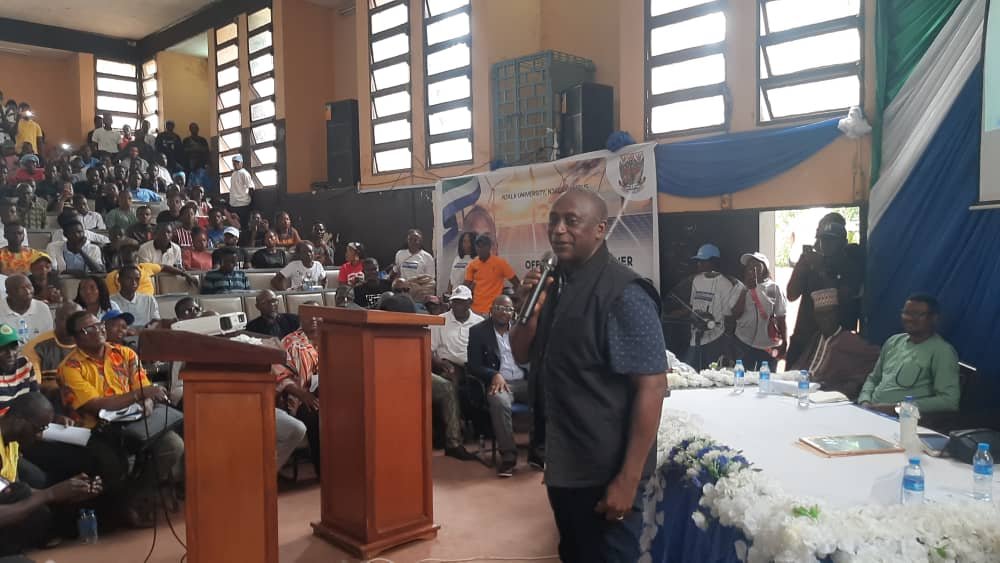
Professor Bashiru Koroma, Vice Chancellor and Principal of Njala University, expressed deep gratitude to both President Bio and Dr. Yumkella during a public lecture at the university’s Multipurpose Hall. He described the project as a “beacon of hope” for an institution long plagued by power challenges.
“Dr. Yumkella once served as President of the Njala Students’ Union,” Prof. Koroma remarked. “He’s not just returning home—he’s returning with a legacy-defining solution that will reshape our academic and social environment.”
The public lecture, themed “Energy Transition and Human Capital Development,” offered a compelling discussion on the connection between clean energy and educational advancement. In a powerful keynote address, Dr. Yumkella reflected on his journey from a student at Njala to a global energy leader.
“I never studied energy,” he said. “But life demanded I learn. Today, I lead global conversations on energy transition. You too can rise beyond limits if you remain focused and believe in your potential.”
He emphasized that energy transition is a long-term, non-political process requiring national commitment. He highlighted major ongoing energy projects, including the 105MW Nant Energy Project, and unveiled Mission 300 Compact, a forward-looking strategy to modernize Sierra Leone’s energy infrastructure and accelerate economic growth.
In a heartfelt message to students, Dr. Yumkella encouraged them to explore academic and career paths in renewable energy, solar technology, and sustainable development critical sectors for Sierra Leone’s future.
“Be ambitious, but stay grounded. Know your limits, be humble, and let discipline guide your aspirations. Humility pays more than arrogance ever will,” he advised.
Also in attendance was Hon. Sarjoh Aziz-Kamara, who praised the project’s alignment with President Bio’s Human Capital Development initiative. He emphasized that energy access is a cornerstone of higher education, innovation, and national prosperity.
“This is more than just power supply it’s the fuel for enlightenment, innovation, and opportunity,” he said.
For many, the moment was deeply emotional. For over four decades, Njala University has struggled with erratic electricity, disrupting studies, research, and campus life. The announcement of the solar project’s launch sparked tears of joy, chants of hope, and a renewed sense of determination.
“This is a new dawn,” said Mariama Kamara, a third-year Agricultural Economics student. “We’ve dreamed of this day. Now, we can study without fear of blackouts. We are inspired.”
The event concluded with a dynamic Q&A session, where Dr. Yumkella responded to student inquiries with warmth and insight. Attendees left feeling empowered and hopeful, committed to protecting and maximizing this transformative investment.
From the dusty roads of Mokonde to the global stage of sustainable energy, Njala University now stands on the threshold of a brighter future illuminated not only by solar panels but by the united vision of a resilient, energy-secure Sierra Leone.