

By: Aminata Sesay
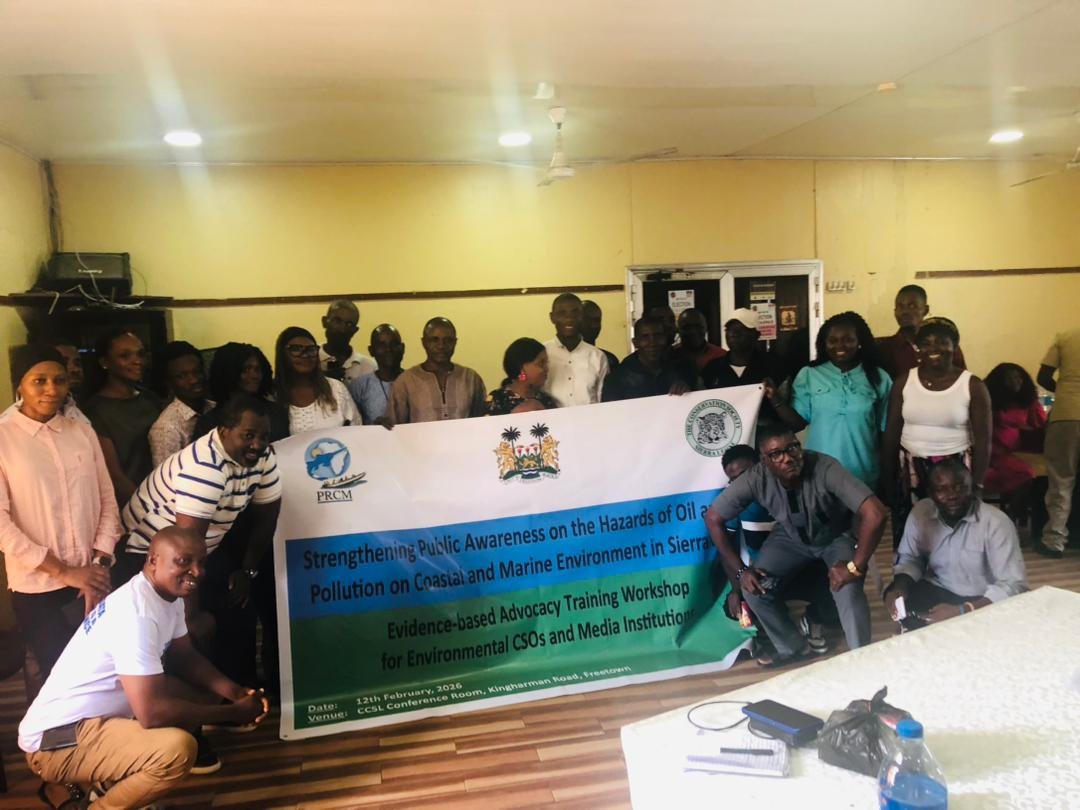
The Conservation Society of Sierra Leone (CSSL), in partnership with the MAVA Foundation through the Regional Partnership for Coastal and Marine Conservation, has organized a training workshop on evidence-based advocacy for environmental civil society organizations (CSOs) and media institutions.
The workshop aimed to strengthen awareness and response to oil and gas pollution affecting Sierra Leone’s coastal and marine environment.
Speaking at the event, CSSL’s Communications Manager, Mr. Abdul Kaprr Dumbuya, emphasized that effective advocacy must be grounded in credible data, verified facts, and reliable information.
“Advocacy cannot succeed without evidence,” Mr. Dumbuya said. “You need accurate data, facts, and figures to make people take your work seriously and to gain public support.”
He explained that the training was designed to equip journalists, media students, and environmental organizations with the skills needed to identify, analyze, and communicate critical information on oil and gas pollution. Participants were trained on how to gather credible environmental data and use it responsibly in public awareness campaigns and policy engagement initiatives.
Mr. Dumbuya also highlighted Sierra Leone’s legal framework for environmental protection, particularly the Environmental Protection Agency (EPA) Act, which prohibits the discharge of oil into the environment. He referenced Section 48(1) of the Act, which makes it illegal to release oil and related substances into land or water bodies.
Commending the Environmental Protection Agency (EPA), he noted that the institution has made significant efforts to enforce environmental regulations.
“To my knowledge, the EPA is doing tremendously well in ensuring compliance with environmental laws,” he stated.
Although Sierra Leone has not yet commenced full-scale oil and gas production, Mr. Dumbuya warned that the country must take proactive measures to prevent potential environmental disasters.
“Exploration data shows that Sierra Leone has millions of barrels of oil,” he said. “We cannot wait until production begins before addressing environmental risks.”
He stressed the need for increased public awareness, stronger regulatory systems, and the reinforcement of existing environmental laws ahead of any oil extraction activities.
Special attention, he added, is being given to riverine, coastal, and marine communities, which are particularly vulnerable to oil spills and related pollution. According to Mr. Dumbuya, an oil spill that is not contained within 24 hours can cause severe damage to biodiversity, livelihoods, and public health.
He cited the Niger Delta in Nigeria as an example of the long-term consequences of poor environmental management, where millions of people have been affected by oil pollution.
“The Niger Delta experience should serve as a warning to us,” he cautioned.
Mr. Dumbuya further emphasized the critical role of the media in promoting environmental governance and sustainable development.
“The media is a formidable institution,” he noted. “Development begins with credible information.”
He explained that journalists and media organizations are essential partners in disseminating environmental information to communities nationwide, particularly in hard-to-reach areas.
By bringing together media practitioners, students, and civil society representatives, the workshop sought to strengthen national capacity for evidence-based advocacy and environmental protection.
Participants expressed appreciation for the initiative and pledged to apply the knowledge gained in their reporting and community engagement efforts.
The organizers expressed hope that the training would contribute to building a more informed public and fostering a stronger institutional response to oil and gas pollution in Sierra Leone.