

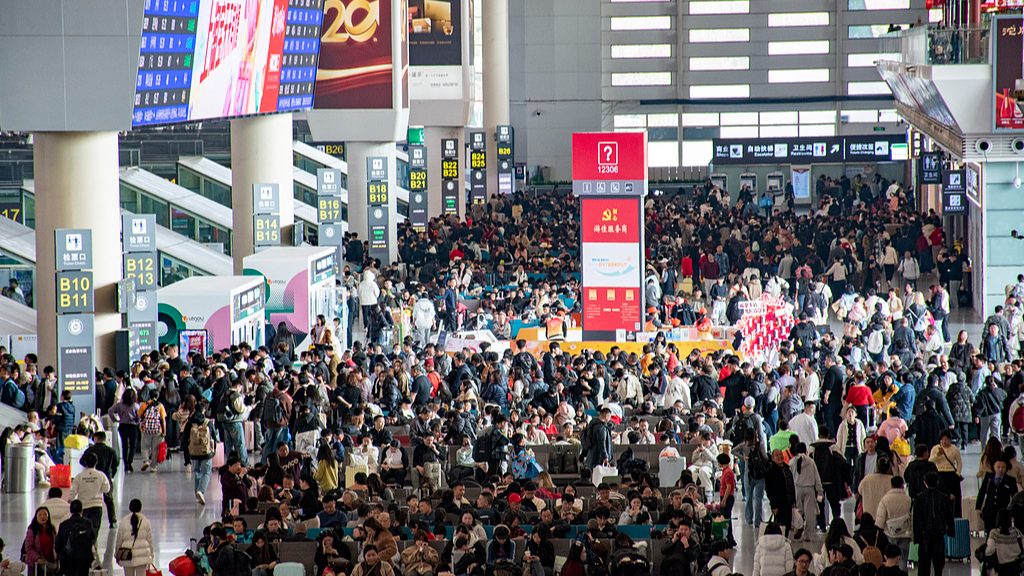
China’s ongoing 2026 Spring Festival holiday has broken multiple records in travel, leisure and consumption as people across the country make full use of the unprecedented nine consecutive days off.
By extending the traditional seven-day holiday, the long break has facilitated a “segmented holiday” model. Consumers can first fulfill family obligations and then embark on long-haul leisure travel, channeling dormant liquidity into the hospitality, aviation, and service sectors.
Unprecedented mobility
China State Railway Group forecasts 15 million passenger trips on Friday, with 1,469 additional trains scheduled. As of 8 a.m. on Friday, a total of 298 million tickets for the Spring Festival travel rush, or Chunyun, have been sold on China’s railway ticketing platform 12306.
The Spring Festival travel period, running from February 2 to March 13, is expected to see a record 9.5 billion cross-regional passenger trips.
A key development this year is the mobilization of the “silver economy,” marked by a notable increase in flight bookings from passengers aged 60 and above. Many of these travelers are flying for the first time to reunite with children in first-tier cities.
Data from Qunar, a leading Chinese travel service platform, showed during the 2026 Spring Festival holiday, 20 percent of travelers flying to Beijing were over the age of 50, with the number of travelers aged 60 and above increasing by 1.6 times compared to the 2025 Spring Festival holiday.
Leisure economy thrives
Leisure activities are also thriving. For example, China’s film market is off to a strong start in 2026, with total box office revenue (including pre-sales) surpassing 6 billion yuan (approximately $868.2 million) by Friday. The Spring Festival season alone contributed over 3.4 billion yuan.
Leading the charge were “Pegasus 3,” “Scare Out (aka “Silent Awakening”), and “Boonie Bears: The Hidden Protector,” drawing audiences across all age groups.
Beyond ticket sales, the Spring Festival season has highlighted the rapid expansion of the “film+” model – an effort to link moviegoing to broader consumption.
Leisure consumption is also reflected in travel trends. According to Tuniu, one of China’s major online travel platforms for package tours, family trips, especially multi-generational travel, surged dramatically. As a result, family-oriented scenic spots like Beijing Universal Resort and Shanghai Disneyland topped the list of the most popular 10 destinations, according to Qunar.
Besides, Chinese tourists flocked to 475 cities globally with the most popular international destinations being in Asia, where travel distances are shorter, visa policies are more accessible and temperatures are favorable for family vacations, according to Qunar. The top destinations included Bangkok, Kuala Lumpur, and Seoul.
‘Becoming Chinese’ goes further
The trend of foreigners experiencing the “Chinese New Year vibe” has gained traction, with many international visitors choosing to spend the holiday in China.
British tourist Dawson Joseph said: “I benefited from the visa-free policy, learned ‘becoming Chinese,’ and experienced the most authentic Chinese New Year. I feel very satisfied.”
The trend is reflected in an increase in foreign visitors. China’s National Immigration Administration forecasts that the average daily number of inbound and outbound travelers nationwide will surpass 2.05 million during the Spring Festival holiday, up 14.1 percent year on year.
Qunar data showed as of Tuesday, the number of domestic flight bookings made with non-Chinese passports during the Spring Festival period increased by 20 percent year-on-year, with foreign visitors spreading across 102 cities in China, including Shanghai, Beijing, Chengdu and Sanya.
Early-year boost to consumption sector
Food and shopping remain integral parts of the Spring Festival holiday. In the first four days of the holiday, average daily sales at major retail and catering businesses rose 8.6 percent compared to the same period last year, according to the Ministry of Commerce.
Traffic and revenue at 78 key shopping streets and districts in the first three days climbed 4.5 percent and 4.8 percent, respectively, said the ministry.
The spending wave blended tradition with new habits, with online platforms reporting strong demand for smart devices. Wearable gadget sales surged 19.7 percent, with smart glasses more than doubling and smart blood glucose monitors increasing by nearly 50 percent.