

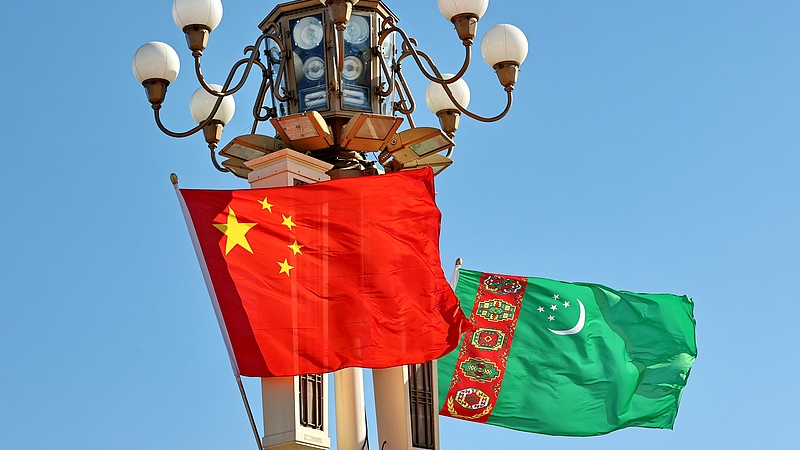
China and Turkmenistan are reinforcing a relationship defined by consistency and strategic trust since 1992, when the two nations established diplomatic ties.
That message was underscored during Wednesday’s meeting in Beijing between Chinese President Xi Jinping and National Leader of the Turkmen People Gurbanguly Berdimuhamedov, who is also Chairman of the Halk Maslahaty of Turkmenistan.
A week ago, China concluded its annual Two Sessions, where lawmakers approved the outline of the 15th Five-Year Plan (2026-2030) for national economic and social development. Against that backdrop, China sees itself moving forward – not in isolation, but alongside partners.
A bedrock of mutual trust
President Xi described mutual support as the core of the China-Turkmenistan comprehensive strategic partnership, an unshakable principle amid global challenges.
China has pledged to always support Turkmenistan’s national independence, sovereignty, territorial integrity, and its permanent neutrality – a status recognized by the UN General Assembly since 1995.
China was among the first countries to establish a strategic partnership with Turkmenistan through formal political documents. In January 2023, when Turkmen President Serdar Berdimuhamedov visited Beijing, the two sides elevated bilateral ties to a comprehensive strategic partnership, its highest level to date.
Berdimuhamedov reaffirmed that Turkmenistan will continue to adhere to the one-China principle.
Economic synergies: Scaling up the energy backbone
While natural gas has long served as the cornerstone of the bilateral relations, the Beijing talks signaled an ambitious expansion of energy cooperation.
Turkmenistan is a major supplier of natural gas to China, and a key country in the China-Central Asia Gas Pipeline – China’s first transnational gas pipeline, which runs through Central Asia into China’s Xinjiang Uygur Autonomous Region. Official data shows that as of November 2024, the pipeline has delivered more than 500 billion cubic meters of natural gas to China since it was put into service in 2009.
Both sides are looking to broaden that cooperation. President Xi called for accelerating the alignment of the China-proposed Belt and Road Initiative with Turkmenistan’s development strategy while expanding into non-resource sectors – connectivity, agriculture, artificial intelligence, digital economy, and clean energy. Berdimuhamedov expressed readiness for this closer alignment. The message was clear: a partnership built on natural gas must grow into something more diversified, more resilient, and more future-facing.
Security pillar
Stability is the prerequisite for progress. Xi said China and Turkmenistan must resolutely combat the “three evil forces” of terrorism, extremism and separatism to foster a secure environment for the development of both countries.
Berdimuhamedov echoed the commitment, expressing Turkmenistan’s willingness to collaborate with China in maintaining regional security and stability. In a neighborhood that has grappled with the spillover effects of conflict and extremism, China and Turkmenistan’s unified stance in dealing with such threats reflects a shared strategic calculus rooted in historical experience.
Global governance: Multilateralism with shared purpose
As the international order faces mounting pressures, China and Turkmenistan are coordinating their positions on the global stage. Xi called on both sides to uphold the status and authority of the United Nations and practice genuine multilateralism. He also urged the two nations to adhere to a global governance philosophy characterized by extensive consultation, joint contribution and shared benefits, and to lead the transformation of global governance based on the principles of fairness, justice, openness and inclusiveness.
Berdimuhamedov spoke highly of the four global initiatives proposed by Xi – the Global Development Initiative, the Global Security Initiative, the Global Civilization Initiative, and the Global Governance Initiative – and commended China for consistently upholding fairness and justice in international affairs. He also affirmed Turkmenistan’s readiness to strengthen coordination with China within the United Nations and the China-Central Asia mechanism – a multilateral framework that has become an important platform for collective Central Asian engagement with Beijing since the inaugural China-Central Asia Summit in 2023.
Both leaders’ remarks pointed to a conviction that the rule-based multilateral system, centered on the United Nations, remains the most legitimate framework for managing global challenges.
People-to-people ties: Warming the relationship from within
Diplomatic documents and energy contracts sustain a partnership at the governmental level. But it is cultural and educational exchanges that give it popular roots. Xi highlighted three concrete initiatives that represent China-Turkmenistan people-to-people engagement: Luban Workshop – China’s flagship vocational skills training program exported to partner countries, the Traditional Chinese Medicine center, and cultural centers in each other’s country.
These initiatives transform high-level strategic goals into tangible benefits for the public, building on a history of academic exchange. China remains a top destination for Turkmen youth, with over 2,000 students enrolled in Chinese higher education institutions. Beijing and Ashgabat are weaving a social fabric intended to endure for generations, ensuring that the China-Turkmenistan community with a shared future is built on a foundation of mutual understanding.
In an increasingly unpredictable world, the China-Turkmenistan partnership offers a model of stability and pragmatism – one where consistency, respect for sovereignty, and shared vision across generations form the true measure of partnership. Thirty-five years after Turkmenistan’s independence, and with the ink still fresh on China’s blueprint for the next five years, the trajectory of this relationship points in only one direction – forward.
SOURCE: CGTN News