

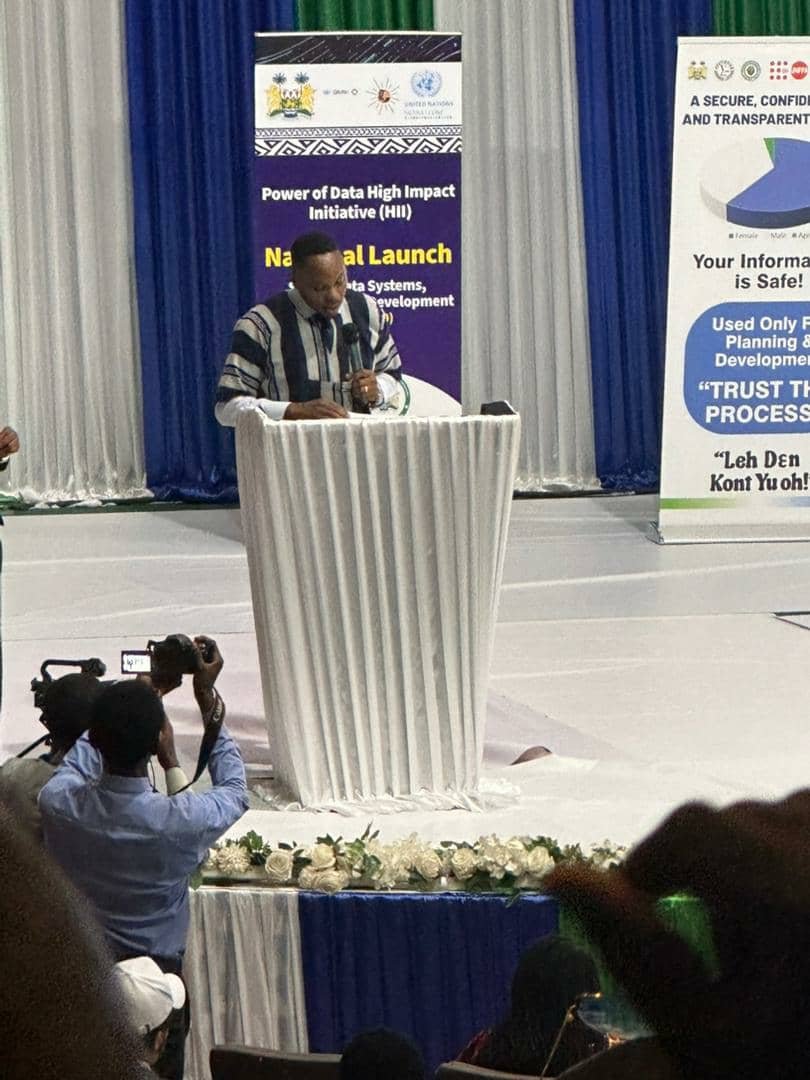
The Chief Minister of Sierra Leone, Dr. David Moinina Sengeh, officially launched the 2026 Population and Housing Census on Monday, 1st December 2025, at the Bintumani Conference Centre in Freetown.
In his keynote address, Dr. Sengeh reassured government officials that the 2026 Census will not collect political information; no one will be asked which political party they support or how they voted. He emphasized that the census represents a defining moment in Sierra Leone’s development trajectory and expressed humility and honor in leading the launch.
Dr. Sengeh noted that this is the country’s first full national census since 2015 and the first conducted under the administration of President Julius Maada Bio. He explained that the mid-term census of 2021 interrupted the ten-year cycle, and the 2026 census restores Sierra Leone to the internationally recognized schedule, which is essential for sound planning, equitable resource distribution, and sustainable development.
He stressed that a population and housing census is not political; it is focused on people, fairness, equity, and development. According to Dr. Sengeh, the census will provide critical insights into population size, geographic distribution, living conditions, and national needs, forming the foundation of policies that improve citizens’ daily lives. He assured that all personal information collected will remain strictly confidential and protected under national law and international statistical standards.
The Statistician-General of Sierra Leone, Andrew Bob Johnny, also addressed the gathering, describing the launch as an important milestone in Sierra Leone’s journey toward evidence-based national development. He emphasized that a national census is far more than a statistical exercise, it is the foundation for national planning.
Johnny explained that the data collected will determine where schools are built, hospitals expanded, roads prioritized, and electricity and water services distributed. It will also guide the allocation of government resources, public health systems, social care programs, infrastructure expansion, and broader development strategies.
He added that government ministries, local councils, private sector investors, NGOs, and development partners all rely on accurate and up-to-date information to design effective programs and deliver essential services. Since the last census in 2015, Sierra Leone has undergone significant social, economic, and demographic changes, making this census crucial.
Johnny highlighted the innovations in the 2026 census, including advanced digital cartography, improved data-collection tools, and robust data-quality checks to ensure accuracy, transparency, and public trust. Enumerators will be fully trained, supervised, and closely monitored to guarantee high-quality data.
Finally, he expressed gratitude to the government’s development partners, including the United Nations Population Fund (UNFPA) and other technical agencies, emphasizing that the success of the census requires collective participation.