

By: Saidu Jalloh
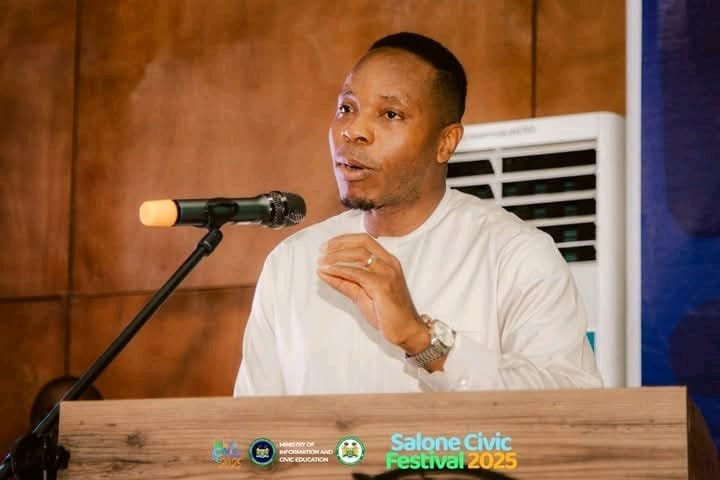
Chief Minister Dr. David Moinina Sengeh on Tuesday unveiled significant national achievements as he opened Day Two of the 2025 Salone Civic Festival, highlighting measurable progress in food security, education, infrastructure, and public sector reform under President Dr. Julius Maada Bio’s Big Five Game Changers.
Addressing government officials, development partners, academics, youth leaders, and civil society representatives, Dr. Sengeh presented data-driven evidence to demonstrate how government policy commitments are translating into tangible outcomes across key sectors of national development.
A major highlight of his keynote address was the Feed Salone initiative, which he said is already delivering visible results. Dr. Sengeh announced the establishment of Sierra Leone’s first modern seed laboratory, enabling the release of four high-yield rice varieties capable of producing between 8 and 10 metric tons per hectare, compared to the national average of 2 to 4 metric tons. He added that improved cassava varieties to boost garri production and enhanced maize seeds have also been rolled out nationwide.
On agricultural financing, the Chief Minister disclosed that US$24 million was disbursed to private-sector actors in 2025, up fromUS$10 million in 2024. He further noted that more than US$235 million worth of agriculture and livestock projects are currently underway, supporting crop development and government-led cattle settlement programmes.
Dr. Sengeh reported that national cultivation targets were exceeded in 2024, with more than 586,000 hectares planted over 50,000 hectares above projections. According to him, these interventions are already easing pressure on households, as food prices are declining for the first time in years. Local rice consumption now accounts for 12 percent, rice imports have dropped by 26 percent, and increased market supply has reduced the cost of essential items such as onions and eggs.
Citing data from the World Food Programme, the Chief Minister revealed that severe food insecurity has continued to decline, falling to 13 percent in 2025.
On human capital development, Dr. Sengeh highlighted landmark achievements in education. Girls’ completion rates at the lower secondary level have reached *97 percent, the highest in West Africa. He also noted a dramatic rise in participation in WAEC examinations, increasing from approximately 30,000 candidates in 2017/2018 to over 200,000 in recent years, while enrollment in technical and vocational education and training (TVET) institutions has doubled.
He explained that this growth is being supported by the construction of new classrooms and full internet connectivity across tertiary institutions. Dr. Sengeh added that Radical Inclusion, a flagship policy of President Bio, is now fully embedded in the National Development Plan, shaping education and broader social policy reforms.
The Chief Minister also outlined progress in infrastructure and governance, citing ongoing road construction projects, updates to the Civil Service Rules, the implementation of the Wage and Compensation Commission Act, and the finalization of new public service policies and institutional frameworks.
He concluded by reaffirming the government’s commitment to transparency, accountability, and people-centered development, noting that the Salone Civic Festival provides a vital platform for citizens to engage directly with evidence-based governance and national progress.