

By: Aminata Sesay
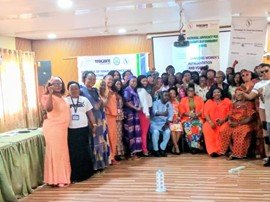
The Network of Female Councillors (NFC), in collaboration with its partners, organized a capacity-building training for female councillors across Sierra Leone under the theme “Meeting on Leadership, Advocacy, and Formation of National and Local Structures.”
The event took place on Monday, 20th October 2025, at the Council of Churches in Sierra Leone (CCSL) Conference Hall on Kingharman Road, Freetown. It brought together the Minister of Gender and Children’s Affairs, representatives from Campaign for Good Governance (CGG), NGOs, female councilors from across the country, and media practitioners.
In his opening remarks, the Chairperson of the event, Mr. Sahr Kendema, welcomed participants and thanked them for attending the important gathering. He emphasized that the event was not a new initiative but a continuation of efforts started with the Ministry of Gender, CGG, and other partners. Mr. Kendema recalled the official launch of the Network of Female Councillors by the Minister of Local Government and Community Affairs in 2024 at Brookfields Hotel.
He highlighted that it would be inappropriate to leave female councillors without proper follow-up support after the launch, making continuous capacity-building crucial. “Today, we have brought together a few female councillors from the 16 districts to discuss leadership and advocacy, as most of their work focuses on development at the local level,” he stated. “Our goal is to engage and empower them to effectively advocate for women, children, and even men in their communities. When communities develop, women develop.”
Mr. Kendema also shared that the next step after this training would be to establish a well-structured body at both national and regional levels to coordinate female councillors across the country.
Delivering her keynote address, Dr. Isata Mahoi, Minister of Gender and Children’s Affairs, described councillors as the direct link to local communities. She expressed her gratitude to CGG and other partners for initiating such a timely program.
Minister Mahoi revealed that her Ministry had conceived similar ideas but lacked funding for their implementation. She emphasized that the formation of the NFC would strengthen the leadership capacity of women and provide them with an opportunity to interact, share experiences, and learn how to serve their communities effectively.
“Politics is complex,” she noted. “Without training, the necessary know-how, and support, you won’t make a meaningful impact. Everyone talks about women’s representation, but if women are not informed and empowered, they cannot lead effectively.” She stressed that even women in ministerial positions require continuous leadership and management training. “You may have all the degrees, but without the capacity to lead, you will not succeed,” she added.
Minister Mahoi urged participants to take the training seriously and share the knowledge gained with others. She called for unity among female councillors, regardless of political affiliation, describing the NFC as a cross-party initiative for women’s collective progress. “We must focus on issues affecting our communities, such as drug abuse, prostitution, and poverty,” she stressed. “Let’s address these challenges together.”
Representing TROCAIRE, Sudie A. Sellu commended the initiative and the active participation of female councillors. She explained that TROCAIRE’s partnership with organizations like Irish Aid is not just about placing women in leadership roles, but ensuring they are adequately supported and mentored for effective performance.
“We don’t just want women in positions because it’s politically popular,” she said. “We want to walk with them side by side, providing the necessary support for their success. When women perform well, they open doors for others. One woman’s victory is a victory for all women.”
Before the main training session, Marcella Samba Sesay, Executive Director of Campaign for Good Governance (CGG), delivered an inspiring presentation. She acknowledged the wealth of local knowledge possessed by councillors and encouraged them to channel it effectively through collaboration and strategic advocacy.
“We need to work together so that our recognition comes through performance,” she said. “Too often, we focus on irrelevant matters. Let’s stop bringing each other down and start building each other up.”
Marcella later facilitated a comprehensive session on Advocacy and Lobbying Strategy Development for Female Councilors, which was interactive and engaging. Participants shared their experiences, discussed personal development efforts, and explored strategies for community empowerment.
At the end of the training, participants elected their National Executive for the Network of Female Councillors (NFC), as follows Chairperson: Councillor Kumba Nyandemoh (Kono District) Deputy Chairperson: Councillor Haja Yapate (Port Loko District) Secretary General: Councillor Alimatu H. Kamara (Western Rural District) Deputy Secretary General: Councillor Jatu Saffa (Kailahun District) Public Relations Officer 1: Councillor Fatmata Mansaray (Bo District) Public Relations Officer 2: Councillor Salamatu Kamara (Karene District), Financial Secretary: Councillor Saio Marrah (Falaba District) Treasurer: Councillor Suad H. Koroma (Bombali District)
The elections were described as free, fair, and transparent, with all participants expressing satisfaction with the outcome.