

By: Saidu Jalloh
The Attorney General and Minister of Justice, Alpha Sesay, Esq., on Tuesday outlined major constitutional reforms as the proposed Constitution Amendment Bill was formally tabled in Parliament, marking a critical milestone in Sierra Leone’s long-running constitutional review process.
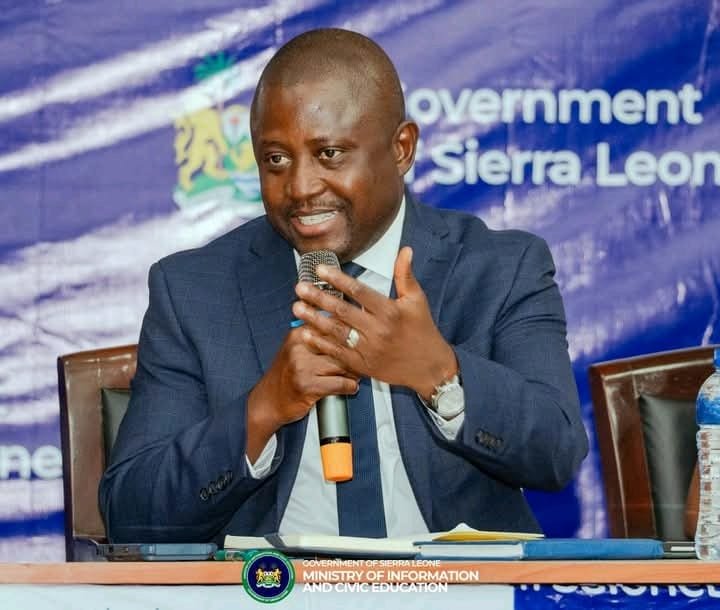
Speaking at the Weekly Press Conference organized by the Ministry of Information and Civic Education at the Miattia Civic Centre in Brookfields, the Attorney General guided journalists through the historical evolution of Sierra Leone’s Constitution and explained the key provisions contained in the proposed amendment bill.
He recalled that Sierra Leone’s constitutional journey began with the 1978 Constitution, which introduced a one-party state, before it was replaced by the 1991 multiparty Constitution shortly before the outbreak of the civil war. He noted that the 1999 Lomé Peace Agreement, particularly Article 10, called for a comprehensive constitutional review to address governance failures exposed by the conflict.
According to the Attorney General, this recommendation led to the establishment of the Truth and Reconciliation Commission (TRC) in 2004, which identified deep constitutional and governance deficiencies and advocated broad-based constitutional reform.
He explained that, in response, the late President Dr. Ahmad Tejan Kabbah issued a White Paper committing the government to constitutional reform and established a committee chaired by Dr. Peter Tucker, whose report was later submitted to former President Dr. Ernest Bai Koroma.
In 2013, President Koroma set up the Justice Edmond Cowan Constitutional Review Committee, comprising more than 80 members drawn from registered political parties, civil society organizations, youth groups, and market women. The committee, he said, conducted one of the most extensive public consultations in the country’s history.
He disclosed that the consultation process included over 10,000 public meetings, 150 position papers, 80 expert engagements, and 180 direct stakeholder sessions, with more than 70,000 consultation forms collected nationwide and 40,960 website visitors recorded. The committee submitted its final report in June 2017, which the government accepted in part and rejected in part.
The Attorney General further revealed that in 2021, President Julius Maada Bio issued another White Paper based on the Cowan Committee’s recommendations, integrating provisions of the Gender Equality and Women’s Empowerment (GEWE) Act into the proposed new Constitution.
Following the 2023 National Peace and Unity Agreement, he said a Tripartite Committee was established, with both sides agreeing on 80 recommendations. He clarified that non-entrenched clauses have now been tabled in Parliament as electoral reforms ahead of the 2028 general elections, while entrenched clauses will proceed through the constitutional review process leading to a national referendum.
Highlighting key proposed amendments, the Attorney General pointed to Section 49(1), which seeks to empower Parliament to remove a Vice President who is expelled from the political party under which he or she was elected an idea originally recommended in the Justice Cowan White Paper.
He also announced proposed reforms on Proportional Representation (PR), including the repeal of Section 38A, which provided temporary PR authority, and an amendment to Section 74(1)(b) to allow a category of Members of Parliament to be elected through proportional representation, with operational details to be determined by Parliament.
On presidential elections, he disclosed that Clause 42(2)(e) proposes replacing the long-standing 55 percent first-round victory threshold with a simple majority of 50 percent plus one, alongside a requirement that a candidate secures at least 20 percent of votes in two-thirds of districts nationwide.
The Attorney General emphasized that the proposed amendments are designed to strengthen democratic governance, enhance electoral credibility, and ensure long-term constitutional stability in Sierra Leone.