

By: Audrey Raymonda John
In some of Sierra Leone’s most remote communities where information rarely reaches and traditions often go unquestioned the Amazonian Initiative Movement Sierra Leone (AIM-SL) is breaking new ground.
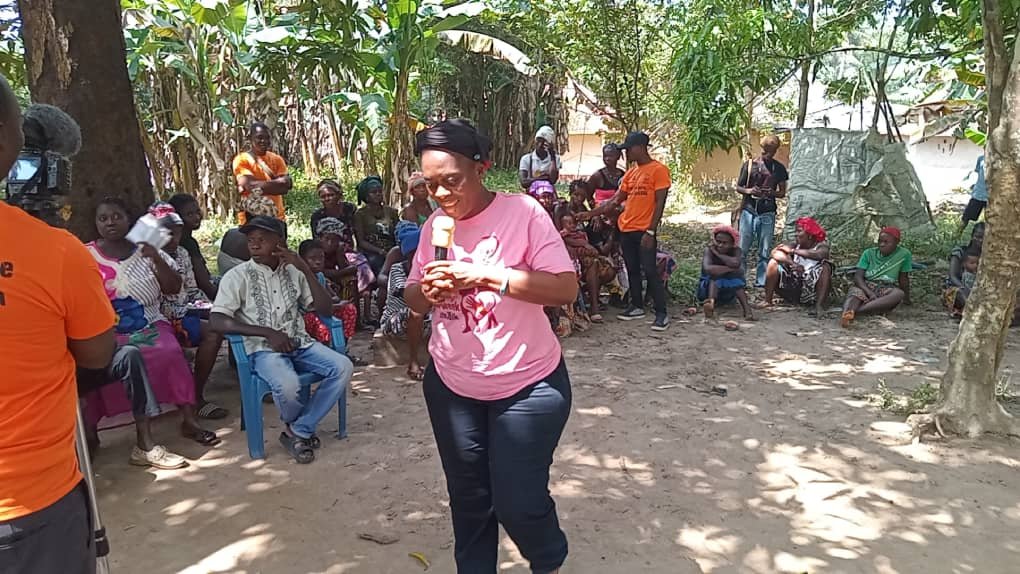
Led by its Executive Director, Madam Rugiatu Neneh Turay, AIM-SL is using powerful and emotional film screenings featuring testimonies from FGM survivors to shift mindsets and spark life-saving conversations.
The film sessions form part of AIM-SL’s mission to strengthen communities through knowledge, truth-telling, and collective reflection, especially in areas where harmful practices persist because people have never been exposed to the realities behind them.
Participants including chiefs, women’s leaders, youth, and parents watched raw, unfiltered testimonies from survivors of Female Genital Mutilation (FGM). Many shared the physical pain, fear, trauma, and lifelong consequences they continue to carry. Some cried. Others sat in shock. Many admitted it was the first time they had ever seen the practice from the survivor’s perspective.
The films also reveal the hidden realities within Bondo society: secrecy, pressure, cultural myths, and the pain inflicted on girls who often have no choice and no voice.
One woman in the film said, “They told me it made me a woman. But it only gave me pain I still feel every day.”
Another survivor recalled, “I remember screaming. But they said it was normal that every girl must suffer.”
These testimonies have sparked deep reflection in the villages visited so far.
Female Genital Mutilation refers to the deliberate cutting, injury, or removal of external female genitalia for non-medical reasons. It is globally recognized as a human rights violation and a form of violence against women and girls.
According to the 2021 Sierra Leone Demographic and Health Survey (DHS) highlighted that 90% of Sierra Leonean women and girls have undergone FGM.
FGM is most common among girls aged 10–14, though some are cut as young as four. FGM contributes to severe childbirth complications, infertility, infections, chronic pain, trauma, and lifelong mental health challenges.
Sierra Leone also records one of the highest maternal mortality rates in the world, with FGM being a contributing factor. Yet the country still lacks an explicit law banning the practice, despite overwhelming evidence of its harm.
AIM-SL reminded communities that this inaction violates an ECOWAS Court ruling, which requires member states to protect girls through legislation and accountability. By refusing to pass a clear law prohibiting FGM, the government leaves girls vulnerable, encourages impunity, and undermines decades of work by activists, survivors, and partners.
As Madam Turay stressed: “How can we talk about development when our daughters are bleeding? When are girls dropping out of school? When pain becomes their first memory of womanhood?”
After the film screenings, community leaders spoke openly about their role in sustaining the practice.
One elder, Soko Kargbo of Konta Line, admitted: “We cut our children because our mothers did it. We believed it was culture and religion. But we never asked why our girls had to suffer so much.”
Many said they had never seen the medical or emotional consequences explained so clearly.
Madam Turay encouraged communities to continue these conversations with honesty and courage: “People can only change when they understand the truth. Film helps us show that truth but change must come from the community itself.”
AIM-SL’s message is unequivocal: FGM must end, and Sierra Leone urgently needs an explicit law banning the practice.
Film screenings, community dialogues, and survivor testimonies are powerful tools but without legal protection, girls remain at risk.
AIM-SL is calling for protection for girls who refuse initiation. Support for alternative, bloodless Bondo rites that preserve culture without harming girls.
The film project continues across hard-to-reach areas, bringing truth, empathy, and courage to communities that have never been shown the reality of FGM.
In the words of a young participant after watching the film: “If our mothers knew this pain, why should we continue it?”