

By: Saidu Jalloh
Statistics Sierra Leone has assured the public of its readiness to conduct the 2026 Population and Housing Census, with preparations covering digital systems, personnel training, field deployment, data security and logistical arrangements ahead of the nationwide exercise.
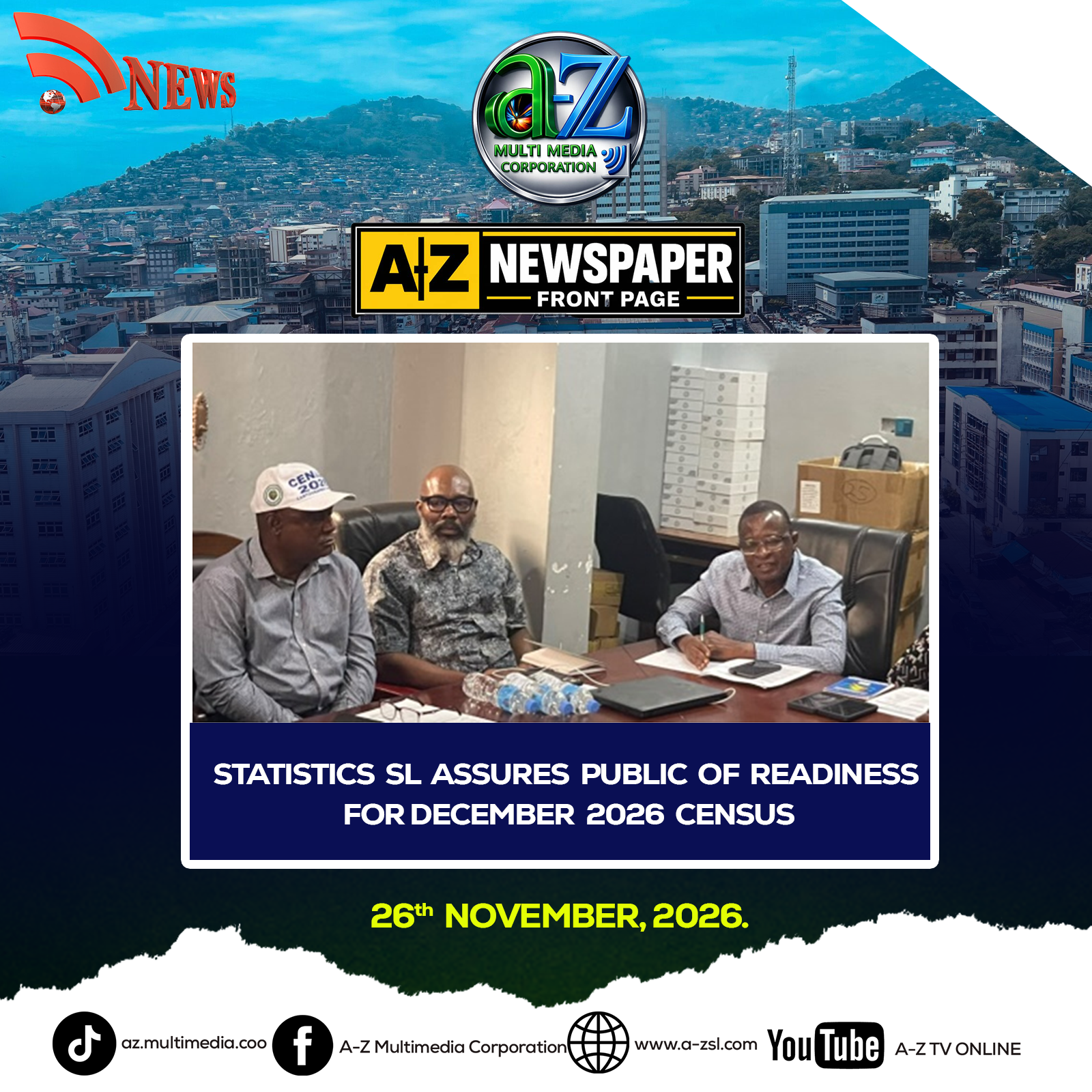
The assurance was given by Statistician-General and Chief Census Officer, Andrew Bob Johnny, Deputy Statistician-General Lasana Kanneh, Director of Data Science Theophilus Blaudfaust and Dr. Collins Opiyo during the inaugural Census Press Conference held on Wednesday, November 25, 2026. Johnny disclosed that national cartographic mapping, the Pilot Census, Mock Census and all three stages of training had been completed, including the Training of Master Trainers, Training of Trainers and Training of Enumerators and Supervisors. He said an additional 3,000 tablets had been received to supplement existing devices, while arrangements were being finalised for field deployment, supervision and resource allocation. He also confirmed that independent monitors had participated in an orientation facilitated by the United Nations Population Fund (UNFPA), with their observations expected to support the identification of challenges during fieldwork.
Johnny urged households to cooperate with enumerators and ensure that everyone who sleeps in their homes on Census Night is counted, explaining that census information would remain confidential and be used strictly for statistical purposes. He emphasised that Census Night is scheduled for Tuesday, December 1, while the actual counting will commence on Wednesday, December 2, 2026, adding that the information collected would guide national planning for schools, health facilities, water supply and other essential services.
Meanwhile, Deputy Statistician-General Lasana Kanneh disclosed that 65,108 Sierra Leoneans applied for positions as enumerators and supervisors following a digital recruitment exercise conducted by Statistics Sierra Leone. He said approximately 31,662 applicants were shortlisted for training, while 30,085 completed the training and sat the final examinations, with almost 95 per cent scoring above 80 per cent. However, only 28,862 candidates will be selected for deployment as enumerators and supervisors across the country. Kanneh said the institution was finalizing their contracts and preparing transport allowances, tablets, power banks and data bundles ahead of deployment.
He added that deployment was expected to be completed by Friday, November 27, to ensure that census personnel were in their respective enumeration areas by Saturday morning for the listing exercise. He assured the public that the institution had sufficient personnel and other essential materials to commence the exercise, with the listing scheduled to precede the main census enumeration beginning December 2.
On the technological aspect, Director of Data Science Theophilus Blaudfaust highlighted the importance of digital systems in improving data quality, accuracy, monitoring and security during the census. He explained that digital data collection provides built-in quality checks that help minimize errors and ensure precision, unlike traditional paper-based methods. He said the technology would also allow the institution to monitor enumerators in real time, track their progress and identify areas requiring attention during field operations. Blaudfaust further disclosed that the census digital system had been developed in collaboration with international partners and United Nations experts, incorporating established data collection practices and security standards.
He said the digital approach would strengthen the overall census process while improving the institution’s capacity to manage modern data collection technologies. He maintained that the combination of digital monitoring, quality assurance and security measures would support the delivery of reliable census information.
Also speaking, Dr. Collins Opiyo said the 2026 Population and Housing Census was being implemented in accordance with United Nations principles and recommendations governing the 2030 round of censuses, which covers the period from 2025 to 2034. He explained that the international standards emphasize methodological and technological innovations to improve data quality and timeliness, noting that Sierra Leone had adopted these approaches throughout the census process. He disclosed that the exercise was fully digital, from training to data capture and field operations, using advanced mapping methods to establish a reliable geospatial framework. He further explained that enumerators would use Computer-Assisted Personal Interviewing (CAPI) applications on GPS-enabled tablets, supported by GIS-based maps, to identify their assigned areas and ensure complete enumeration.
Dr. Opiyo added that the census had an end-to-end data capture and management system supported by cloud servers, security protocols and disaster recovery mechanisms. He said the census instruments and digital systems had been tested during the Pilot Census, Mock Census and practical training sessions, while recruitment and training of qualified field personnel had been completed and deployment was underway. He stressed that the objective was to count every building, household and individual in the right place, noting that reliable information on where people live and who lives there was essential for effective development planning. He also described the media as strategic partners in ensuring public awareness and called for continued support to deliver a high-quality and credible census that meets the expectations of the Government, people of Sierra Leone and the international community.
The 2026 Population and Housing Census is expected to provide essential demographic and housing information to support national development planning and evidence-based decision-making.