

By: Mohamed J. Bangura
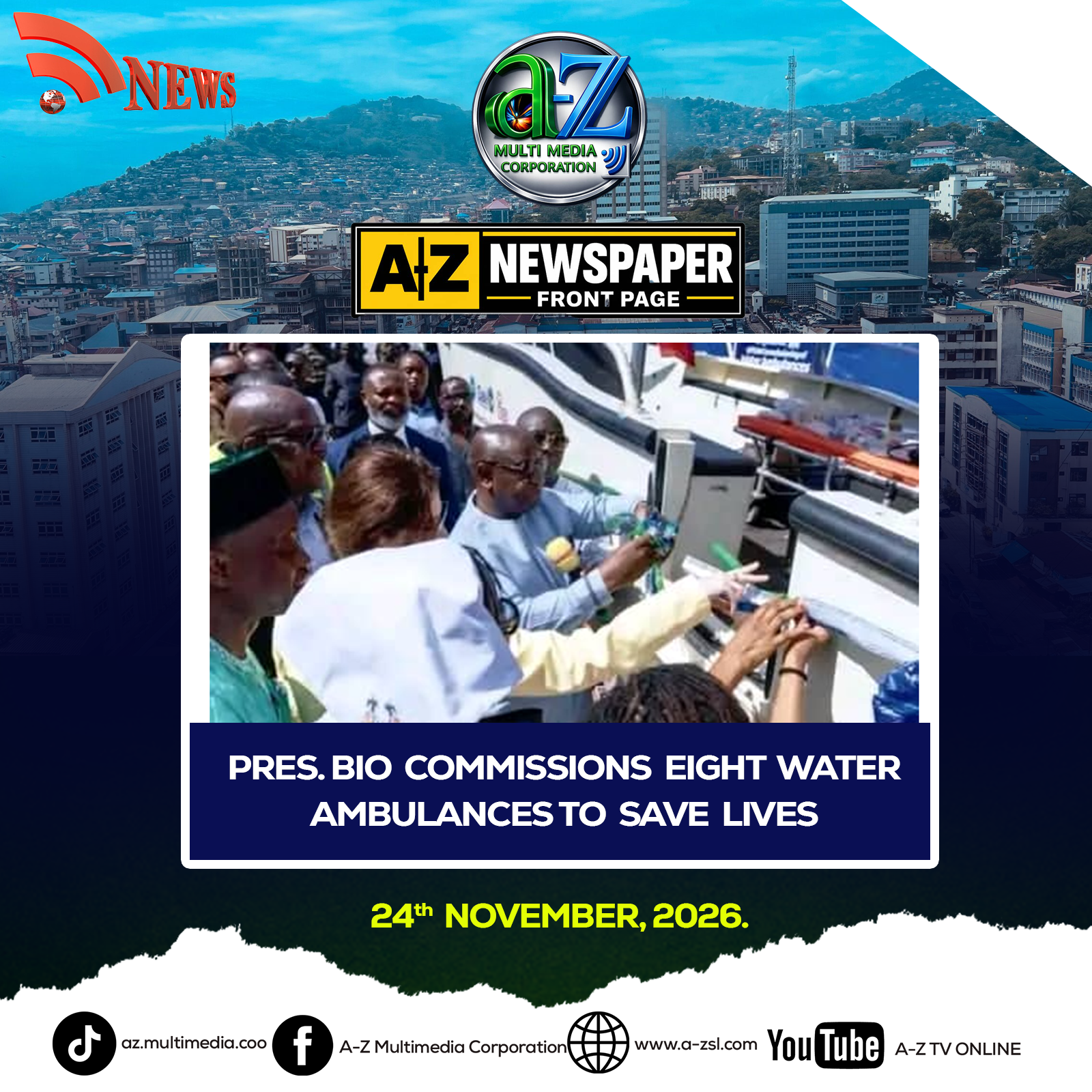
President Julius Maada Bio has commissioned eight government-owned water ambulances, the first of their kind in Sierra Leone, to improve emergency healthcare access and save lives in Remote Island and riverine communities across the country.
The commissioning ceremony was held on Friday, 20 November 2026, at the Naval Base in Murray Town, Freetown, in the presence of the Minister of Health, Dr. Austin Demby, senior government officials, development partners and representatives of the Republic of Sierra Leone Armed Forces.
The introduction of the water ambulances marks a significant step towards strengthening the country’s emergency healthcare system, particularly for thousands of people living in communities where access to health facilities by road is difficult or impossible.
For years, residents of remote islands and riverine communities have relied largely on canoes and other traditional boats to transport sick and injured persons to health facilities. This has often resulted in delays in accessing medical attention, particularly for pregnant women, children and critically ill patients requiring urgent care.
With the commissioning of the eight vessels, the government is establishing a dedicated emergency water transportation service to ensure that geographical barriers do not prevent citizens from receiving timely medical attention.
Speaking at the ceremony, President Bio emphasised that no Sierra Leonean should lose their life simply because of where they live. He stressed that access to emergency healthcare must not depend on whether a community is connected by road or surrounded by water.
The President reaffirmed his government’s commitment to extending life-saving emergency medical services to families in remote communities, ensuring that they have the same opportunities to access healthcare as those living in urban centres.
Each water ambulance is equipped with a stretcher, emergency medical equipment, life jackets and a communication system that enables operators to alert hospitals before patients arrive. This will allow medical facilities to prepare for incoming emergencies and improve the coordination of patient referrals.
The operational arrangement also provides for land ambulances to be stationed at designated landing points to receive patients transported by water and convey them to hospitals for further medical attention.
To ensure effective service delivery, 24 operators drawn from the communities the vessels will serve have been trained and certified by the Republic of Sierra Leone Navy. Their involvement is expected to strengthen community participation and ensure that the service responds effectively to local needs.
The Minister of Health, Dr. Austin Demby, described the initiative as a major breakthrough in improving primary healthcare delivery in hard-to-reach communities.
He explained that the water ambulances would strengthen emergency referral systems, improve maternal and child healthcare and enable health workers to reach communities that have historically faced transportation challenges.
Beyond emergency patient transportation, the vessels will also support vaccination programmes by transporting vaccines and health workers to isolated island communities. This is expected to improve routine immunization coverage, particularly among children who have previously missed vaccinations because of difficulties accessing healthcare facilities.
The eight water ambulances will serve communities across seven districts and areas: Bonthe, Pujehun, Kambia, Moyamba, Port Loko, Western Area Rural and Western Area Urban.
Under the new arrangement, members of the public requiring emergency medical assistance can call the national emergency health number, 117, to access the service. This will enable residents of isolated island communities to access the same emergency response system available to people in urban areas.
The initiative has received support from development partners, including the United Nations Children’s Fund (UNICEF), the World Health Organization (WHO) and Gavi, alongside the Republic of Sierra Leone Armed Forces, which played a key role in training the operators.
The Ministry of Health has encouraged members of the public, particularly residents of island and riverine communities, to spread information about the service to ensure that families know how to access emergency assistance when needed.
The commissioning of the eight government-owned water ambulances represents an expansion of Sierra Leone’s emergency healthcare transportation system beyond conventional road networks, bringing life-saving medical services closer to communities that have long struggled to access health facilities.
For pregnant women, children and other vulnerable people living in remote waterways, the initiative is expected to provide a vital link to emergency medical care and help reduce preventable deaths.