

By: Mohamed J. Bangura
The World Bank Group has called for increased employment opportunities and better-paying jobs to reverse the slowdown in global poverty reduction and lift millions of people out of extreme poverty.
The call is contained in the World Bank’s Poverty, Prosperity and Planet Report 2026: Jobs at the Center of Poverty Eradication, which identifies job creation as one of the most effective ways to increase household incomes, promote shared prosperity and strengthen economic security.
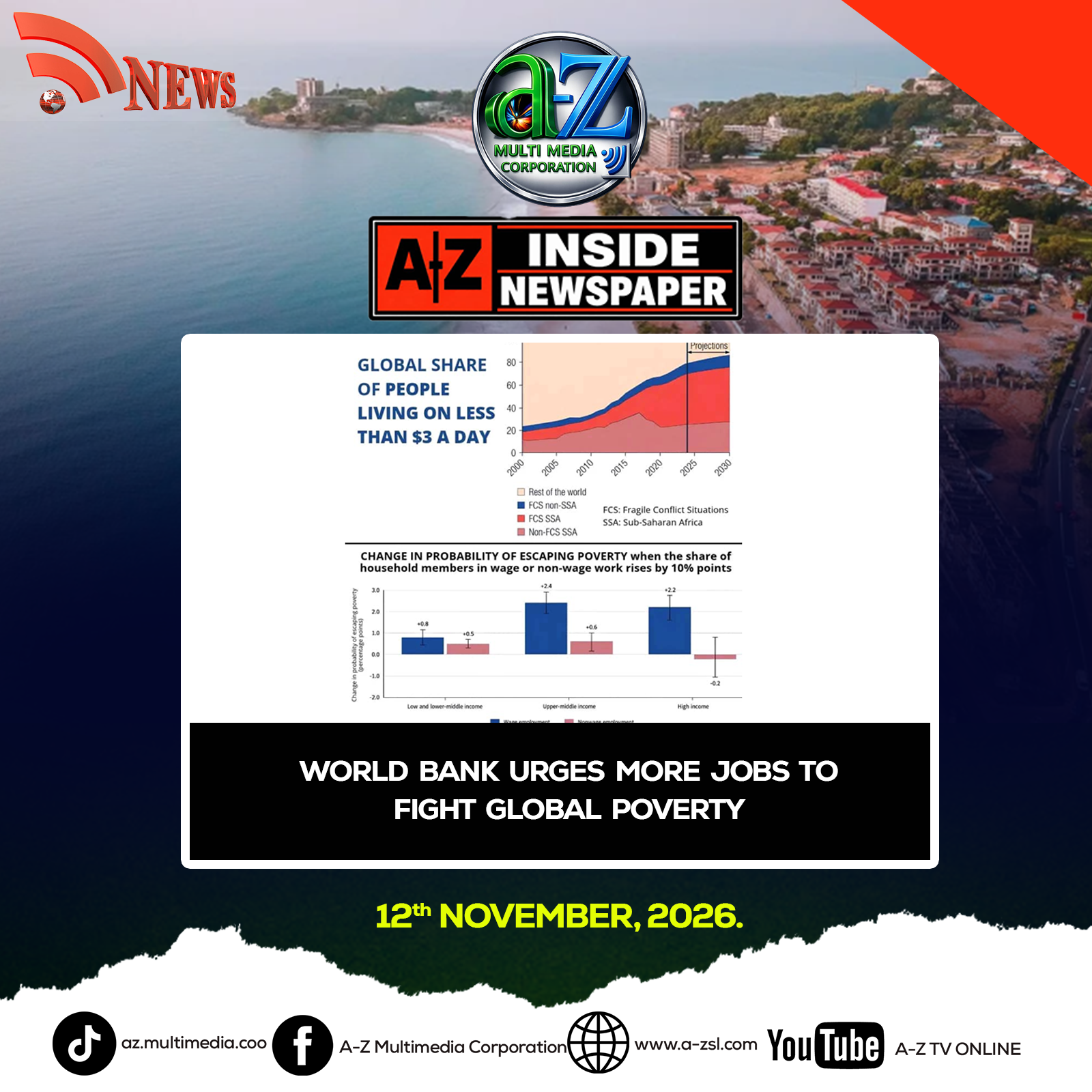
According to the report, global progress in reducing extreme poverty has stalled, with approximately 811 million people, representing one in every ten people worldwide, projected to be living on less than US$3 a day in 2026.
The World Bank warns that without stronger economic growth per person, the number of people living in extreme poverty could be higher in 2030 than it is today.
The report emphasizes that creating more and better-quality jobs is essential to reversing this trend, particularly in developing economies where limited employment opportunities and low wages continue to affect millions of vulnerable households.
It explains that most poor households depend primarily on their labour and human capital as their main productive assets, making access to employment and improved earnings central to poverty reduction efforts.
The report further reveals that increasing employment among working-age adults in poor households to 75 per cent could reduce extreme poverty by approximately one-fifth.
It also estimates that raising the earnings of poor workers to levels comparable with those of non-poor workers could reduce poverty by nearly half, with the greatest benefits accruing to the poorest households.
To address these challenges, the World Bank highlights the need to expand employment opportunities, improve workers’ productivity and ensure that people receive better returns for their labour.
On the regional distribution of poverty, the report identifies Sub-Saharan Africa as facing an increasingly significant challenge. It projects that by 2030; approximately 87 per cent of the world’s extremely poor people will be living in Sub-Saharan Africa, fragile and conflict-affected situations, or both.
The report also notes that nearly half of the world’s population, approximately 3.7 billion people, continue to live on less than US$8.30 a day, leaving them vulnerable to economic shocks that could push them further into poverty.
Beyond employment, the World Bank identifies inequality as another major obstacle to shared prosperity. It observes that progress in reducing the global Prosperity Gap, which measures how far people are from achieving a dignified and secure standard of living, has slowed considerably since 2013.
Climate change also remains a major threat to poverty reduction. According to the report, approximately 4.6 billion people live in areas exposed to significant climate-related hazards, while 1.5 billion are highly vulnerable due to inadequate social protection and limited access to basic infrastructure.
Although the proportion of people facing high climate risks declined between 2010 and 2024, the number of people exposed to climate hazards increased by approximately 550 million.
The World Bank further estimates that eradicating extreme poverty would add less than five per cent to global greenhouse gas emissions. It notes that the poorest populations contribute the least to global emissions but remain among those most vulnerable to the effects of climate change.
The Poverty, Prosperity and Planet Report 2026 is the World Bank Group’s flagship biennial publication, which tracks global progress towards ending extreme poverty, promoting shared prosperity and protecting the planet.
The report’s findings reinforce the importance of placing employment at the centre of development strategies, with increased investment in job creation, better wages, productivity and economic opportunities needed to ensure that economic growth translates into improved living conditions for people worldwide.