

By: Mohamed Sahr
With the support of the School of International Communication at the Communication University of China (CUC), my study tour, themed “Travelling Across China, Understanding China,” offered an opportunity to explore China’s historical heritage, cultural identity and remarkable development. My journey through Shanghai and Suzhou provided a deeper understanding of how China preserves its past while embracing modernity.
My first stop was the historic site of the First National Congress of the Communist Party of China (CPC), located at 76 Xingye Road in Shanghai’s Huangpu District. Entering this monumental building was an inspiring experience after bounding a high-speed train from Beijing to Shanghai. I learned that the First National Congress began on 23 July 1921, bringing together 13 delegates representing communist groups from across China. The preserved artefacts, photographs, paintings and historical records offered valuable insights into the ideological foundations and early development of the CPC. Beyond its historical significance, the site demonstrated China’s commitment to preserving its political heritage.
Modern China and Media Development
As an International Communication student studying in China as well as a journalist, my visit to the Museum of China Press and Publication was particularly meaningful. I explored the evolution of printing, from traditional techniques such as collotype to offset printing and modern digital technologies. Seeing historical printing equipment reminded me of the important role of print media in documenting history and shaping public knowledge.
The Shanghai Film Museum also stood out and brought back childhood memories of watching Chinese films in Sierra Leone. Seeing the photographs of legendary actors such as Jackie Chan, Jet Lei among others was an exciting experience, reminding me of how Chinese cinema has influenced audiences beyond China’s borders
My visit to the Shanghai Museum further deepened my appreciation of Chinese civilization. Its collections of bronze objects, ceramics and cultural artefacts from different dynasties revealed the sophistication of ancient Chinese craftsmanship. I drew parallels with Sierra Leone’s own cultural heritage, particularly the mysterious Nomoli figures and traditional artefacts.
At The Bund (Waitan), I witnessed Shanghai’s fascinating combination of history and modern architecture. Overlooking the Huangpu River, the magnificent skyline of Pudong, featuring the Oriental Pearl TV Tower and Shanghai Tower, reflects China’s remarkable urban transformation. Walking along this iconic waterfront offered a powerful impression of how a city can preserve its historical identity while embracing modern development.
My exploration continued along Nanjing Road Pedestrian Street, one of China’s most historic commercial avenues. Its vibrant atmosphere, filled with shoppers and visitors from different parts of the world, illustrated Shanghai’s commercial significance and cosmopolitan character.
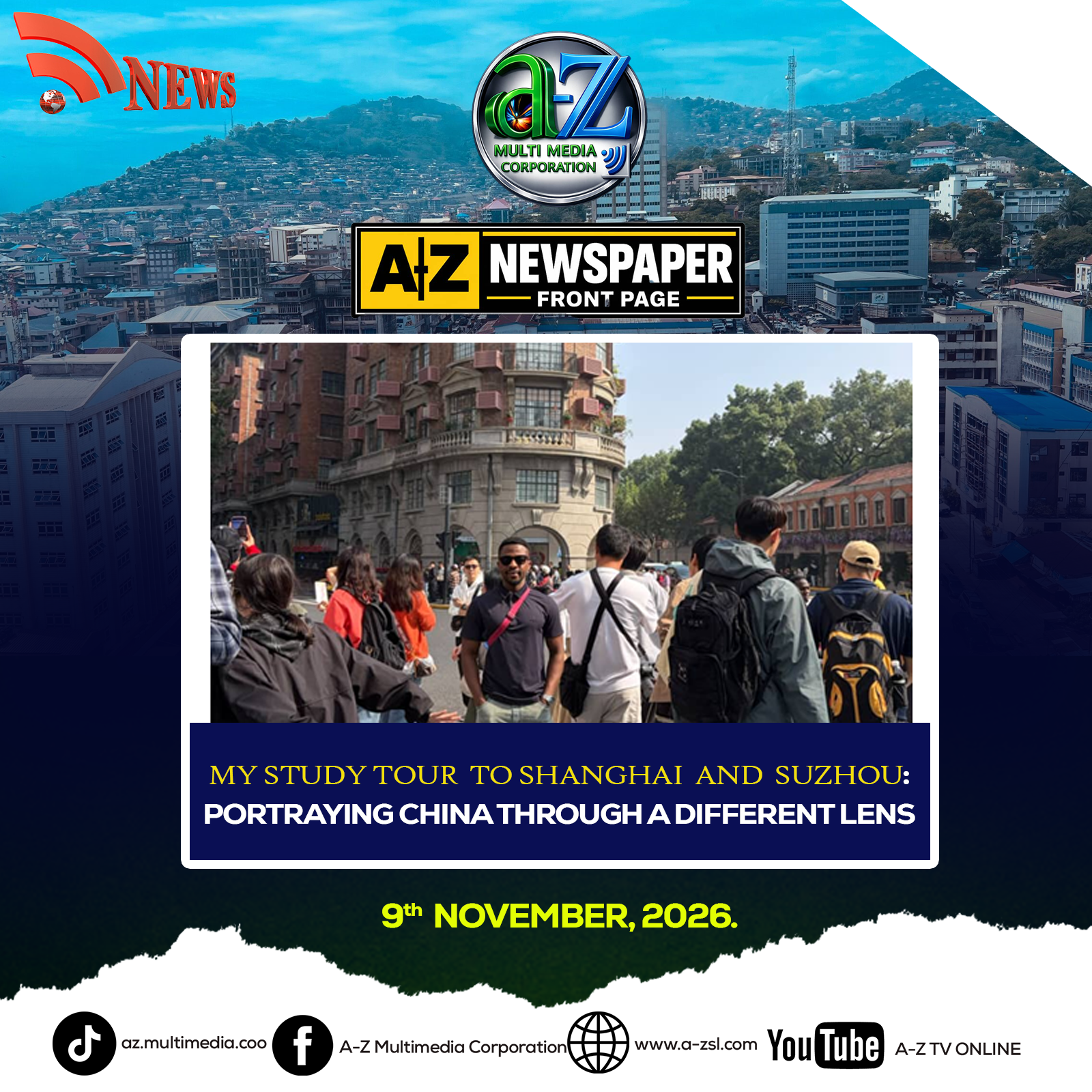
At Wukang Road, I admired the architectural beauty of Wukang Mansion, formerly the Normandie Apartments, built in 1924. Its distinctive European architectural influence demonstrated Shanghai’s multicultural history.
Traditional Culture and Cultural Heritage
In Suzhou, the Lingering Garden, a UNESCO World Heritage site, showcased the elegance of classical Chinese garden design. Meanwhile, Pingjiang Road, with its historic canals and traditional architecture, reminded me of the waterways and cultural landscape of Bunce Island in Sierra Leone. At Tiger Hill, I was particularly impressed by the historic Huqiu Pagoda and the enduring respect Chinese people demonstrate towards their heritage.
Ultimately, this study tour was more than sightseeing; it was an educational journey into China’s history, culture, media and development. It reinforced my belief that understanding a country requires looking beyond its economic achievements to appreciate its people, traditions and historical experiences. Through this journey, being an international communication student, I discovered another dimension of China; one that connects its glorious past with its rapidly evolving future. I also feel as if nature itself is lifting the path up to the heavens.