

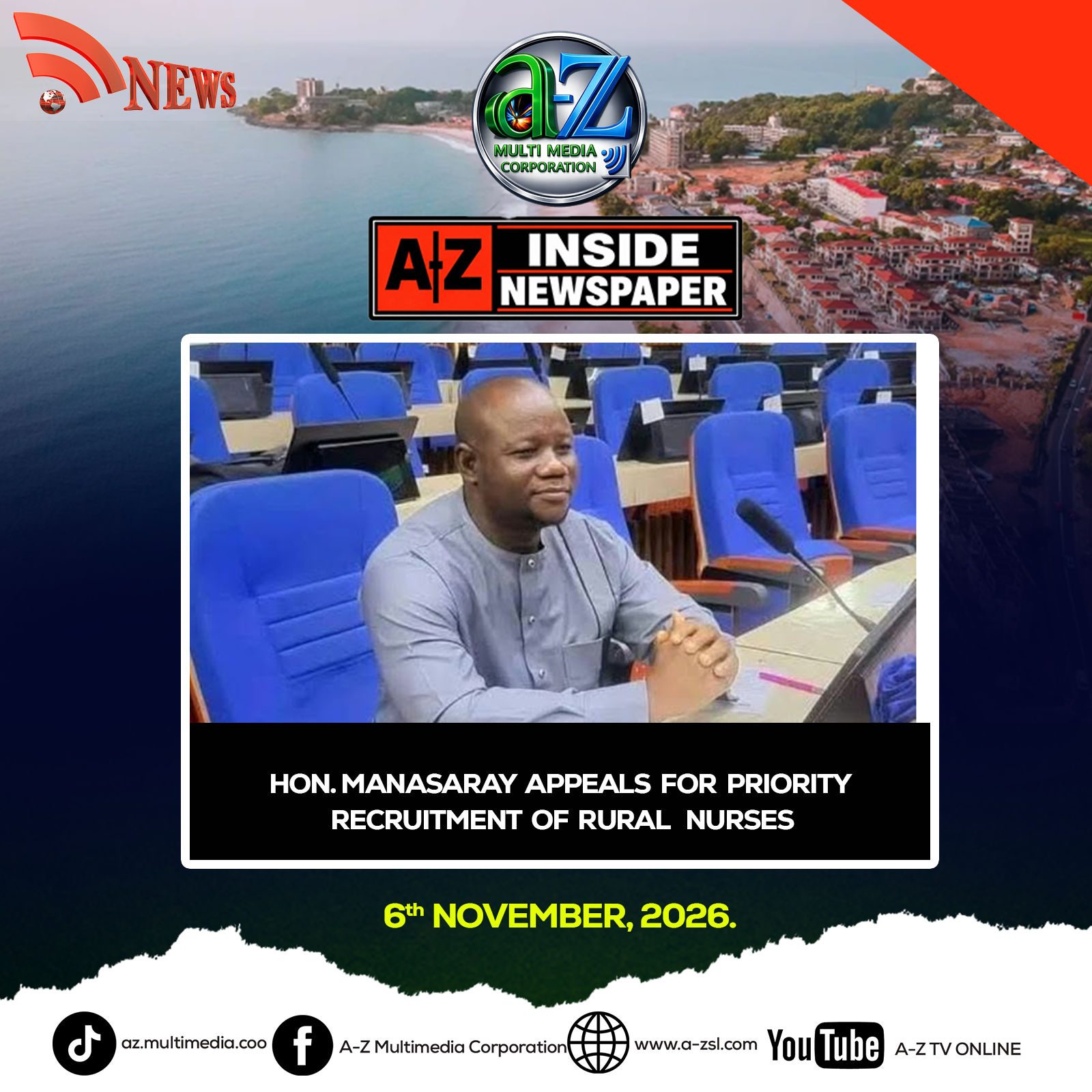
By: Aminata Sesay
Member of Parliament for Moyamba District, Hon. Alpha Ben Mansaray, has called on the Ministry of Health and the Health Service Commission to prioritize the recruitment of nurses who have been serving in rural communities for years, warning that persistent staff shortages in peripheral health units continue to undermine healthcare delivery, particularly maternal and child health services.
Hon. Mansaray made the appeal during the third allotted day of debate on President Julius Maada Bio’s Address in Parliament, where he raised concerns about the centralization of the recruitment process in Freetown.
He disclosed that many nurses working in rural communities had served as volunteers for between five and six years without being absorbed into the government payroll, despite providing essential healthcare services. He expressed concern that when recruitment exercises are conducted, PIN codes are sometimes allocated to individuals working in urban areas instead of those already serving in underserved rural health facilities.
According to him, the situation has left several peripheral health units struggling with inadequate staffing, with some facilities depending on just two nurses. He explained that when one volunteer nurse leaves and the government-employed nurse is away attending a workshop, patients may arrive at the facility without finding any health worker available to attend to them.
He therefore urged the Ministry of Health and the Health Service Commission to give priority to experienced volunteer nurses who have continued serving rural communities without PIN codes, particularly as the country seeks to reduce maternal and child mortality at district level.
On substance abuse, Hon. Mansaray called for the establishment of specialized detoxification and rehabilitation centres to address the growing problem of drug addiction among young people.
While acknowledging ongoing efforts to combat Kush and other harmful substances, he stressed that rehabilitation should not be limited to admitting affected individuals into psychiatric facilities. He argued that dedicated centres were necessary to provide appropriate treatment, counselling and rehabilitation.
He warned that failure to address substance abuse could result in the loss of a generation of young people who could otherwise contribute meaningfully to agriculture, skilled trades and national development.
The Moyamba MP also highlighted the financial challenges facing tertiary institutions, noting that the burden of university education increasingly falls on parents and students. Referring to ongoing industrial actions within the education sector, he called for greater government attention to the funding, administration and welfare of tertiary institutions.
Turning to infrastructure, Hon. Mansaray renewed his appeal for the construction and completion of critical roads in Moyamba District, including the Moyamba–Shenge Road, Jagbah Road, Mabang–Bongor Junction Road and Sogbo–Mabang Road.
He noted that residents had waited for years for improvements to the district’s road network, emphasizing that completing these projects would enhance connectivity, facilitate the movement of goods and services, and stimulate economic activities.
He further expressed concern over delays in the EU-funded Sogbo–Mabang Road project, stating that work had reportedly stalled for nearly two years amid concerns over the government’s failure to fulfil its counterpart funding obligations.
On education, Hon. Mansaray called for stronger measures to curb examination malpractice, proposing improved monitoring of public examinations and effective compliance mechanisms for schools.
He maintained that students should not be discouraged from resitting public examinations to improve their academic performance, but emphasised that adequate supervision and monitoring were necessary to safeguard the credibility and integrity of the examination process.