

By: Audrey Raymonda John
The Executive Director of the Amazonian Initiative Movement Sierra Leone (AIM-SL), Rugiatu Neneh Turay-Koroma, has taken her campaign to end female genital mutilation (FGM) to Masimera Chiefdom in Port Loko District, promoting alternative initiation rites that preserve Bondo traditions without genital cutting.
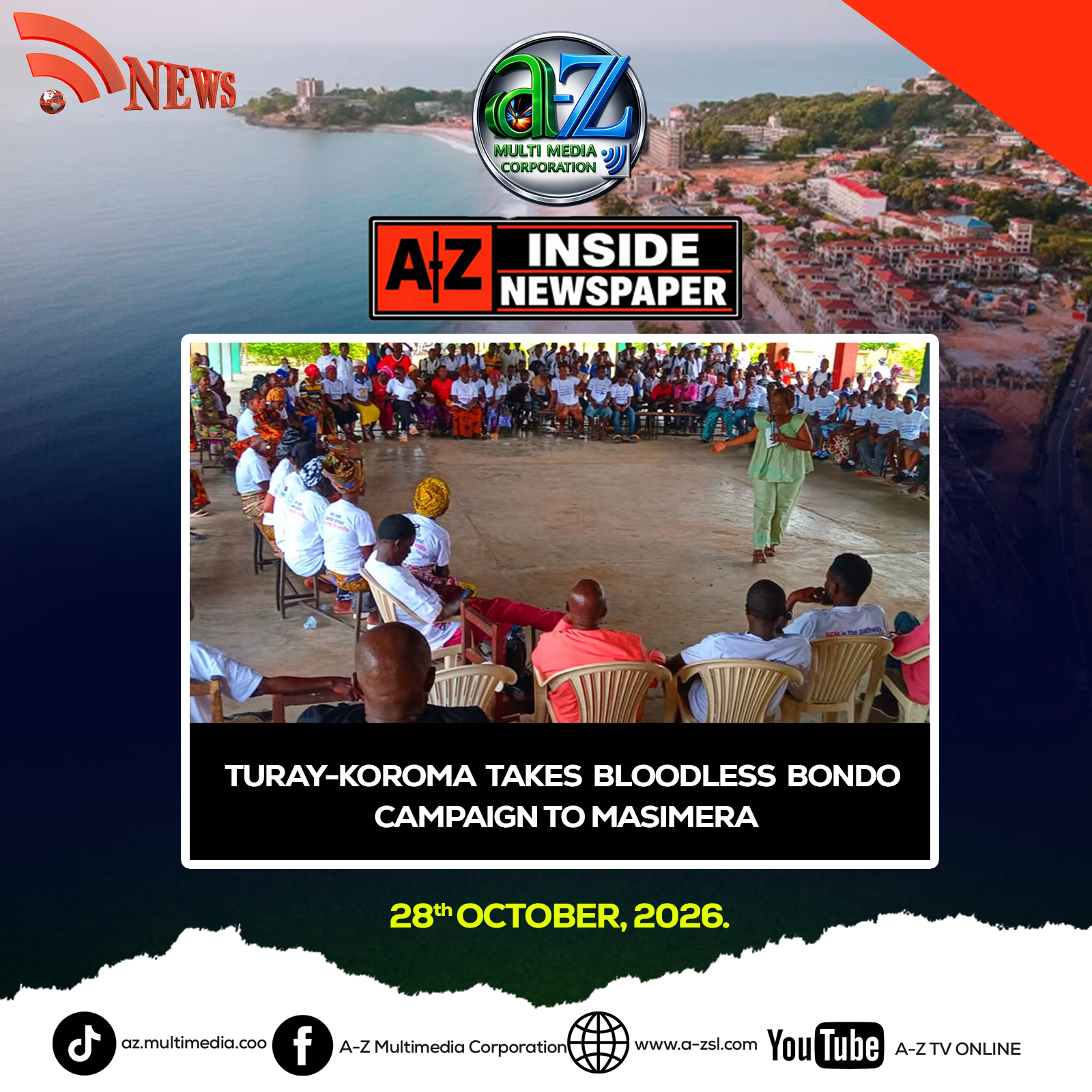
The engagement, held as part of activities marking the International Day of the Girl Child, brought together chiefs, Soweis, religious leaders, students and other community stakeholders to discuss the protection of women and girls from harmful practices. The initiative was undertaken by AIM-SL in partnership with Irish Aid.
Turay-Koroma called for stronger community participation in ending FGM, stressing that cultural traditions can be preserved without practices that harm the health and wellbeing of women and girls.
Her advocacy centres on Bloodless Bondo, an alternative rite of passage that retains the cultural education, songs, mentorship and communal celebrations associated with traditional initiation while eliminating genital cutting.
For more than two decades, Turay-Koroma has worked through AIM-SL to challenge the belief that FGM is an indispensable part of Bondo. Her approach involves engaging traditional practitioners, particularly Soweis, to encourage community-led alternatives rather than excluding them from efforts to end the practice.
In a 2020 interview published by Soroptimist International, Turay-Koroma discussed AIM-SL’s organization of an alternative rite of passage in 2019, following a public declaration by 45 Soweis who had committed to abandoning cutting.
The initiative demonstrated how traditional practitioners could continue participating in initiation ceremonies without performing FGM. Similar efforts have been documented by Deutsche Welle and the Community of Practice on FGM, which have highlighted AIM-SL’s engagement with traditional leaders, former cutters and communities to promote alternative rites of passage.
Turay-Koroma’s work has also received international recognition. In 2024, she received the International Hrant Dink Award for her longstanding efforts to challenge FGM, engage traditional practitioners and promote alternatives that protect women and girls while respecting non-harmful cultural traditions.
The recognition highlighted her efforts to encourage traditional practitioners to abandon cutting and explore alternative livelihoods, while supporting the continuation of Bondo as a cultural institution without genital mutilation.
During the Masimera engagement, Turay-Koroma urged chiefs, Soweis, parents and religious leaders to take responsibility for protecting girls from harmful practices. She emphasised that sustainable change requires the involvement of people who influence decisions within families and traditional institutions.
Participants discussed the health consequences of FGM, the importance of girls’ education and the need to uphold the rights and wellbeing of women and girls.
According to the World Health Organization (WHO), FGM involves the partial or total removal of external female genitalia, or other injury to female genital organs, for non-medical reasons. The practice has no health benefits and can result in severe pain, bleeding, infections, childbirth complications and long-term psychological harm.
Sierra Leone continues to face a significant challenge in addressing the practice. The 2019 Demographic and Health Survey reported that approximately 83 per cent of women and girls aged 15 to 49 had undergone FGM, underscoring the importance of sustained prevention, public education and community engagement.
AIM-SL’s efforts extend beyond awareness-raising to include practical alternatives to cutting. In 2022, the organization reportedly facilitated a Bloodless Bondo initiation involving 60 adult women in Matotoka. In August 2023, another 60 women completed an alternative initiation ceremony in Koya Chiefdom, Port Loko District.
In 2026, AIM-SL also reported that 55 women completed an alternative rite of passage in Mabalay Village, Port Loko District, with support from Irish Aid.
These initiatives illustrate the organization’s continued efforts to make alternative initiation ceremonies accessible to communities while involving traditional practitioners in the transition away from FGM.
The approach also recognizes the role of Soweis in traditional society and the livelihoods associated with initiation practices. By involving them in designing and leading alternative ceremonies, AIM-SL seeks to encourage the abandonment of cutting without excluding traditional women leaders from community life.
Young people also contributed to the Masimera engagement. Alimatu I. S. Fofanah, a student of Dr. Kadie Sesay Secondary School in Port Loko District, called for increased grassroots awareness and education to address FGM and protect girls’ rights.
Her contribution underscored the importance of involving students and young people in discussions about harmful practices, education and community responsibility.
Chiefs, religious leaders, traditional authorities and social welfare representatives also participated in the engagement, providing an opportunity to discuss the role of local leadership in preventing FGM and supporting safer alternatives.
Through her work, Turay-Koroma continues to promote the message that preserving cultural identity does not require the continuation of harmful practices. Her campaign seeks to demonstrate that Bondo’s cultural teachings and community traditions can continue without exposing women and girls to the risks associated with genital cutting.
Although alternative initiation ceremonies and public commitments do not, on their own, prove that FGM has ended in participating communities, they provide practical examples of community-based efforts to change established practices.
As AIM-SL continues its engagement in Masimera and other communities, the Bloodless Bondo initiative highlights the role traditional leaders, Soweis, women’s organisations, religious leaders and young people can play in promoting cultural practices that respect the health, dignity and rights of women and girls.