

By: Saidu Jalloh
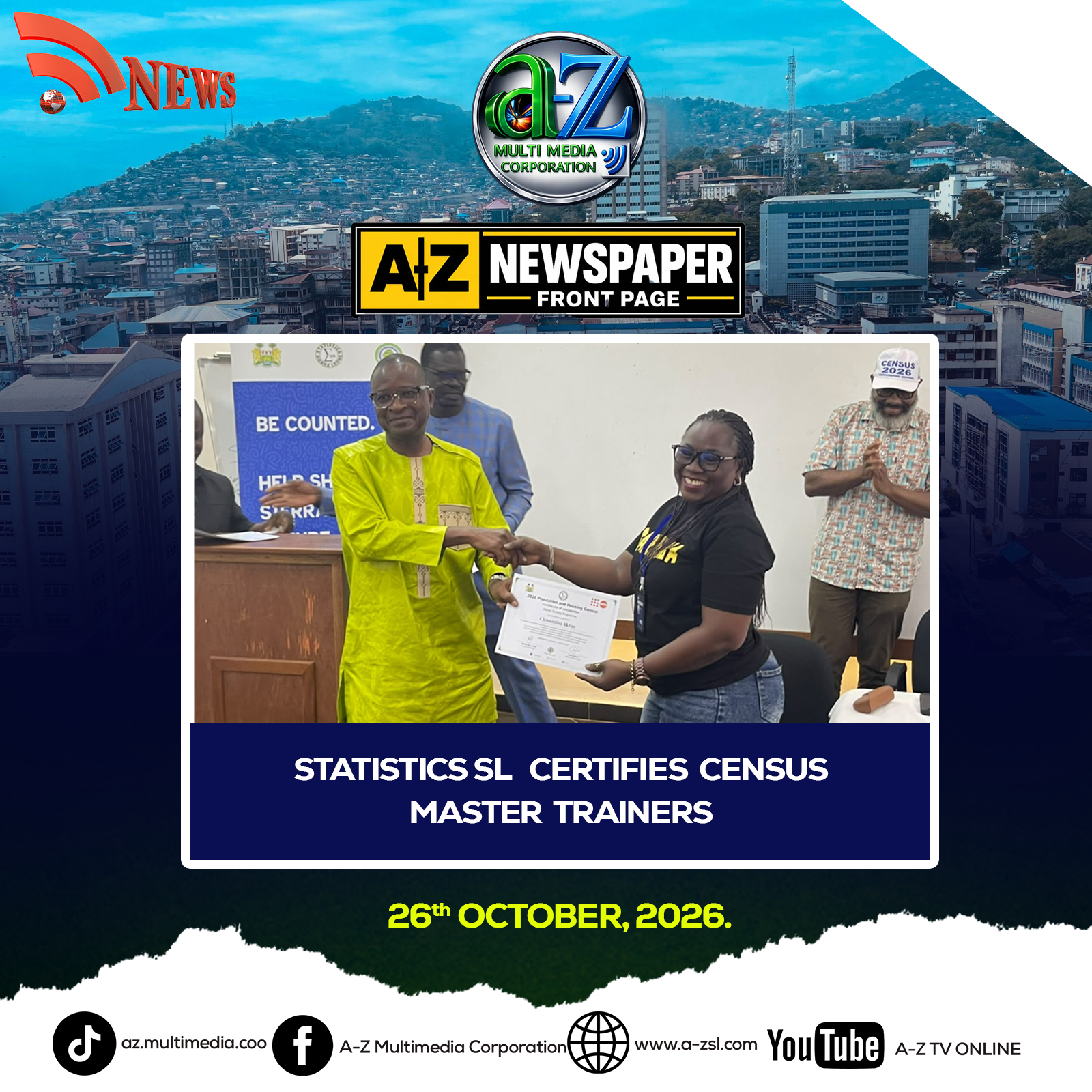
Statistics Sierra Leone has completed an intensive training programme for master trainers and data quality managers ahead of the 2026 Population and Housing Census, marking a major milestone in preparations for the country’s digital census.
The training concluded on Friday, 23 October 2026, at Family Kingdom Resort in Freetown, with officials emphasizing professionalism, teamwork and data integrity as essential to delivering a credible national census.
The newly certified master trainers are expected to commence the Training of Trainers (ToT) programme on Monday, 26 October, across regional headquarters and designated locations in Bo, Kenema, Makeni, Port Loko, Freetown and Waterloo.
The programme will prepare additional trainers to facilitate the subsequent training of enumerators and supervisors responsible for collecting population data across Sierra Leone.
Speaking at the closing ceremony, Statistician General Andrew Bob Johnny underscored the importance of teamwork, delegation and staff development in strengthening the institution’s capacity.
He said Statistics Sierra Leone was committed to creating opportunities for staff to develop their skills, demonstrate their abilities and contribute meaningfully to the organization’s work.
Johnny commended Deputy Statistician General Lansana Kpewolo Kanneh and the institution’s directors for their dedication and support, noting that their efforts had contributed significantly to the progress achieved.
He also acknowledged the contributions of his predecessor, Professor Sanko, and Mr. Kane, stressing that effective leadership involved empowering colleagues and recognizing their contributions.
Presenting the assessment results, Theophilus Blaudfaust, Director of Data Science at Statistics Sierra Leone, disclosed that participants completed seven core assessments during the training, in addition to a separate Data Quality Management test.
According to Blaudfaust, the assessments recorded a median success rate of 92.3 per cent, well above the required pass mark of 80 per cent.
Participants achieved average scores of 94.1 per cent on the first day, 91.6 per cent on the second day and 84.1 per cent on the third day. The final examination recorded an average score of 95.1 per cent.
Hall One emerged as the leading group, achieving an overall performance score of 93.4 per cent.
Blaudfaust explained that selected participants also underwent specialized Data Quality Management training based on their relevant experience in mapping and major surveys. The group recorded an average score of 83 per cent, while the five highest performers in the overall assessment scored between 97.6 and 98.5 per cent.
He said participants could access their results through the assessment portal, enabling them to identify areas of weakness and revisit relevant training materials before taking up their assignments.
He emphasised that the assessments were intended not to promote competition but to build a competent team capable of delivering accurate and reliable census results.
Outlining the next phase, CCIT Lead James Medo announced that approximately 1,700 participants would undergo the Training of Trainers programme, followed by online training for about 30,000 enumerators and supervisors.
Physical training for enumerators and supervisors will subsequently take place as part of preparations for the nationwide data collection exercise.
Medo also outlined the census timetable, stating that household listing was scheduled for 23–28 November, Census Night for 1 December, and the commencement of enumeration for 2 December 2026.
Deputy Statistician General Kanneh said the successive training stages demonstrated Statistics Sierra Leone’s commitment to technical preparedness and due diligence.
He cautioned the newly certified master trainers against abusing their authority, describing them as ambassadors responsible for upholding professional standards and ensuring quality training at every level.
Kanneh warned that weaknesses introduced during training could spread throughout the census workforce and compromise the quality of the final data. He therefore encouraged participants to support colleagues who might need additional assistance.
He further disclosed that contracts for the Training of Trainers phase had been prepared, with additional contracts expected to follow performance assessments for the main data collection exercise.
Emphasizing national unity, Kanneh reminded participants that the census was a collective responsibility requiring cooperation and commitment across the country.
UNFPA Representative Sibeso Mululuma congratulated the master trainers, describing them as leaders and ambassadors of truth and precision who would help safeguard the integrity of Sierra Leone’s digital census.
She said reliable census data would be vital to national development, guiding policymaking, improving planning and supporting progress towards the Sustainable Development Goals.
Mululuma expressed confidence that Sierra Leone was preparing to deliver a transparent and credible census, with findings expected to inform national development priorities for years to come.
Speaking on behalf of his colleagues, master trainer Dr. Tommy Matthus Hanson described the training as demanding but transformative.
He thanked Statistics Sierra Leone for strengthening participants’ knowledge and professional capacity, pledging their collective commitment to conducting a credible census with integrity.
The completion of the master trainers’ programme marks a significant step towards the December census. Statistics Sierra Leone is now preparing to expand the training process and equip personnel with the skills needed for effective nationwide data collection.
With the next phase scheduled to begin on Monday, 26 October, the institution is intensifying efforts to ensure that census personnel are adequately prepared to deliver accurate, reliable and credible population data for national planning and development.