

Ulanqab, a city in north China’s Inner Mongolia Autonomous Region, is transforming its traditional agricultural identity as China’s “Potato Capital” and “Oat Capital” into a growing centre for green computing, using its abundant wind and solar resources to drive economic growth and technological innovation.
Since China launched its national “East Data, West Computing” project in 2022, Ulanqab has accelerated investment in computing infrastructure. In late 2025, the city introduced a three-year development strategy aimed at building a “Token City” powered by renewable energy.
Official data show that Ulanqab had signed 109 computing centre projects by August 2026. Between January and August, the industry generated 5.68 billion yuan (approximately US$849 million) in revenue, representing a 40.3 per cent increase compared with the same period in 2025.
Chinese President Xi Jinping visited Ulanqab on Friday and called for the effective use of the region’s abundant wind and solar resources to expand the green computing industry. He also emphasised the importance of balancing high-quality economic development with strong environmental protection and maintaining a commitment to green development.
During his inspection, Xi visited the Chahar High-Tech Development Zone, where he was briefed on Inner Mongolia’s progress in developing a national computing hub under the “East Data, West Computing” initiative. He called for completed projects to operate efficiently and for ongoing projects to be completed on schedule.
Xi further urged officials to ensure that the industry develops efficiently, sustainably and safely while actively promoting green computing infrastructure.
The “East Data, West Computing” initiative seeks to establish a coordinated national computing network by directing computing demand from eastern China to western regions. The programme aims to optimise the distribution of data centres, improve computing efficiency and promote balanced regional development. Inner Mongolia is one of eight national computing hubs designated under the initiative.
Computing centres require reliable electricity, high-speed internet connectivity and efficient cooling systems. Ulanqab’s natural conditions and renewable energy resources have helped it attract investment in the sector.
John Gong, a professor of economics at the University of International Business and Economics, told CGTN that Ulanqab has effectively used its renewable energy resources to support China’s artificial intelligence development. He said Xi’s visit highlighted support for a development model that uses local resource advantages to promote economic growth and technological innovation.
With an average annual temperature of 4.3 degrees Celsius, Ulanqab can take advantage of naturally cool conditions to reduce data-centre cooling requirements for nearly 10 months of the year. Its abundant wind and solar resources, combined with relatively low infrastructure costs, have also made it an attractive destination for major technology companies establishing computing facilities.
Through investments in cities such as Ulanqab, China is seeking to use renewable energy to reduce the environmental impact of its expanding computing industry.
Alongside its push for green computing and technological advancement, China has continued to emphasise ecological conservation.
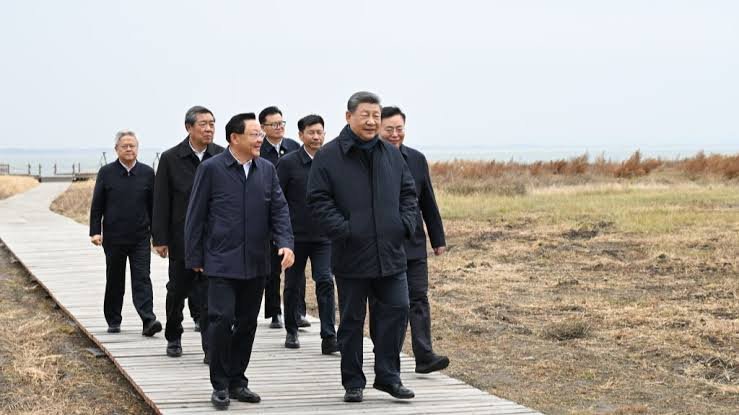
During his visit on Friday, Xi also inspected the Huangqihai Lake nature reserve, where he received updates on conservation efforts, examined the lake’s shoreline and mudflats, and observed birds inhabiting the area.
He called for the full implementation of China’s Wetland Protection Law, the protection of ecological boundaries and the preservation of biodiversity. He also stressed that the restoration of degraded wetlands should prioritise natural recovery, supported by human intervention where necessary, with all measures implemented scientifically.
Huangqihai was once an inland lake with a closed drainage basin that came close to drying up due to climatic and other factors. A county-level nature reserve was established in 1993 to support wetland restoration, and the reserve was upgraded to autonomous-region-level status in 2003.
Years of conservation and restoration efforts have helped revive the lake’s water levels and surrounding vegetation, creating a more suitable habitat for wildlife.
Ulanqab’s transformation highlights China’s efforts to combine economic development with environmental protection. By using renewable energy to support computing infrastructure while restoring and protecting natural ecosystems, the city is demonstrating how local resources can become drivers of sustainable economic growth.