

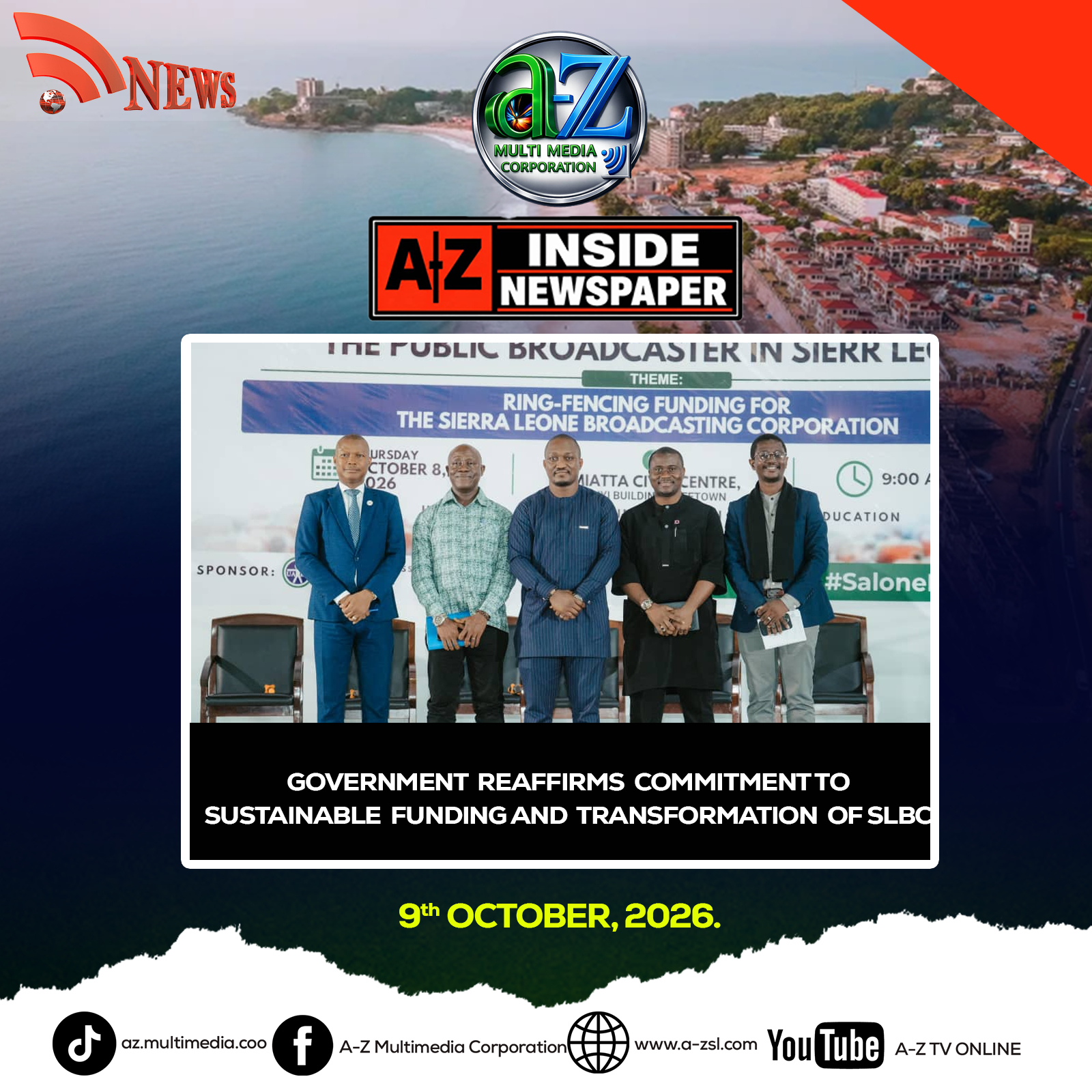
By: Mariama Benovia Davies
The Ministry of Information and Civic Education, in collaboration with the Sierra Leone Broadcasting Corporation (SLBC), on Thursday, 8 October 2026, hosted the National Conference on Sustainable Funding for the Public Broadcaster in Sierra Leone, under the theme “Ring-Fencing Funding for the Sierra Leone Broadcasting Corporation.” The high level conference brought together key stakeholders to examine sustainable financing mechanisms capable of strengthening SLBC’s public service mandate, modernising its operations and positioning the national broadcaster to effectively serve citizens across the country. Delivering the keynote statement on behalf of the Honourable vice President Dr Mohamed Juldeh Jalloh, the Minister of Information and Civic Education, Chernor Bah, reaffirmed government’s strong commitment to transforming SLBC into a credible, modern and financially sustainable public broadcaster.
Minister Bah recalled his longstanding commitment to the development of SLBC, noting that the institution represents an important component of Sierra Leone’s national information infrastructure and should remain at the centre of the country’s transformation of the information sector. He acknowledged the considerable challenges accumulated over the years, including infrastructure, resources and financing constraints, while highlighting the progress already being made through improvements to the institution’s facilities, workers’ environment, programme quality and the development of modern studios in partnership with development partners and other stakeholders. He commended the Director General, Madam Josephine Kamara, the Board, management and staff of SLBC for their continued dedication and service, particularly under challenging circumstances.
He emphasised that predictable, sufficient and sustainable financing is fundamental to building the national broadcaster Sierra Leone needs. He noted that while competition for audiences has intensified significantly in the rapidly changing media environment, the demand for accurate, credible and accessible information has become even more important. According to him, SLBC has a unique public service responsibility to verify information before broadcasting it, explain national issues clearly and ensure that citizens, particularly those in remote communities, have access to reliable information. He stressed that a strong public broadcaster can contribute significantly to national cohesion, peace, civic education and democratic participation by ensuring that citizens across the country remain informed and connected to national developments.
He further highlighted the importance of SLBC’s national mandate, stressing that the broadcaster must serve communities beyond the commercial centres and reach citizens in remote chiefdoms as well as those in the capital. He said SLBC must continue creating space for local languages, supporting agriculture, promoting national pride, reflecting Sierra Leone’s diversity and strengthening civic education and public engagement. He also emphasised that the credibility of the institution depends on fairness, professionalism, editorial independence, sound management and public accountability. In this regard, he maintained that sustainable financing should not only provide resources for the institution but also strengthen the systems and standards required to ensure that those resources are used transparently and effectively in the public interest.
A major focus of the keynote was Sierra Leone’s transition from analogue to digital broadcasting, which the Minister described as both an important national commitment and a significant opportunity for the broadcasting sector. He explained that digital transmission could enhance the quality of television and radio services, create opportunities for additional programming and content producers, and allow multiple channels to share transmission infrastructure more efficiently. He disclosed that preliminary studies and technical work had already been undertaken towards the transition, while noting that the most conservative estimate available placed the cost of the required transition at approximately US$50 million. He therefore called for the development of a fully funded national plan that would support the transition while ensuring that citizens are properly informed and equipped to benefit from the digital broadcasting environment.
He also identified the unfinished SLBC building as another major area requiring strategic national attention and investment. He described the structure as a symbol of the institution’s long history, vision and unrealised potential, noting that its development dates back several decades. Rather than viewing the facility solely as an abandoned structure, he called for a comprehensive assessment and viable investment plan that could transform the property into a modern hub for broadcasting and the wider information sector. He noted that the facility could potentially accommodate modern studios, production facilities, training spaces, archives and other services capable of strengthening SLBC while creating opportunities for income generation. He stressed the importance of determining what is structurally possible, the cost of rehabilitation and the most appropriate financing model to ensure that the public interest remains protected.
Addressing the issue of financing, Minister Bah called for serious consideration of mechanisms that can provide SLBC with predictable and dependable public support while strengthening accountability. He noted the importance of examining legislative and revenue options, including the possibility of a dedicated public broadcasting fund, while emphasising the need for stronger coordination between institutions responsible for information, broadcasting, telecommunications, spectrum and related infrastructure. He maintained that every proposed financing mechanism must pass practical tests of fairness, viability, transparency and value for money, while protecting SLBC’s public service mandate. He further stressed that every financial commitment must be accompanied by strong accountability measures, enabling citizens to understand what the broadcaster receives, how resources are utilised and what services are delivered as a result.
In his closing remarks, Minister Bah challenged stakeholders at the conference to move beyond acknowledging SLBC’s financing needs and focus on identifying concrete, credible and sustainable solutions. He called for continued engagement with Parliament, the private sector, communities, development partners and citizens to advance the financing and transformation agenda. He reaffirmed that the future of Sierra Leone’s national broadcaster cannot rest solely on the shoulders of one minister or government institution, but must become a national commitment anchored in the recognition of public broadcasting as a public good and an essential pillar of democracy. The Minister declared that understanding the depth of the challenges confronting SLBC had only strengthened his determination to support its transformation, and, on behalf of His Excellency the President, officially declared the National Conference on Sustainable Funding for the Public Broadcaster in Sierra Leone open