

By: Mohamed J. Bangura
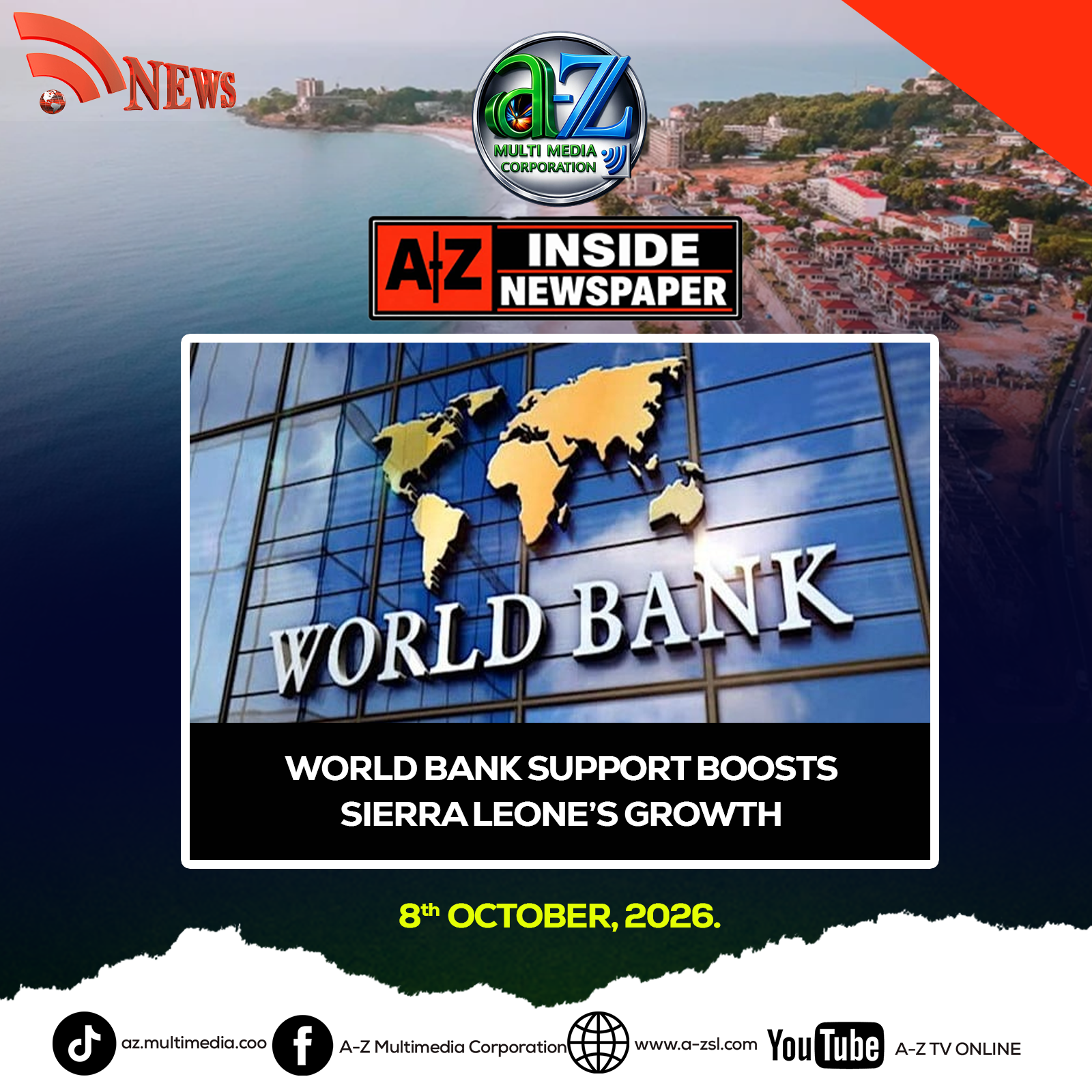
Sierra Leone’s economy is projected to grow from an estimated 4.5 percent in 2026 to 4.7 percent in 2027, supported by agriculture, services, investment and major development programmes, according to the World Bank.
The projected growth comes as the World Bank continues to support Sierra Leone through investments in agriculture, energy, infrastructure, digital development, social protection and private-sector development.
According to the Bank’s latest Sierra Leone Country Update, real GDP growth is expected to remain at 4.5 percent in 2026 before increasing to 4.7 percent in 2027. The Bank said strong performance in agriculture and services has contributed to economic activity, while private investment and household consumption have also supported demand.
One of the Bank’s latest major interventions is the US$40 million Sustainable Agricultural Value Chains Intensification for Growth (SAVIG) Project, approved in June 2026.
The project is aimed at increasing agricultural productivity, attracting private investment and creating jobs across selected agricultural value chains. It will support farmers and agribusinesses from production to processing and marketing, with the aim of strengthening agriculture as an engine of economic growth.
The World Bank said the project will contribute to the Government’s Feed Salone target of creating at least 35,000 formal jobs in agriculture, while expanding opportunities for women, young people and rural entrepreneurs.
The Bank is also supporting Sierra Leone’s energy sector, recognizing that reliable electricity is essential for businesses, industries and communities.
Under the Regional Distributed Access through Renewable Energy Solutions programme, Sierra Leone is receiving US$60 million to expand access to renewable electricity through solutions such as solar systems and mini-grids.
The programme is expected to reach underserved communities and create new economic opportunities for households, businesses and farmers. Improved electricity access could also help businesses reduce operating challenges, support agricultural processing and encourage investment in productive activities.
GROWING DEVELOPMENT PARTNERSHIP
The scale of the World Bank Group’s engagement reflects the breadth of its partnership with Sierra Leone.
As of September 30, 2026, the Bank’s financing database showed US$3.34 billion in total commitments across 103 projects in Sierra Leone.
The portfolio covers areas including infrastructure, energy, agriculture, financial inclusion, governance, education, social protection, health and digital development. According to the Bank, these investments are aimed at supporting sustainable growth, economic diversification and resilience.

ECONOMIC OUTLOOK TOWARDS 2027
Indicator| 2025| 2026 Projection| 2027 Projection
Real GDP Growth| 4.5%| 4.5%| 4.7%
The projections indicate that Sierra Leone’s economy is expected to maintain its growth momentum in 2026 and record a modest increase in 2027.
The outlook comes amid external pressures, including higher energy and transport costs and continued global economic uncertainty.
The World Bank’s October 2026 Africa Economic Update also projected that growth in Sub-Saharan Africa would increase from 4.1 percent in 2025 to 4.3 percent in 2026.
For Sierra Leone, continued investment in agriculture, electricity, infrastructure and the private sector could provide a stronger foundation for job creation, productivity and economic diversification.
With growth projected to reach 4.7 percent in 2027, the country’s economic outlook points to continue expansion as Sierra Leone works to strengthen the foundations for long-term and inclusive development.
The World Bank’s support, alongside domestic reforms and private-sector participation, remains an important component of Sierra Leone’s efforts to build a more productive, diversified and resilient economy.