

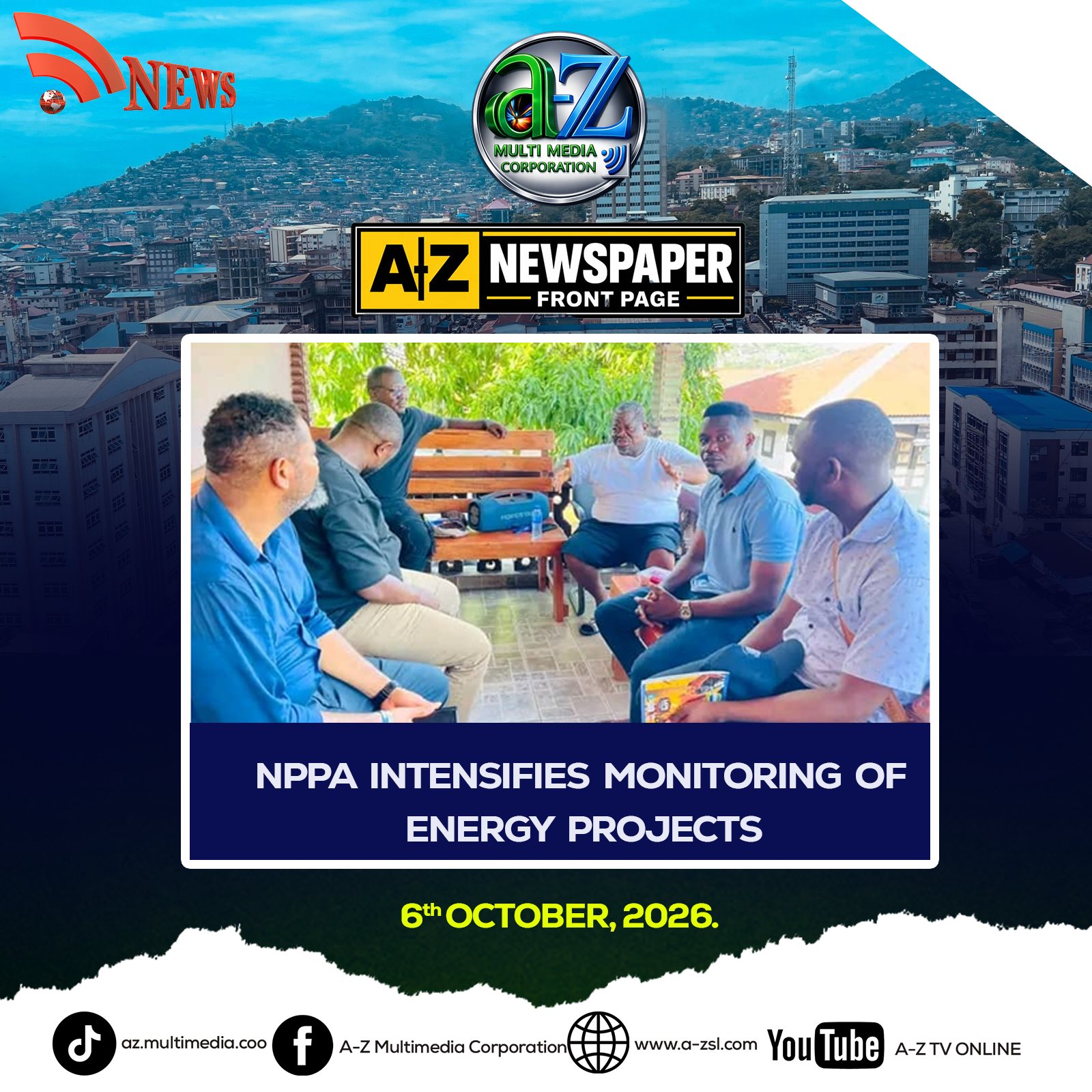
The National Public Procurement Authority (NPPA) has intensified monitoring of government-funded energy projects to promote value for money, assess implementation progress and ensure that public infrastructure delivers the intended benefits to citizens.
Through its Engineering Directorate, the Authority recently inspected energy projects in Kabala, Kambia and Bauya Sognini, while engaging traditional authorities and communities on the protection, ownership and sustainability of the infrastructure.
The monitoring exercise, conducted between September 30 and October 2, 2026, focused on the physical condition of the projects, progress of implementation, functionality and challenges affecting their completion.
The NPPA stressed that the award of a contract does not mark the end of the procurement process, noting that the ultimate objective is to ensure that contracted goods, works and services are delivered in accordance with contractual requirements.
In Kabala, the team inspected the Design, Supply, Installation and Commissioning of 11kV Distribution Networks on September 30.
The project comprises 17 transformers across Kabala Township and was reported to be approximately 70 percent complete. Some households had also received service connections.
However, the team was informed that 10 transformer locations had been vandalized, with armoured and other electrical cables reportedly stolen. Physical inspection showed that the transformers were largely intact, while the main damage involved associated cables and other infrastructure.
Two transformer locations, at the Makakura checkpoint and military barracks, were reportedly untouched.
The team was also informed that five of the 17 transformers are low-voltage transformers and do not require panels. The project has undergone a one-year addendum, while implementation has reportedly been halted over a payment-related issue raised by the contractor.
The NPPA team also engaged Paramount Chief Yembeh Marah, the Chiefdom Speaker of Wara Wara Chiefdom, and the Section Chief of Bawuya Section, Chris Sieh Mansaray.
The Paramount Chief welcomed the monitoring exercise and said communities were aware of electrical works in their areas but often lacked detailed information about the scope and implementation of projects.
He also raised concerns about theft and vandalism and assured the NPPA team of the community’s willingness to help protect the infrastructure.
In Kambia, the Engineering Directorate inspected the Design, Supply, Installation and Commissioning of Distribution Networks on October 1.
The inspection revealed concerns over vandalism and operational challenges. A transformer located behind the powerhouse had reportedly been completely vandalized, while two other transformers in Kambia Township had also been affected. The team was informed that the damaged transformers had subsequently been repaired.
The NPPA was further informed that electricity generation had commenced but was later suspended because of a lack of fuel. The powerhouse has reportedly remained non-operational since April 12, 2026.
The project also includes a solar electrification component, although the monitoring team could not obtain detailed information on its implementation status during the visit.
The team later paid a courtesy call on Paramount Chief Hon. PC Bai Farma Tass Bobo IV, who acknowledged the challenges caused by theft and vandalism and said the community had taken steps to discourage such acts.
He also confirmed that the powerhouse had not been operating because of the lack of fuel.
The NPPA emphasized the need for stronger collaboration among communities, the Electricity Distribution and Supply Authority (EDSA), the Electricity Generation and Transmission Company (EGTC), security institutions and other stakeholders to protect the infrastructure.
In Bauya Sognini Chiefdom, the NPPA team inspected the powerhouse and transformer installation sites on October 2. The team was received by Site Engineer Joseph Kolie and Site Supervisor Emmanuel Harold Lincolm.
The team toured the powerhouse and associated facilities and observed that office spaces had been provided. However, no generator had been supplied at the time of the inspection.
The team subsequently visited transformer installation sites to assess the physical condition of the infrastructure and the progress of implementation.
The monitoring exercise highlighted community ownership as critical to the protection and sustainability of public infrastructure.
The NPPA noted that energy projects represent significant public investments intended to improve the lives of communities. It therefore called on beneficiary communities to help protect public infrastructure, report suspected vandalism and theft, and work closely with implementing agencies, local authorities and security institutions.
The Authority also stressed the importance of regular engagement between project implementers and communities to ensure that beneficiaries understand the purpose, scope and status of projects being implemented in their localities.
The monitoring of the energy projects in Kabala, Kambia and Bauya Sognini forms part of the NPPA’s broader project monitoring mandate, which was formally launched earlier this year.
The Authority said it will continue conducting physical inspections, engaging contractors and implementing agencies, interacting with traditional authorities and beneficiary communities, and documenting project progress and challenges.
The NPPA said the exercise is intended to extend procurement oversight beyond the award of contracts by ensuring that contractual obligations are translated into tangible results for citizens.
The Authority further noted that project implementation can face technical, financial, logistical, security and operational challenges, but said regular monitoring provides an opportunity to identify and document such challenges and bring them to the attention of the institutions responsible for addressing them.
Ultimately, the NPPA said its objective is to ensure that public resources are used efficiently, infrastructure is protected, projects are completed to the required standards and citizens receive the benefits for which public investments were made.