

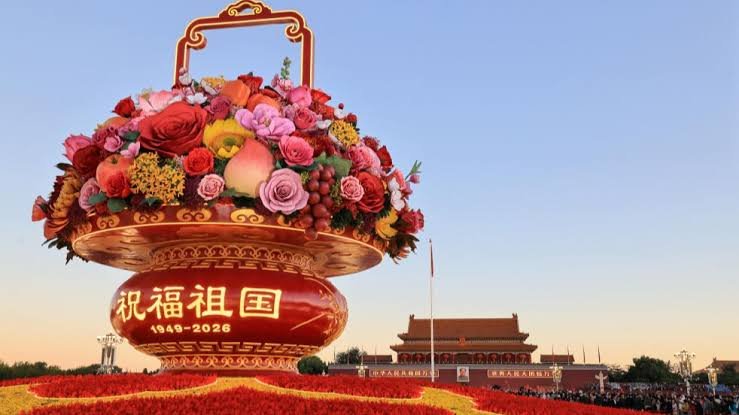
As the final notes of the national anthem faded into the early morning air, tears welled in Wang Fang’s eyes.
It was 4 a.m. on October 1, but about 101,000 people had already gathered at Beijing’s Tian’anmen Square to witness the raising of the five-starred red flag at sunrise.
For Wang, who was visiting Beijing for the first time with her middle-school-aged son after travelling hundreds of miles from Linyi in east China’s Shandong Province, the moment was more than a ceremony. It was a memory they would carry home and a glimpse of what the National Day holiday means to an ordinary family.
Across China, the arrival of October brought a similar sense of occasion. What began as a day marking the founding of the country has evolved into one of the year’s longest holiday periods, with the week-long “Golden Week” putting millions of people on the move.
The holiday has offered a snapshot of how emotional connections, cultural experiences and consumer activity are combining to shape holiday spending in China.
Red Landmarks Draw Holiday Crowds
National pride has emerged as a major theme of China’s National Day holiday, with travellers visiting iconic landmarks, retracing revolutionary history and turning their trips into cultural experiences.
Bookings for red tourism have also increased significantly year on year, with many families adding visits to revolutionary sites to their holiday itineraries.
This year marks the 90th anniversary of the victory of the Red Army’s Long March. In Yudu County, east China’s Jiangxi Province, the memorial park marking the starting point of the Central Red Army’s Long March has attracted large numbers of students and tourists. Nearly 300,000 visitors are expected to visit the site during the seven-day holiday.
Dai Bin, president of the China Tourism Academy, said the growing popularity of revolutionary landmarks reflects a strong emotional connection to China’s history and revolutionary traditions.
He stressed the importance of presenting historical facts accurately while telling stories in an engaging way, allowing visitors of different ages to better understand and reflect on the history they encounter.
Immersive Experiences Boost Spending
Beyond traditional sightseeing, immersive experiences are reshaping holiday consumption as cultural and tourism offerings become increasingly diverse.
In southwest China’s Chongqing, for example, restaurants are combining hotpot with experiences themed around the city’s ports, industrial heritage and outdoor camping.
Visitors can also take part in activities combining low-altitude flights with hands-on experiences such as fishing and making traditional snacks, offering them a taste of countryside life in Chengdu, southwest China’s Sichuan Province.
From October 1 to 3, foot traffic and revenue at 78 major shopping streets and commercial districts monitored by the Ministry of Commerce increased by 3.4 percent and 5.3 percent year on year, respectively.
The government’s consumer goods trade-in programme also generated 19.63 billion yuan, about $2.91 billion, in sales during the same period, benefiting 3.48 million consumers.
Cinemas Expand Beyond Movies
The holiday film market is also creating new opportunities for businesses.
Family-friendly films have emerged as a major attraction during this year’s National Day holiday, with a lineup spanning animation, crime thrillers, comedies and socially themed dramas aimed at audiences across generations.
At the same time, cinemas are expanding beyond traditional movie screenings. At a cinema in Nanshan District of Shenzhen, south China’s Guangdong Province, moviegoers can access a city bookstore, head spa and wellness services, as well as an esports area, allowing them to read, relax or unwind before or after a film.
A movie museum in Qingdao, east China’s Shandong Province, houses a large collection of audio and visual artefacts dating back to the 1950s. Its exhibition spaces recreate the look and feel of appliance stores from the 1980s and 1990s.
By incorporating film and television resources into its collections and exhibitions, the museum is exploring new ways to preserve local folk culture while making cultural services more accessible to the community.
The developments during the holiday show how China’s tourism and consumer sectors are increasingly moving beyond traditional sightseeing and shopping towards richer, more immersive experiences