

By: Saidu Jalloh
At a time when Sierra Leone is seeking to strengthen domestic production, expand exports and create greater opportunities for local businesses, the Ministry of Trade and Industry occupies a strategic position in the country’s economic transformation agenda.
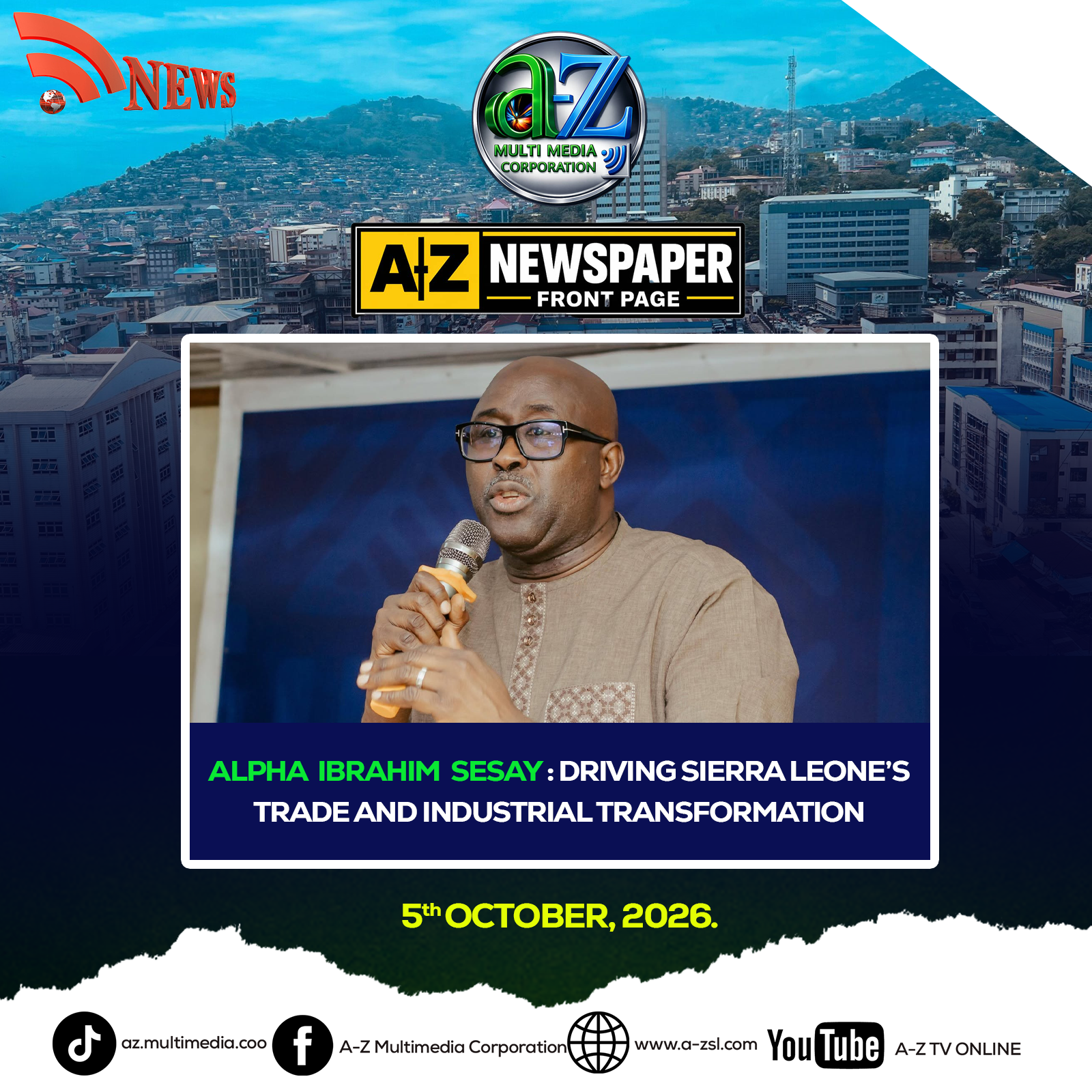
At the centre of that responsibility is Hon. Ibrahim Alpha Sesay, the Minister of Trade and Industry, who has been leading the Ministry’s efforts to promote trade, industrial development, private-sector participation and Sierra Leone’s integration into regional and international markets.
The Ministry’s current strategic priorities include strengthening institutional capacity, accelerating industrialization and the development of Special Economic Zones, improving trade facilitation, supporting small and medium-sized enterprises, and harmonizing national policies with regional and global trade frameworks.
For Minister Sesay, trade is not simply about the movement of goods across borders. It is closely connected to production, employment, investment and the development of local industries.
His Ministry has therefore placed emphasis on increasing Sierra Leone’s capacity to produce goods locally while creating opportunities for those products to compete in domestic, regional and international markets.
One of the areas highlighted by the Ministry is the development of local manufacturing. The Ministry says industrial growth is being supported through policies, private-sector engagement and monitoring aimed at strengthening Sierra Leone’s manufacturing base.
The government has also identified industrial zones as part of its broader strategy for economic transformation. At the 2025 Manufacturers’ Roundtable and Made-in-Sierra Leone Exhibition, Minister Sesay announced plans for four Special Industrial Zones and the revival of the Koindu International Market.
A major component of the Minister’s portfolio is the effort to encourage Sierra Leoneans to produce and consume more locally manufactured goods.
The government’s industrial agenda is aimed at reducing excessive dependence on imported products while creating a stronger domestic production base.
This approach is also reflected in the Ministry’s emphasis on local content. The Sierra Leone Local Content Agency quotes Minister Sesay as describing local content as a driver of industrialization, with the objective of increasing the use of domestic resources along value chains, improving capacity utilization and expanding manufactured exports.
The development of local industries can also create opportunities for farmers, manufacturers, entrepreneurs and small businesses by connecting production with markets.
Another important area of Minister Sesay’s work is Sierra Leone’s participation in the African Continental Free Trade Area (AfCFTA).
In 2025, he highlighted the importance of AfCFTA in advancing intra-African trade, industrialization and regional integration. He also reaffirmed Sierra Leone’s commitment to moving from policy development to implementation, with attention to women and youth, regional value chains and an enabling environment for private-sector growth.
The Ministry also identifies export promotion as a key priority, including strengthening private-sector capacity and using trade agreements such as AfCFTA and AGOA to improve Sierra Leone’s export competitiveness.
For a country with agricultural, mineral, fisheries and other productive resources, expanding exports requires more than producing raw materials. It requires investment in processing, manufacturing, standards, packaging, logistics and market access.
That is where the Ministry’s trade and industrial responsibilities intersect.
Supporting Businesses and Managing Market Pressures
Minister Sesay’s responsibilities also extend to protecting the stability of the domestic market.
In March 2026, during a government press conference, he said the government was monitoring global supply-chain disruptions and their potential impact on essential commodities, particularly fuel. He explained that Sierra Leone’s dependence on imported petroleum products and other commodities leaves the country exposed to international market fluctuations.
He also stressed the importance of increasing local production and manufacturing as part of Sierra Leone’s long-term economic resilience.
This places the Ministry at the intersection of two important objectives: facilitating trade while simultaneously helping the country build the productive capacity needed to reduce excessive dependence on imports.
The Ministry’s agenda places considerable emphasis on private-sector development.
Its strategic framework identifies SMEs and entrepreneurship as one of five key pillars, alongside institutional capacity, industrialization and Special Economic Zones, trade facilitation, and policy harmonization.
This is significant because small and medium-sized enterprises account for a large part of economic activity in many developing economies. Creating an environment in which local businesses can access markets, finance, infrastructure and appropriate regulations is therefore central to industrial development.
Minister Sesay’s parliamentary engagements have also included presenting investment and industrial agreements involving companies operating in Sierra Leone.
In 2025, for example, he presented to Parliament an agreement involving Kissy Industry and Trading Company, highlighting its employment of more than 300 workers and its links with farmers and small and medium-sized enterprises.
Building the Next Phase of Sierra Leone’s Economy
The challenge before the Ministry of Trade and Industry is therefore broader than increasing the volume of trade.
It involves helping Sierra Leone move towards an economy in which local businesses can produce competitively, farmers can connect to industrial value chains, manufacturers can access markets, entrepreneurs can expand, and Sierra Leonean products can increasingly reach consumers beyond the country’s borders.
Minister Ibrahim Alpha Sesay’s tenure is taking place within that wider national effort.
With industrialization, local content, SME development, export promotion and AfCFTA implementation forming important parts of the Ministry’s agenda, the coming years will be critical in determining how effectively Sierra Leone can translate its trade policies into increased production, investment, employment and market opportunities.
For Minister Sesay, the task is ultimately about turning trade and industrial policy into tangible economic activity moving Sierra Leone from being predominantly a consumer and importer of goods towards becoming a stronger producer, processor and exporter.