

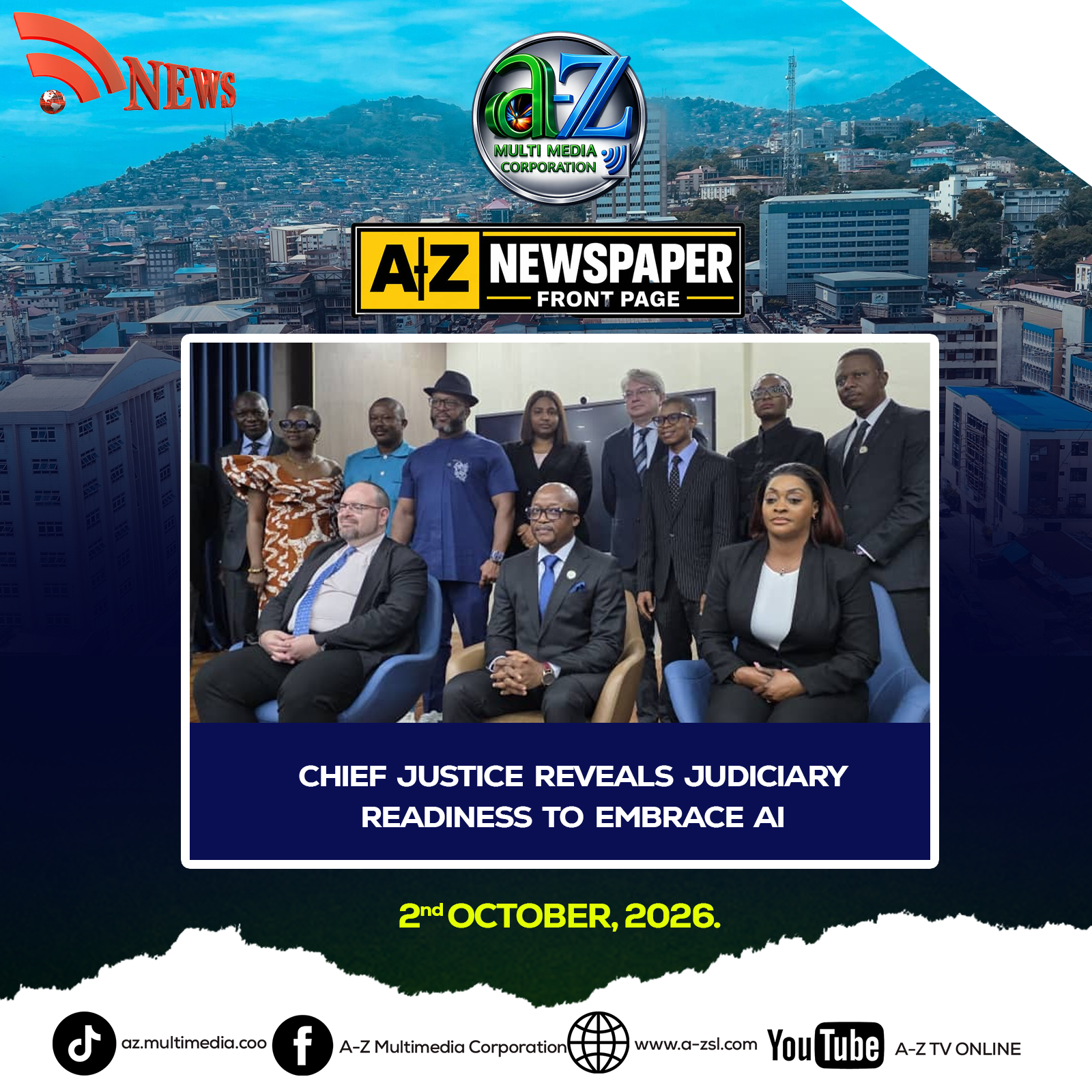
Sierra Leone’s Chief Justice, His Lordship Justice Komba Kamanda, has revealed the Judiciary’s readiness to embrace Artificial Intelligence (AI) and other technologies to improve access to justice and public information.
Justice Kamanda made the disclosure on Thursday, October 1, 2026, while delivering the keynote address at the commemoration of the International Day for Universal Access to Information at NaTCA Tower in Freetown.
Speaking on the theme, “AI, Justice and the Rule of Law,” the Chief Justice said AI is no longer a distant concept confined to laboratories and technology companies, but is increasingly becoming part of how governments communicate, institutions manage information and citizens access public services.
“It is increasingly becoming part of how governments communicate, how citizens access information, how institutions manage knowledge, and how justice institutions can improve the delivery of justice,” he said.
Justice Kamanda said the Judiciary has a fundamental responsibility to ensure that justice is not only done, but is also accessible, understandable and trusted by the people it serves.
He noted that AI tools are enabling judiciaries around the world to improve access to judgments and legal materials, support legal research, facilitate public access to court information, improve case management systems and make judicial services more accessible to citizens.
Reaffirming the Judiciary’s preparedness to embrace technological developments, Justice Kamanda said the institution must enter the future while remaining guided by its constitutional and institutional responsibilities.
He stressed the need for a justice system that is not only technologically enabled, but also open, accessible, transparent and human-centred, with the rule of law firmly at its core.
In his welcome address, the Chief Director and Professional Head of the Ministry of Communication, Technology and Innovation, Mohamed Moumini Jalloh, said AI is rapidly transforming the way governments operate, institutions manage information and citizens access public services.
For Sierra Leone, he said, the question is no longer whether AI is coming, but how the country prepares to harness it responsibly and inclusively in ways that deliver tangible benefits to citizens.
The Deputy Minister of Justice, Madam Saptieu E. Saccoh, affirmed her Ministry’s commitment to working collaboratively with relevant institutions to promote the responsible adoption and use of AI.
Meanwhile, UNESCO Director for Inclusion, Policies and Digital Transformation, Guilherme Canela, said UNESCO is focused on training and supporting justice sector professionals in the application of AI tools in courts and tribunals.
He said UNESCO has developed guidelines for the use of AI in courts and tribunals, which he described as the first globally oriented ethical and operational framework of its kind.
The event brought together stakeholders to discuss the opportunities and challenges associated with AI, particularly its implications for access to information, justice delivery and the rule of law.