

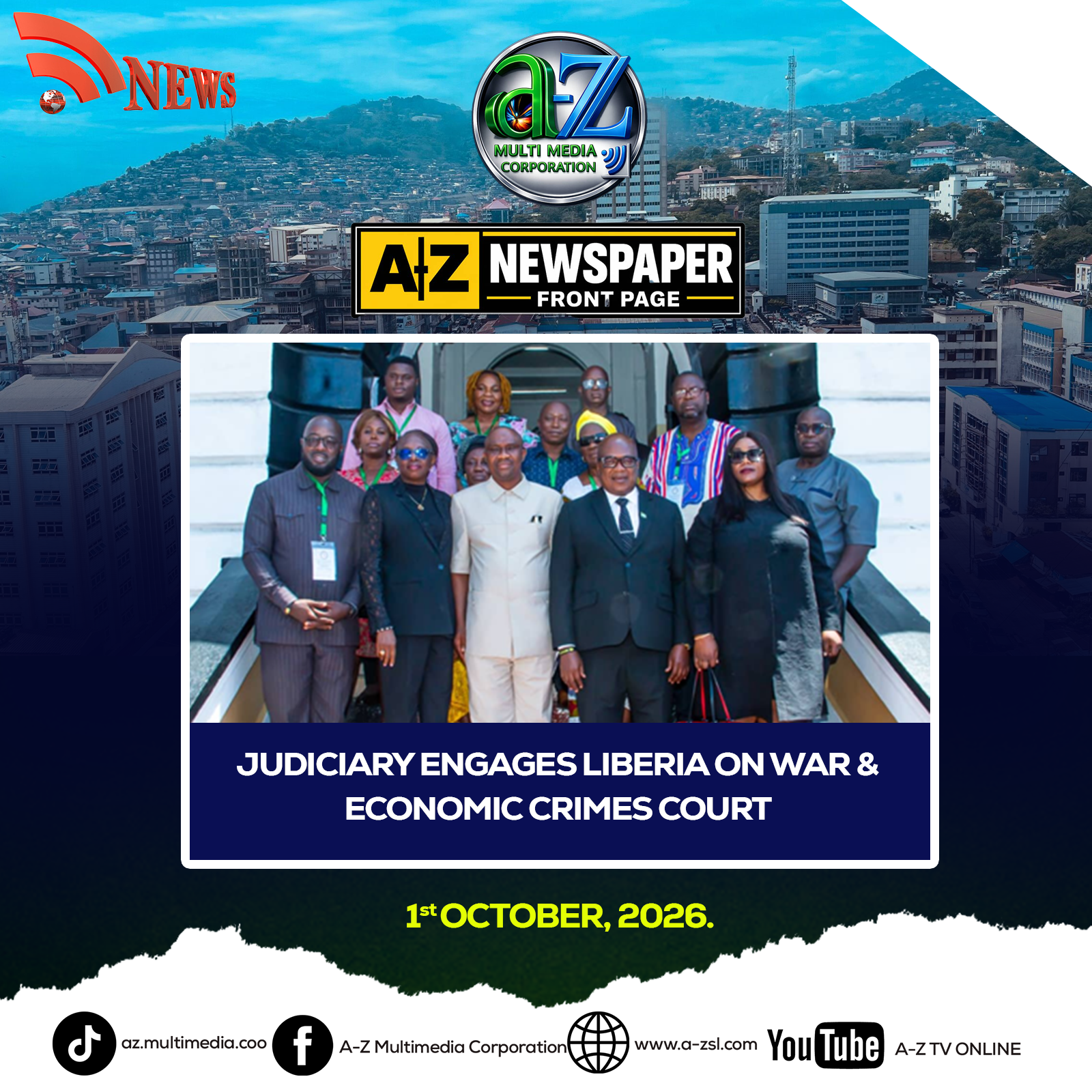
The Judiciary of Sierra Leone has engaged a Liberian delegation on the proposed establishment of a War and Economic Crimes Court in Liberia.
The engagement took place at the Chief Justice’s Chambers in Freetown on September 30, 2026, where Court of Appeal Judge, Justice Jamesina E.L. King, received the delegation on behalf of Chief Justice Komba Kamanda.
Justice King described the proposed court as a laudable initiative and assured the delegation that the Judiciary of Sierra Leone was prepared to share its expertise and experience with Liberia.
She, however, noted that justice is costly and requires adequate resources and commitment to successfully establish and operate such a court.
Sharing Sierra Leone’s experience, Justice King said Sierra Leone and Liberia share similar histories, having both experienced brutal civil wars.
She recalled that, following an agreement between the Government of Sierra Leone and the United Nations, the Special Court for Sierra Leone was established to prosecute persons who bore the greatest responsibility for atrocities committed during the country’s civil war.
According to her, the Special Court successfully prosecuted several accused persons, with a number of those indicted subsequently convicted. She added that some convicted persons continue to serve their sentences outside Sierra Leone due to security considerations associated with the trials.
Justice King noted that the Special Court for Sierra Leone was internationally driven and encouraged Liberia to consider an approach that is owned and led by Liberians.
She stressed that peace and justice must ultimately prevail.
On economic crimes, Justice King highlighted Sierra Leone’s efforts to strengthen the fight against corruption and other economic offences, citing the establishment of specialized courts, including the Anti-Corruption Court.
She explained that trained and experienced judges are assigned to hear cases brought by the Anti-Corruption Commission, adding that before the relevant legislation was enacted, corruption-related cases were filed through the Office of the Attorney-General.
According to Justice King, the establishment of specialized mechanisms has provided a more effective and efficient approach to addressing corruption-related offences.
Court of Appeal Judge Justice John Bosco Allieu also spoke on the importance of healing and accountability following conflict.
He said that although the war had ended, the lives lost and suffering caused by the atrocities could never be fully restored.
“Many people were maimed and disabled as a result of the war,” Justice Allieu said.
High Court Judge Justice Isata Susan Sellu Tucker encouraged the Liberian delegation to undertake a follow-up visit and engage other institutions to broaden its understanding and learn from their experiences.
Speaking on behalf of the Liberian delegation, Head of the Office of War Crimes Rev. Amnimadab K. John expressed appreciation for the engagement.
He said religious leaders in Liberia had come together to help pioneer the initiative and welcomed the opportunity to exchange knowledge and experiences with Sierra Leone.
The engagement forms part of efforts to strengthen regional cooperation and knowledge-sharing on transitional justice, accountability, and the prosecution of war and economic crimes.