

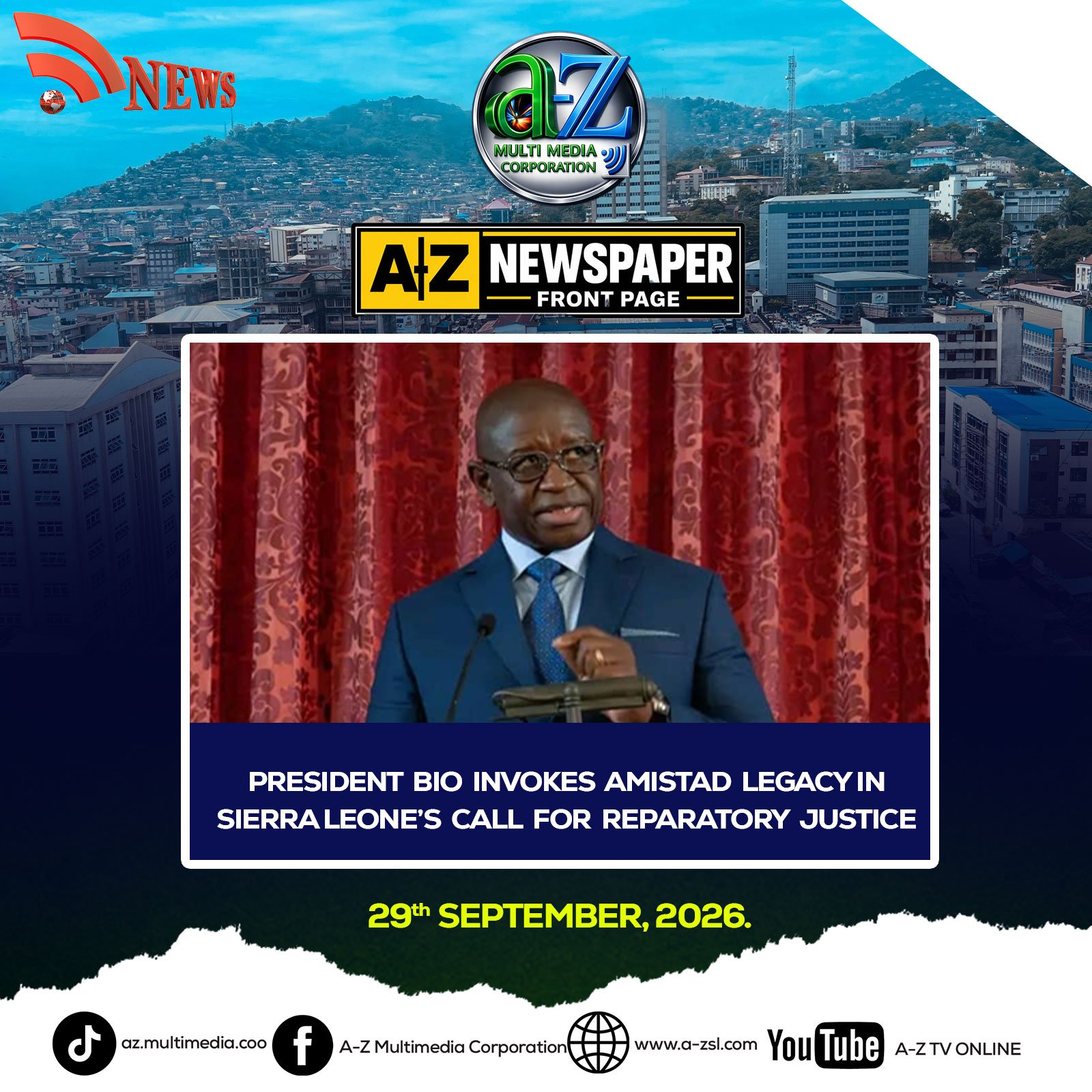
President Julius Maada Bio has invoked the historic Amistad story to renew Sierra Leone’s call for reparatory justice over the enduring consequences of enslavement and the transatlantic slave trade.
Speaking at the United First Parish Church in Quincy, Massachusetts, on Sunday, September 27, 2026, under the theme “Celebrating Courage: Honouring the Historic Link Between Quincy and Sierra Leone,” President Bio said the legacy of the Amistad must go beyond remembrance and serve as a call for responsibility, justice and reconciliation.
The President highlighted the story of Sengbe Pieh, known in the United States as Joseph Cinqué, and other Mende captives who were forcibly taken from Sierra Leone in 1839 and enslaved aboard the Spanish schooner La Amistad. Their resistance sparked a landmark legal battle in the United States, culminating in the Supreme Court’s 1841 decision affirming their freedom.
Former U.S. President John Quincy Adams played a prominent role in arguing the case before the Supreme Court.
President Bio said the Amistad story demonstrated two forms of courage: Sengbe Pieh’s resistance to injustice and Adams’ decision to confront the case through law, conscience and principle.
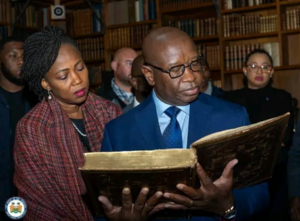
During his visit to Adams National Historical Park, President Bio also viewed the historic Mendi Bible preserved in the Stone Library. He described the Bible as a witness to history and a sacred link between Sierra Leone and the United States.
He said reparatory justice should not be viewed as an attempt to reopen old wounds, but as an effort to acknowledge historical truth, honour victims of injustice, address its lasting consequences and build a more equitable future.
President Bio connected Sengbe Pieh’s courage and resilience to Sierra Leone’s own experience of adversity, including the country’s eleven-year civil war, the Ebola outbreak, the 2017 mudslide and the COVID-19 pandemic.
He said Sierra Leone had repeatedly demonstrated its ability to recover and rebuild in the face of profound challenges.
The President stressed that sustainable national progress requires peace, strong institutions, quality education, justice and respect for human dignity.
He also called for greater efforts to educate children, tackle hunger and food insecurity, expand opportunities for women and girls, and ensure that Africans are empowered to shape their own future with dignity and agency.
President Bio further called for the historic relationship between Quincy and Sierra Leone to be strengthened around shared values of truth, justice, freedom, friendship and humanity.
He stressed that history should not simply be remembered, but should serve as a lesson for present and future generations, guiding societies towards greater justice, reconciliation and shared progress.