

By: Mohamed J. Bangura
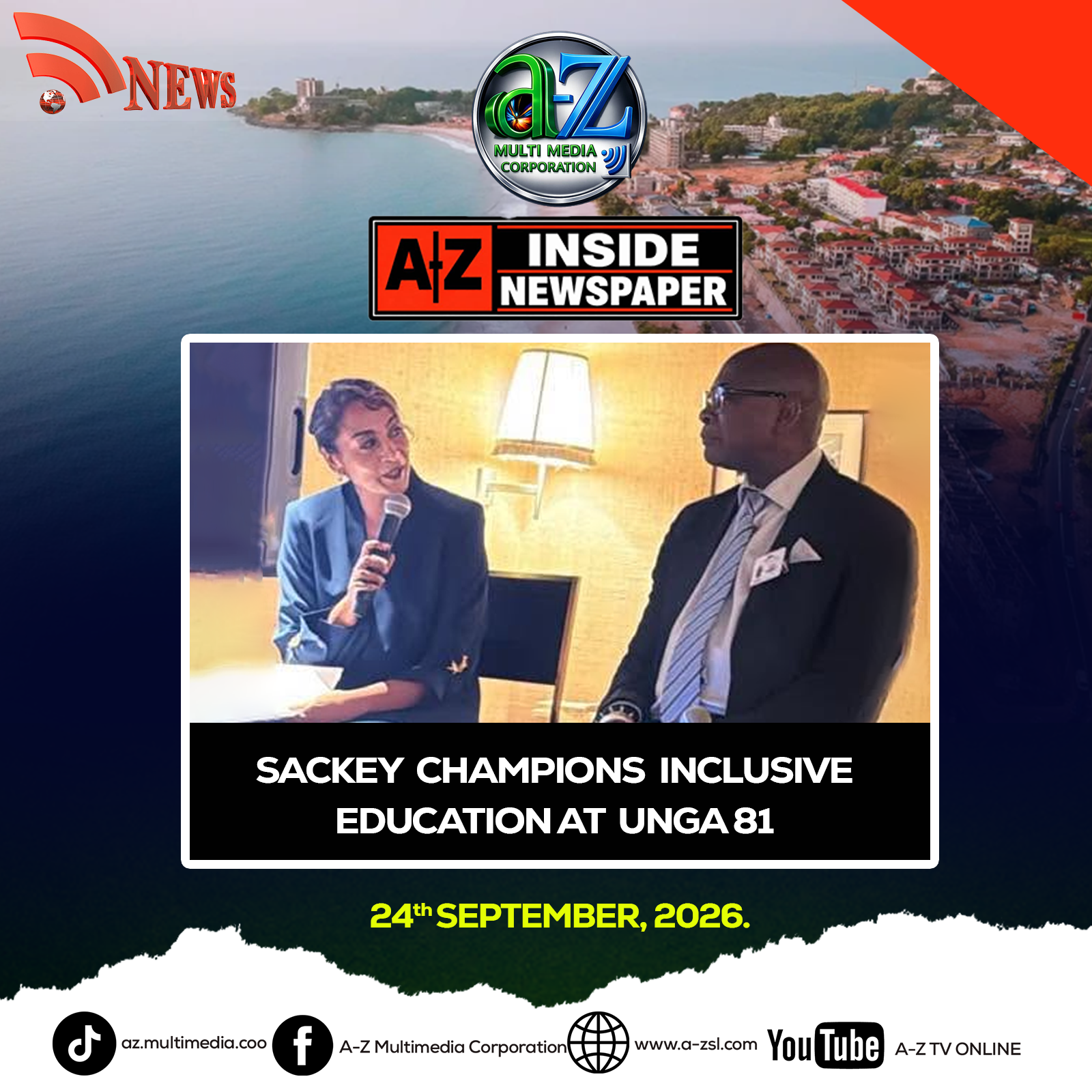
Sierra Leone’s Minister of Basic and Senior Secondary Education, Conrad Sackey, has highlighted the country’s efforts to promote inclusive education, stressing the need to ensure that every child, regardless of their circumstances, has the opportunity to access and complete their education.
Minister Sackey made the statement on Tuesday, September 22, 2026, while delivering the opening keynote at the Perkins Institute in New York, on the margins of the 81st United Nations General Assembly (UNGA 81).
Opening his keynote with the African proverb, “The pattern of the cloth is only complete when every thread is visible, not hidden beneath,” Minister Sackey used the metaphor to describe Sierra Leone’s efforts to identify and address barriers preventing children from fully participating in education.
He said the classroom where he delivered his keynote demonstrated the importance of designing learning environments around the needs of every learner.
According to the Minister, the classroom featured quiet spaces, interpreters, sensory tools, wheelchair access and seating designed to accommodate different learners from the outset, rather than being added later.
Minister Sackey recalled that Sierra Leone’s decision to make basic education free in 2018 opened access to education for thousands of children across the country.
However, he said the government later confronted a more difficult question: who was still being left out?
According to figures presented by the Minister, 36 percent of children from the poorest households were out of school, while only six in every 100 poor rural girls completed secondary education.
He also highlighted the former policy that prevented pregnant girls from attending school, saying such barriers demonstrated that making education free did not automatically make it accessible to everyone.
“That is when we understood: a free door is not the same as an open door,” Minister Sackey said.
He explained that in 2021, Sierra Leone adopted a more targeted approach to inclusion by identifying groups that had historically been underserved by the education system.
Among the measures he highlighted were the reversal of policies excluding pregnant girls from classrooms, the placement of Girls’ Champions in schools and the development of individual learning plans for children with disabilities.
The Minister acknowledged that significant challenges remain, particularly regarding infrastructure for learners with disabilities.
He said only about one in 10 of Sierra Leone’s approximately 11,000 schools currently has a wheelchair ramp.
“We did not wait for perfection. Only one in 10 of our 11,000 schools has a wheelchair ramp today. But we now know exactly who we are still failing. And that clarity is where reform begins,” he said.
Minister Sackey called on educators, parents and young people to view inclusion as a shared responsibility rather than an additional programme.
“Inclusion is not an add-on. It is not someone else’s problem. It is the test of whether any system actually works,” he said.
He said Sierra Leone was continuing to reshape its education system by paying greater attention to children who have historically faced barriers to education.
“We are learning to weave differently in Sierra Leone. We are counting every thread before we begin,” he said.
Concluding his keynote, Minister Sackey described the country’s education reform journey as an unfinished cloth that is gradually taking shape.
“The loom is still working. The cloth is still unfinished. But now, when I look at it, I see a truer pattern emerging,” he said.
“One where no child is woven in so deeply that they disappear.”
His address at the Perkins Institute placed Sierra Leone’s education reforms within the wider global discussion on accessibility, equity and inclusion, while highlighting the country’s efforts to ensure that every child has a place in the classroom.