

By: Mohamed Sahr
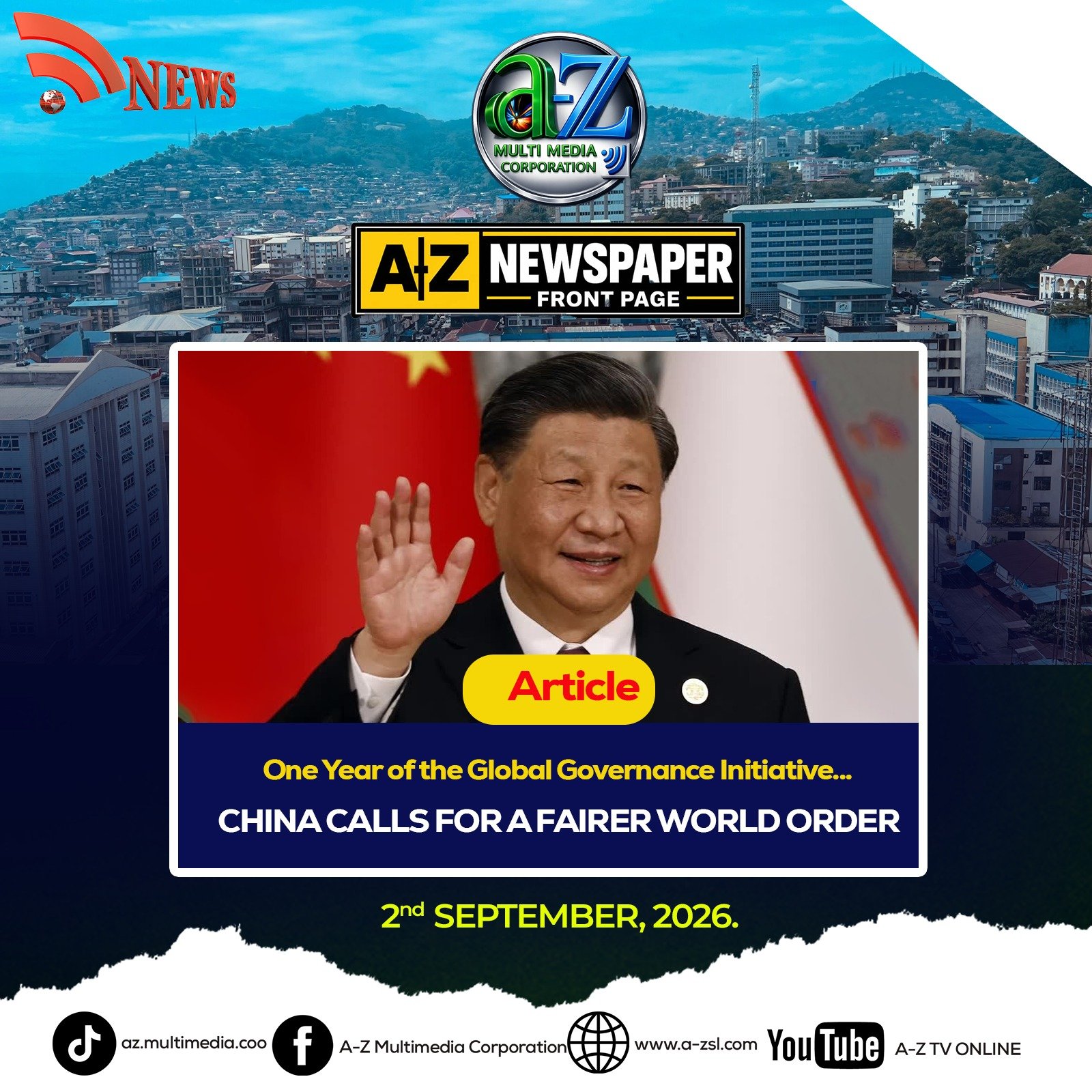
At a moment when the world is confronting growing geopolitical tensions, economic uncertainty, conflicts and widening development gaps, China put forward the Global Governance Initiative (GGI) with a simple but far-reaching proposition: ‘’The International System Must Become More Just, Inclusive and Equitable If It Is to Effectively Serve Humanity.’’
As the initiative marks its first anniversary, its significance goes beyond the policy document in which it was introduced. It speaks to a question that increasingly concerns governments, developing countries, international organizations and ordinary people alike: Can global governance continue to work effectively if large parts of the world feel that their voices are not being heard? China’s answer is that reform is both necessary and urgent.
The GGI emerged from China’s broader vision of building a community with a shared future for humanity. At its heart is the belief that countries are not isolated islands. They share the same planet, face many of the same challenges and, ultimately, cannot secure lasting prosperity and security by acting alone. The first year of the initiative has therefore been presented as a period of building international understanding around five central principles: sovereign equality, the international rule of law, multilateralism, a people-centered approach and real actions. These principles may sound diplomatic, but their implications are practical.
A Changing World Requires a Stronger System
The global environment has changed dramatically since the establishment of the United Nations more than eight decades ago. The UN was created from the devastation of World War II to provide countries with a platform for dialogue, cooperation and the peaceful settlement of disputes. Yet today’s world is far more complex.
Conflicts continue in different regions. Geopolitical rivalries are affecting trade and technology. Protectionism and unilateral sanctions are creating new barriers to economic cooperation. Climate change, food insecurity, cyber threats and the rapid development of artificial intelligence are producing challenges that no country can manage independently.
For developing nations, especially in Africa, these global pressures are not abstract diplomatic issues. They affect food prices, energy costs, investment, employment, access to technology and the ability of governments to provide basic services.
This is where the GGI seeks to make its strongest argument: global governance must respond to the realities of the world as it exists today, not simply preserve structures designed for another era. China argues that this does not require dismantling the existing international system. Rather, the task is to reform and improve it, while maintaining the central role of the United Nations.
Giving the Global South a Stronger Voice
Perhaps one of the most important dimensions of the GGI for developing countries is its emphasis on the Global South. Over the decades, Asia, Africa and Latin America have undergone profound political and economic transformations. Many countries that were once colonies are now independent states with growing populations, expanding economies and increasingly influential regional and international roles.
Yet political and economic influence has not always translated into proportional representation in global decision-making institutions. The GGI argues that this imbalance must change. For Africa, the message is particularly significant. African countries are increasingly seeking greater representation in global institutions and stronger participation in decisions affecting international finance, trade, climate change, technology, peace and security.
A fairer global governance system, therefore, should not simply ask developing countries to implement decisions made elsewhere. It should give them a meaningful opportunity to participate in shaping those decisions. This is the essence of sovereign equality: whether a country is large or small, rich or poor, developed or developing, its sovereignty and dignity deserve respect.
Multilateralism In an Increasingly Divided World
Another central message of the GGI is that multilateralism remains indispensable.
The world has witnessed growing geopolitical competition and the emergence of competing blocs. At the same time, economic interdependence has never been greater. A conflict in one region can affect food and energy prices thousands of kilometres away. A financial crisis can cross borders within hours. A cyberattack can originate in one country and cause disruption in another. Climate change respects no national boundary. These realities make cooperation unavoidable.
The GGI therefore calls for extensive consultation, joint contribution and shared benefits. In practical terms, this means that countries should seek solutions through dialogue rather than confrontation and should strengthen international institutions rather than weaken them.
The United Nations Remains at the Centre of This Vision
China has emphasized its role as a permanent member of the UN Security Council and highlighted its financial contributions, peacekeeping participation and support for UN-led international cooperation as part of its commitment to multilateralism.
The larger principle is clear: international institutions may have shortcomings, but abandoning cooperation altogether would leave the world with fewer tools to manage common problems.
Development Must Remain at The Centre
For much of the developing world, however, the most important test of any global governance model is whether it improves people’s lives. The GGI consequently places a people-centered approach at the heart of its philosophy. Peace and security matter, but so do jobs, food, education, healthcare, infrastructure, energy and access to technology.
This is particularly relevant to Africa, where young populations are demanding greater economic opportunities and where governments are working to close infrastructure and digital gaps. China points to initiatives such as the Belt and Road Initiative and the Global Development Initiative as examples of how international cooperation can be translated into infrastructure, trade, training, investment and capacity building. The figures highlighted in the white paper are substantial, including thousands of cooperation projects under the Global Development Initiative and training for tens of thousands of people in developing countries.
But the deeper lesson is that development cooperation must increasingly move beyond traditional donor-recipient relationships and toward partnerships that strengthen countries’ ability to develop sustainably and independently.
From Promises to Action
The fifth principle of the GGI real actions may ultimately be the most important. Global governance is often criticized for producing declarations, resolutions and commitments that do not always translate into results on the ground. The GGI recognizes that credibility depends on implementation.
For developing countries, this means that commitments relating to development financing, climate finance, technology transfer, food security and capacity building must become measurable outcomes. It also means that developing countries themselves have responsibilities. South-South cooperation, according to the initiative, should be strengthened so that countries of the Global South can share experience, technology, expertise and resources.
China’s own development experience is presented as part of this broader contribution. Through trade, infrastructure cooperation, education, vocational training, agriculture, digital development and people-to-people exchanges, China argues that its engagement with developing countries can contribute to a more interconnected global economy.
One year on, the journey is only beginning. The first anniversary of the Global Governance Initiative is therefore less a conclusion than a reminder of the work still ahead. A more just global governance system will not emerge overnight. It will require sustained dialogue, institutional reform, political courage and a willingness by major powers and smaller nations alike to recognize their shared responsibilities. It will also require the international community to confront difficult questions.
One year after its launch, China’s Global Governance Initiative is placing a strong emphasis on a world where countries consult rather than dictate, cooperate rather than isolate, and share the benefits of development rather than allow prosperity to remain concentrated in a few hands. For Africa and the wider Global South, the initiative also offers an opportunity to renew the call for a global system in which development, dignity and representation are not privileges, but rights.