

By: Aminata Sesay
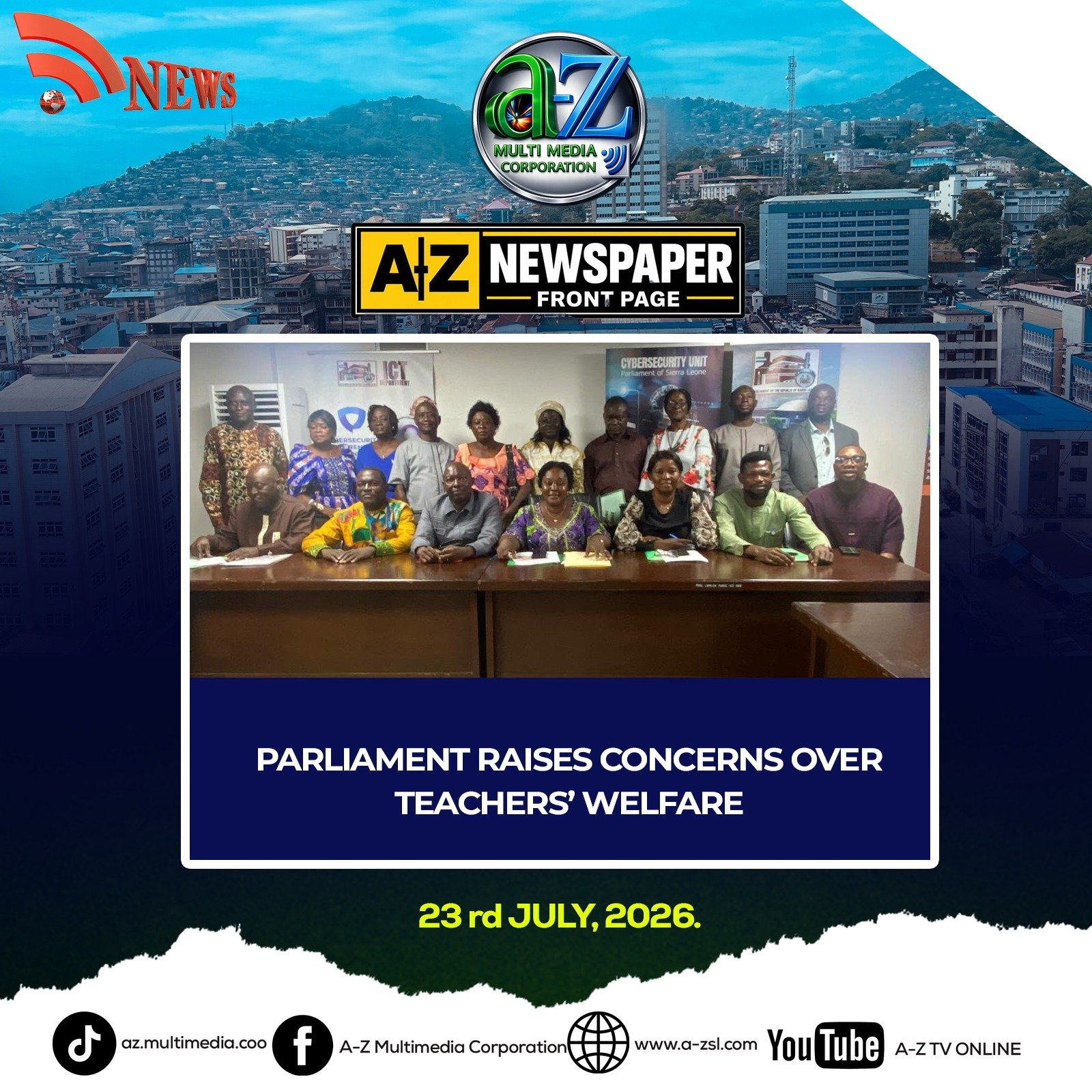
The Parliamentary Oversight Committee on Basic and Senior Secondary Education has expressed serious concerns over the declining welfare of teachers following an engagement with the leadership of the Sierra Leone Teachers Union (SLTU) during an oversight meeting held at Parliament.
The meeting, chaired by Hon. Rebecca Yei Kamara, was part of Parliament’s constitutional oversight responsibilities aimed at assessing the operations, achievements, challenges, and overall contribution of the SLTU to the education sector.
Opening the engagement, Hon. Kamara said the Committee sought a better understanding of the challenges affecting teachers and the policy interventions needed to improve education delivery nationwide. She encouraged open and constructive discussions to help Parliament address issues confronting the teaching profession.
Presenting on behalf of the SLTU, President Ibrahim Bankapoma Kargbo provided an overview of the union’s history, explaining that it was established in 1963 following the merger of three teachers’ unions, with its roots tracing back to the 1890s. He noted that the union currently operates through 100 branches across Sierra Leone’s 20 districts, with 611 elected officials responsible for overseeing its activities.
Kargbo outlined the union’s four-year strategic plan, which focuses on strengthening membership, improving communication, building institutional capacity, promoting professional development, and creating investment opportunities for teachers.
He highlighted SLTU’s advocacy efforts for improved salaries and conditions of service, teacher training, welfare support, legal and medical assistance, increased education financing, leadership development, and negotiated loan facilities for teachers.
However, the SLTU President painted a concerning picture of teachers’ welfare, describing current conditions of service as challenging. He disclosed that despite having more than three decades of teaching experience and advanced academic qualifications, his monthly salary remains Le2,500, while some qualified teachers earn as low as Le1,500.
He further cited delayed promotions, failure to implement approved salary scales for teachers with Master’s degrees, the absence of remote area allowances, overcrowded classrooms, inadequate teaching and learning materials, delays in transitioning volunteer teachers onto the government payroll, and unpaid school subsidies as some of the major challenges affecting the profession.
Committee members expressed concern that poor teacher welfare could negatively affect the quality of education and undermine the objectives of the Free Quality School Education Programme.
Hon. Rebecca Yei Kamara noted that inadequate remuneration, overcrowded classrooms, shortages of qualified teachers, and the increasing commercialization of education through private study camps pose serious challenges to improving learning outcomes. She called for stronger collaboration among the Ministry of Basic and Senior Secondary Education, the Teaching Service Commission, and the SLTU to address these issues.
Lawmakers also questioned the union on issues including examination malpractice, ghost teachers, duplicate pupil registrations, payroll irregularities, and the management of teachers’ financial contributions, emphasizing the need for greater transparency and accountability within the education sector.
Responding to concerns about alleged corruption, Kargbo rejected such claims against the union, stating that the SLTU operates within a strong governance framework supported by annual budgets, internal and external audits, strategic planning, and oversight from its National Executive Committee.
He reaffirmed the union’s commitment to dialogue rather than industrial action in pursuing improved welfare for teachers. While acknowledging examination malpractice as a serious challenge, he argued that poor working conditions contribute to unethical practices and pledged the union’s continued support for disciplinary measures through the Teaching Service Commission.
On concerns regarding ghost teachers and duplicate pupil registrations, Kargbo said the union supports government verification exercises but noted that such matters largely fall outside the SLTU’s direct mandate.
Closing the meeting, Hon. Kamara thanked the SLTU leadership for its presentation and assured members that Parliament would continue engaging relevant stakeholders, including the Ministry of Basic and Senior Secondary Education and the Teaching Service Commission, to develop practical and sustainable solutions to challenges facing teachers.
She reaffirmed Parliament’s commitment to strengthening oversight, improving service delivery, and supporting reforms aimed at enhancing the quality of education in Sierra Leone.