

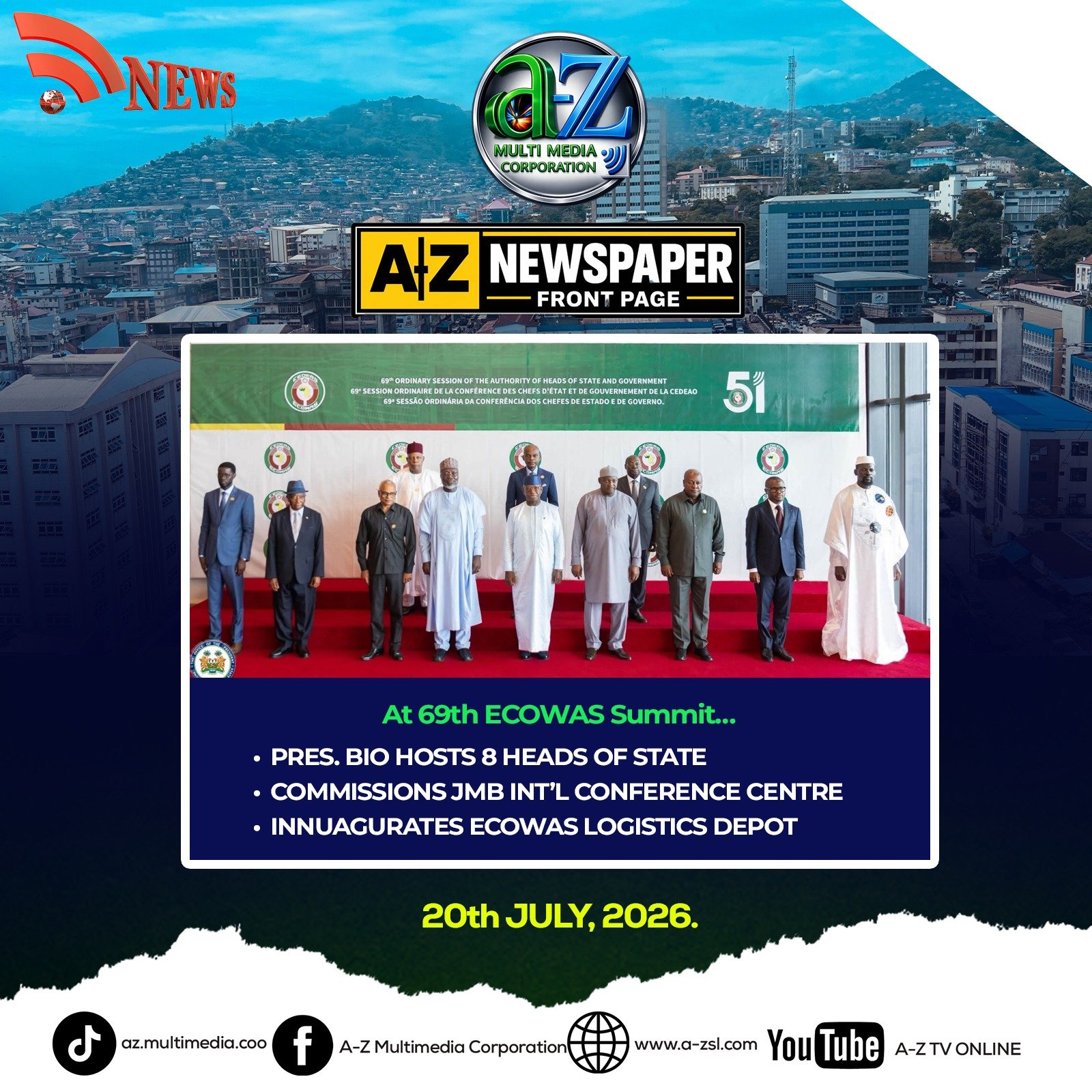
- Bio Hosts 8 Heads of State
- Commissions JMB Int’l Conference Centre
- Inaugurates ECOWAS Logistics Depot
By Saidu Jalloh
President Julius Maada Bio has hosted eight Heads of State at the 69th Ordinary Session of the ECOWAS Authority of Heads of State and Government in Lungi, where leaders renewed calls for deeper regional integration, stronger democratic governance, institutional reforms, and increased investment in science and technology to address West Africa’s growing political, economic, and security challenges.
Speaking in his capacity as Chairman of the ECOWAS Authority of Heads of State and Government, President Bio thanked member states for their continued commitment to the regional bloc, noting that ECOWAS, established 51 years ago, has remained a key institution for promoting peace, democracy, regional integration, and shared prosperity across West Africa.
President Bio described the current global environment as one of rapid transformation, highlighting the impact of technological advancement, artificial intelligence, climate change, energy transitions, geopolitical tensions, food insecurity, and environmental challenges on the region’s future. ‘’I am chairing the Summit of the Future and the 69th Ordinary Session of the ECOWAS Authority of Heads of State and Governments at the newly inaugurated Julius Maada Bio International Conference Centre in Lungi. I anticipate decisive and productive discussions,’’ President Bio said.
He stressed that no country could effectively address these challenges alone, urging member states to strengthen collective action, regional solidarity, and cooperation.
“We are not alone,” President Bio declared, emphasizing that coordinated regional responses are essential to tackling emerging threats.
The ECOWAS Chairman outlined his vision of a peaceful, secure, democratic, and prosperous West Africa built on good governance, innovation, and the creativity of its people. He described regional integration as a strategic necessity that would increase the region’s global influence, strengthen its credibility, and accelerate sustainable development.
President Bio also called for greater investment in education, science, technology, and innovation, noting that human capital development remains critical to achieving long-term progress.
“Our vision for the future must rest on a secure foundation based on security, community, prosperity, integration, and development,” he said.
He further warned about the rising threats of cybercrime, organised crime, and other forms of transnational insecurity, calling for stronger collaboration among ECOWAS member states to protect the region’s future.
Addressing the summit, Ghanaian President John Dramani Mahama supported the call for unity and urged ECOWAS leaders to maintain dialogue with all countries in the sub-region, including members of the Alliance of Sahel States (AES).
“We must therefore continue to preserve channels of dialogue among all the countries of our subregion, including the AES states. Geography has made us neighbors, history has made us partners, and our future requires that we remain one West African family,” President Mahama stated.
He stressed that differences among countries should not weaken the region’s shared commitment to peace, cooperation, and sustainable development.
President Mahama also emphasized the need for increased investment in science, technology, digital transformation, innovation, and artificial intelligence, describing these sectors as critical drivers of modern economies, education, e-commerce, and industrial development.
He called for comprehensive reforms within ECOWAS institutions to improve efficiency and service delivery, while stressing the importance of involving young people, women, and future generations in shaping the region’s future.
The Ghanaian President further argued that democracy must provide meaningful improvements in the lives of citizens beyond elections.
“Our citizens are tired of only being called upon to vote every four or five years. They want to see the real benefits of democracy, and it is our responsibility as leaders to make that happen,” he said.
He noted that ECOWAS’ future should be built not only through diplomatic meetings but also through investments in schools, farms, factories, research institutions, innovation centres, marketplaces, and local communities.
While acknowledging the progress achieved over the past five decades through ECOWAS treaties, protocols, and policy frameworks, President Mahama urged member states to focus on effective implementation of existing commitments.
He also noted that the appointment of a new ECOWAS Commission President, Vice President, and Commissioners comes at a critical moment for the Community, urging the incoming leadership to deepen integration, rebuild public confidence, and address the region’s political, economic, and security challenges.
Addressing recent attacks against African nationals in North Africa, President Mahama welcomed the Authority’s endorsement of Ghana’s request for the African Union to consider the matter at its next summit. He warned that Africa’s tradition of solidarity must not be weakened by intolerance and discrimination.
The Ghanaian leader concluded by commending the outgoing leadership of the ECOWAS Commission for their dedication, professionalism, and service to the regional organization.
The 69th ECOWAS Summit brought together Heads of State and Government from across West Africa to deliberate on regional peace and security, economic integration, institutional reforms, and the future direction of the Community.
PRESIDENT BIO COMMISSIONS JMB INT’L CONFERENCE CENTRE & ECOWAS LOGISTICS DEPOT
His Excellency President Julius Maada Bio on Saturday 18th July 2026 officially commissioned the Julius Maada Bio International Conference Centre and the ECOWAS Logistics Depot in Lungi, describing the two landmark facilities as strategic investments that will promote regional integration, peace, diplomacy, security and economic development across West Africa.
The commissioning ceremony, held ahead of the 69th Ordinary Session of the ECOWAS Authority of Heads of State and Government, brought together Heads of State and Government from across the region, senior United Nations officials, the President of the ECOWAS Commission, ministers, diplomats, security chiefs, development partners and other distinguished guests.
In his welcome address, Sierra Leone’s Vice President, Dr. Mohamed Juldeh Jalloh, described the country’s transformation from civil war and international isolation to regional leadership and increasing global recognition as a reflection of what he called “Sierra Leonean Exceptionalism.”
Dr. Jalloh said the commissioning of the two facilities represented a defining moment in Sierra Leone’s development journey, reflecting the resilience, courage and determination of its people.
He noted that the projects were more than physical structures, describing them as symbols of visionary leadership, national renewal and Sierra Leone’s commitment to regional integration and African-led solutions.
The Vice President highlighted Sierra Leone’s role as Chair of the ECOWAS Authority of Heads of State and Government, as well as its growing influence in regional and international affairs, saying the country has emerged as a respected voice in promoting peace, democracy and sustainable development.
According to Dr. Jalloh, the conference centre and logistics depot represent investments not only in infrastructure but also in diplomacy, security, economic growth and the shared future of West Africa.
Officially commissioning the facilities, President Bio said the projects demonstrate the shared commitment of Sierra Leone and the Economic Community of West African States (ECOWAS) to building stronger institutions that advance peace, security, regional cooperation and sustainable development.
“It is a profound honour and privilege, on behalf of the Government and people of Sierra Leone, to welcome you to the official commissioning of the Julius Maada Bio International Conference Centre and the ECOWAS Logistics Depot,” President Bio stated.
He explained that although the two facilities have different ownership structures and purposes, they are connected by a common vision: “a stronger Sierra Leone serving a stronger West Africa.”
Speaking on the conference centre, President Bio described it as a strategic national investment aimed at positioning Sierra Leone as a preferred destination for regional and international conferences, diplomatic engagements, exhibitions and investment forums.
He said the country, once largely associated with post-war recovery, is now increasingly recognized for democratic governance, peacebuilding, regional leadership and economic transformation.
The President noted that the conference centre would provide a platform for governments, development partners, investors, academics and entrepreneurs to discuss issues affecting millions of people across the region while promoting investment and economic cooperation.
He added that hosting major international events would create jobs, boost tourism and generate business opportunities for hotels, restaurants, transport operators and small businesses, particularly in Lungi and surrounding communities.
“This facility is not merely about architecture,” President Bio emphasized. “Its true value will be measured by the partnerships it builds, the investments it attracts, the opportunities it creates and the contribution it makes to the prosperity of Sierra Leone and West Africa.”
Turning to the ECOWAS Logistics Depot, President Bio described the facility as a strategic regional asset that reflects ECOWAS’ confidence in Sierra Leone’s stability, strategic location and commitment to peace and security.
He explained that the depot was established to strengthen ECOWAS’ operational readiness for peace support operations, humanitarian interventions and emergency response missions across West Africa.
The facility includes an administrative and maintenance complex for logistics planning, equipment management and mission support, as well as a modern training and residential complex for military, police, civilian and humanitarian personnel from ECOWAS member states.
President Bio said the depot would enable personnel from across the region to train together, exchange knowledge and strengthen their ability to respond effectively to emerging security challenges and humanitarian crises.
He stressed that the two facilities represent a single vision: while the conference centre provides a platform for dialogue, diplomacy and policymaking, the logistics depot provides ECOWAS with the operational capacity to implement those decisions.
“Peace and development are inseparable,” President Bio said. “Without peace, investment cannot thrive; without security, prosperity cannot flourish; and without strong institutions, regional integration cannot succeed.”
The President said the two projects symbolize confidence over conflict, partnership over isolation, preparedness over complacency and progress over stagnation, reaffirming Sierra Leone’s growing role in regional diplomacy, peacebuilding and economic cooperation.
He commended the ECOWAS Commission, the Government of Sierra Leone, private sector partners, contractors, consultants and technical teams for successfully delivering the projects.
President Bio concluded by expressing confidence that the Julius Maada Bio International Conference Centre and the ECOWAS Logistics Depot would strengthen regional cooperation, attract investment and serve as lasting symbols of Sierra Leone’s contribution to peace and development in West Africa.