

By: Mohamed Sahr
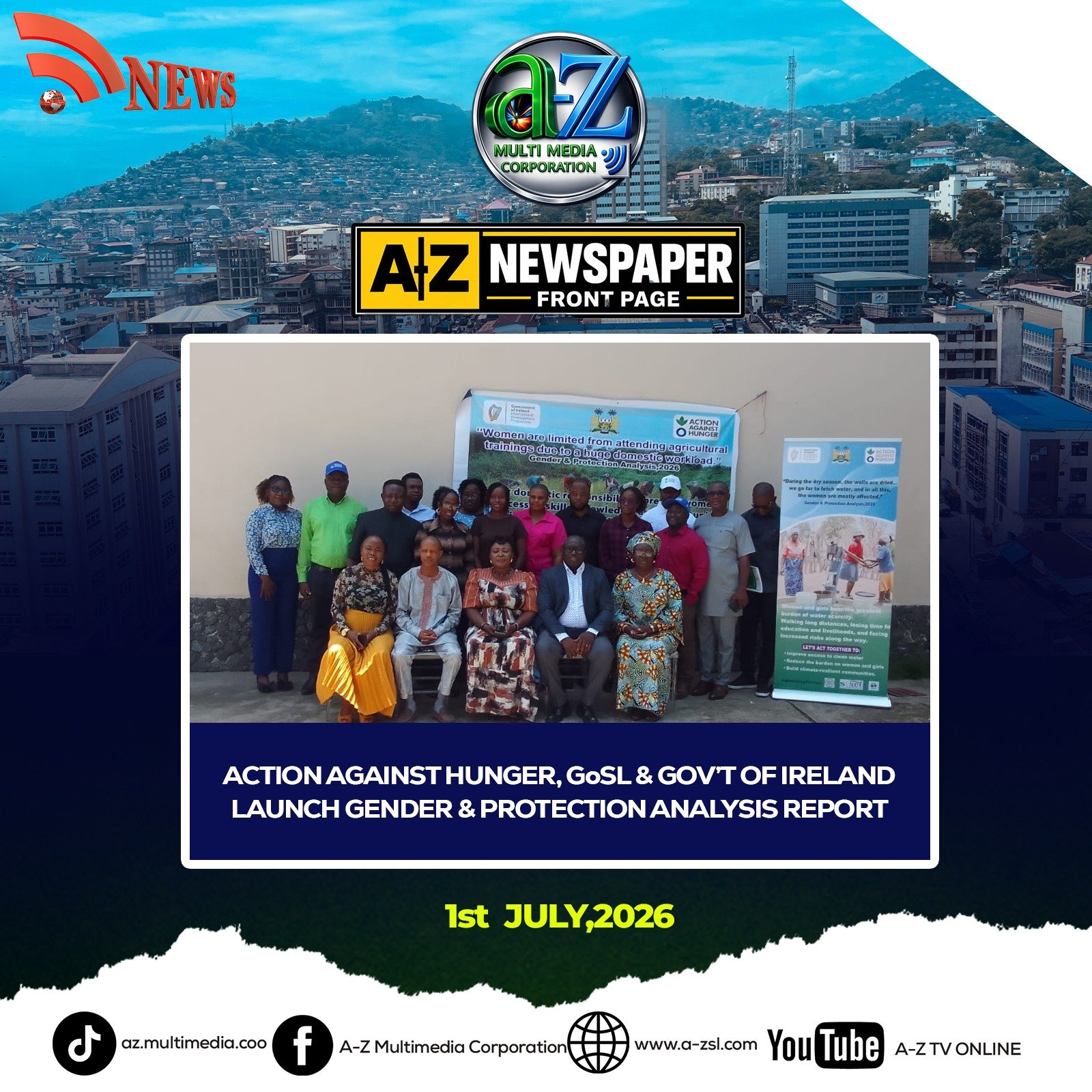
Action Against Hunger in collaboration of Government of Sierra Leone and the Government of Ireland officially launched the Gender and Protection Analysis (GPA) Report to guide the implementation of the Nutrition-Sensitive Climate Change Adaptation and Mitigation Programme (NuCAMPS) on Tuesday 30 June 2026 at Family Kingdom, with a strong focus on addressing gender inequality, protection risks and climate resilience.
Delivering the keynote address, Charles Vandi, Chief Director of Protection at the Ministry of Gender and Children’s Affairs said the report’s central finding is that gender inequality in Sierra Leone is structural rather than incidental.
“The central conclusion of this analysis is clear: gender inequality is not incidental; it is structural. Across our districts, women carry the heaviest burdens. They are the backbone of agriculture planting, weeding, harvesting, processing and trading. They manage households by cooking, fetching water, caring for children and maintaining homes. They are the silent engines of survival. Yet, despite this immense contribution, they remain excluded from land ownership, access to credit, training and decision-making,” he said.
Vandi explained that girls are socialized into unequal systems from childhood, limiting their educational opportunities and prospects.
“The division of labour is not complementary; it is unequal. It is sustained by entrenched social norms, intensified by economic hardship and worsened by climate stress. This inequality is the soil from which protection risks grow. Unless we address it, every programme and intervention will be built on fragile foundations,” he stated.
Vandi said the report revealed alarming levels of gender-based violence across the three districts covered by the study. “The findings reveal protection concerns of grave magnitude. Physical violence against women exceeds 48 percent across the districts, with Moyamba recording 57.6 percent. Sexual violence is highest in Falaba at 21.2 percent,” he disclosed.
He noted that women and girls continue to experience domestic violence, sexual coercion, harassment in markets and on farms, and exploitation during economic transactions. “These figures are unacceptable, and we need to strengthen our multisectoral response through improved coordination and effective case management to address this menace,” he emphasized.
According to him, these are not isolated incidents but predictable consequences of unequal power relations that deny women control over resources, mobility and decision-making.
He further noted that the absence of a safe shelter for survivors of gender-based violence in Bonthe District represents a significant gap in the country’s protection system. “Across all districts, gender-based violence is both a cause and a consequence of vulnerability. It restricts participation, erodes well-being and perpetuates cycles of poverty and exclusion. Protection is not peripheral; it is central to development, justice and peace. The protection of women and children is not optional. It is the measure of our nation’s humanity,” he said.
He described VSLAs as trusted financial mechanisms that reduce dependency, increase women’s economic agency and strengthen solidarity.
However, he cautioned that resilience remains fragile because it is built on unequal foundations. “Persons with disabilities remain excluded, while elderly women and female-headed households are often left behind. Resilience that excludes the most marginalized is partial and precarious. We must deliberately expand inclusion and ensure that coping mechanisms become platforms for empowerment rather than reflections of inequality,” he said.
The Chief Director revealed that the report shows significant inequalities in access to productive resources and essential services.
According to the findings, land ownership favours men by a ratio of seven to one, while female literacy in Falaba is as low as 19.7 percent, limiting women’s access to training and information.
More than 80 percent of women reported serious barriers to healthcare, while food insecurity ranges between 66 and 71 percent, despite women bearing primary responsibility for household food production and nutrition.
“These figures are not abstract. They represent barriers that undermine nutrition, health and livelihoods. They remind us that development without equity is not development at all,” he stressed.
Vandi said climate stress continues to intensify across the districts through irregular rainfall, prolonged dry seasons, flooding and extreme heat, threatening agricultural productivity and food security.
He observed that women face greater exposure because they perform many of the activities disrupted by climate shocks while receiving less information and fewer resources to adapt.
“Yet women are already the primary practitioners of climate-smart agriculture through intercropping, mulching, crop rotation and tree planting, often without formal support or recognition. Women are not merely victims of climate change; they are agents of resilience. Our programmes must recognize and build upon this knowledge,” he added.
Sulaiman Sowe, Senior Programme Advisor for Nutrition and Food Security at the Embassy of Ireland in Sierra Leone reaffirmed Ireland’s commitment to supporting Sierra Leone’s agriculture, health, nutrition and social protection sectors.
He said the current country support programme runs until 2029 and is now in its second year of implementation through a consortium of four partners, including Action Against Hunger and the Conservation Society of Sierra Leone.
Sowe also highlighted additional European Union-funded initiatives that support nutrition, social protection and climate resilience through the installation of agro-meteorological stations.
“We remain fully committed to supporting these programmes through to completion. These interventions contribute directly to national priorities and the implementation of the National Development Plan. Although considerable progress has been made toward achieving Zero Hunger and reducing malnutrition, there is still more work to be done. We will continue working with the Government and our partners to address malnutrition, food insecurity, environmental challenges and climate-related disasters while promoting sustainable adaptation strategies that improve the lives of communities across Sierra Leone,” he said.
Hon. Catherine Zainab Tarawaly, Deputy Opposition Whip and Chairperson of Parliament’s Gender and Children’s Affairs Committee, , described the report as timely and important.
She said the findings reinforce the need for stronger collaboration among Parliament, civil society organizations, development partners and the Ministry of Gender.
“We have made significant progress in legislation, including laws addressing child marriage and the Land Rights Act 2022. However, the real challenge lies in implementation and public awareness. Many people still do not know these laws exist. Passing legislation alone is not enough; we must ensure that citizens understand their rights and are able to benefit from these legal protections,” she said.
Tarawaly reaffirmed the Government’s commitment to advancing gender equality, women’s participation and inclusion, adding that the increasing number of women in leadership positions demonstrates that women can lead and deliver results at every level.
Samuel Byrne, Project Consultant explained that the Gender and Protection Analysis was conducted across Bonthe, Falaba and Moyamba districts to inform the implementation of NuCAMPS by Action Against Hunger Sierra Leone.
The study examined how gender inequalities, protection risks and structural barriers affect communities’ access to services, livelihood opportunities and climate adaptation.
Using primarily qualitative research methods, the study collected data through focus group discussions with women, men, adolescents, youth and persons with disabilities, as well as key informant interviews with district authorities, traditional leaders and civil society organizations. These findings were complemented by secondary data from the 2019 Sierra Leone Demographic and Health Survey (DHS) and the World Food Programme (WFP).
The report concludes that women continue to bear disproportionate productive and reproductive responsibilities while remaining excluded from ownership of productive resources and decision-making. It recommends integrating gender equality, disability inclusion, safeguarding and gender-based violence risk mitigation into every stage of programme planning and implementation to ensure that climate resilience interventions are safe, equitable and effective for all members of society.