

By: Aminata Sesay
The Parliamentary Committee on Local Government and Community Affairs has called on the Local Government Service Commission (LGSC) to take urgent measures to strengthen human resource management, improve accountability, and enhance service delivery across Sierra Leone’s Local Councils.
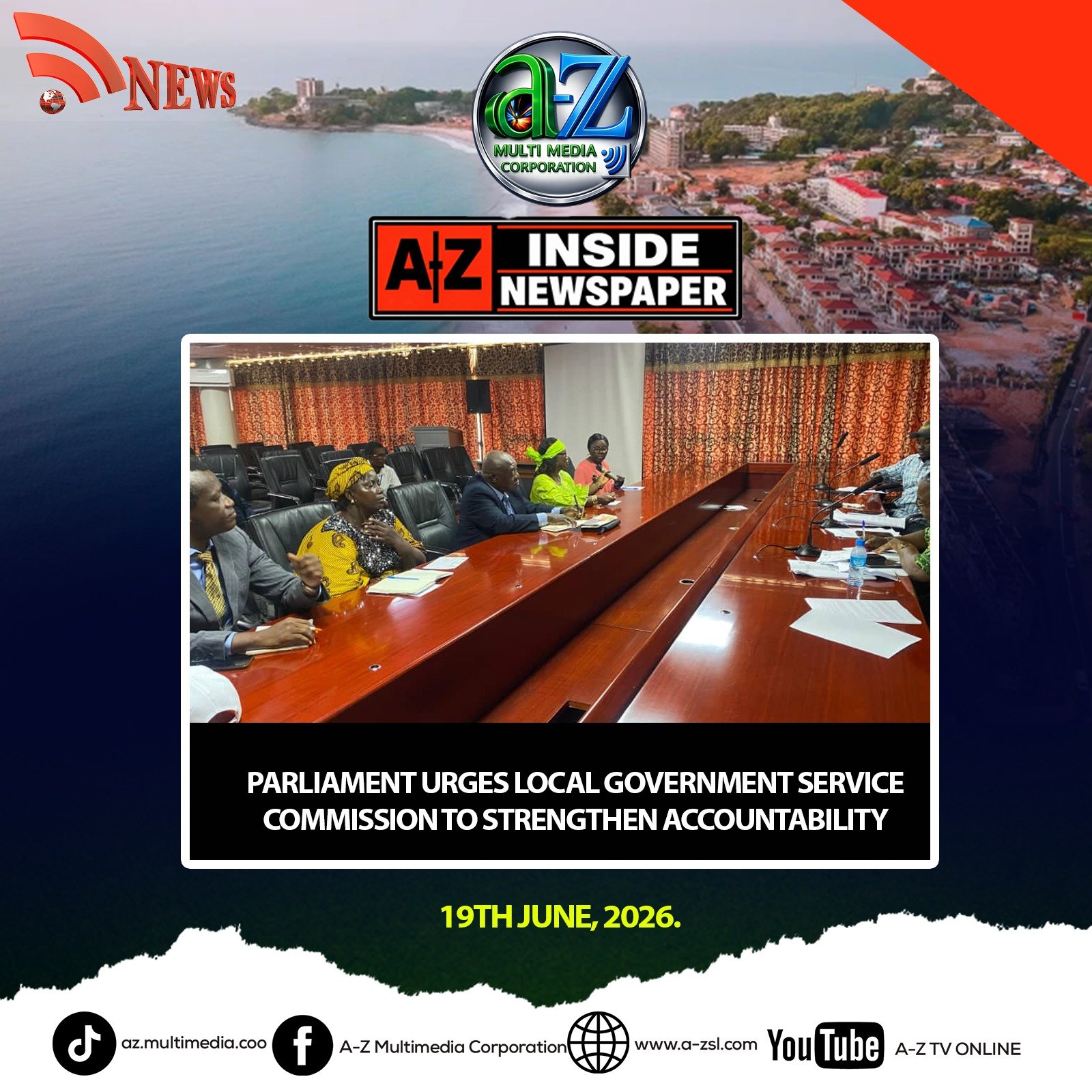
The call was made during an engagement between the Committee and the Chairman, Commissioners, and Executive Secretary of the LGSC on Thursday, 18 June 2026, at Committee Room One, Parliament Building, Tower Hill, Freetown.
The meeting formed part of Parliament’s constitutional oversight responsibilities aimed at assessing the Commission’s performance, reviewing the implementation of its mandate, and identifying challenges affecting effective local governance.
Chairman of the Committee, Hon. Peter Yaba Koroma, welcomed the delegation and underscored the importance of parliamentary oversight in promoting accountability and good governance.
He reminded the Commission that cooperation with Parliament is essential and noted that failure to comply with parliamentary oversight responsibilities could constitute contempt of Parliament under the Constitution.
Hon. Koroma also acknowledged the recent reconstitution of the Commission following a prolonged period without a substantive Chairman and expressed appreciation to the leadership for appearing before the Committee.
Presenting the Commission’s mandate, Chairman of the Local Government Service Commission, Dr. Falla D. Lamin, explained that the institution’s responsibilities are guided by the Local Government Act, 2022.
He outlined four key priority areas for the Commission: the development of a comprehensive Human Resource Policy for Local Councils, the implementation of the Integrated Performance Appraisal System (IPAS), the improvement of service delivery standards, and the monitoring of compliance with established regulations.
Dr. Lamin acknowledged that the Commission had not fully achieved its mission and vision due to several institutional challenges, including the absence of a substantive Chairman for nearly two years.
However, he assured the Committee that the newly constituted Commission remains committed to strengthening local governance structures and improving service delivery nationwide.
The Commission’s Executive Secretary, Abdul R. Conteh, informed Members of Parliament that the institution had benefited from support under the World Bank-funded Accountable Governance for Basic Service Delivery Project.
According to him, the support enabled the Commission to conduct a capacity needs assessment, undertake a management and functional review through the Public Sector Reform Unit (PSRU), carry out recruitment exercises for Local Council staff, provide initial training on IPAS, and develop recommendations for institutional reforms.
Mr. Conteh clarified that the report submitted to Parliament reflected activities undertaken during the reporting period and did not encompass the full scope of the Commission’s statutory responsibilities.
Members of the Committee, however, expressed concern over what they described as limited progress by the Commission despite the broad powers granted to it under the Local Government Act.
Hon. Momoud Kamara questioned whether sufficient progress had been made toward achieving the Commission’s mandate and called for a more proactive approach to addressing challenges facing Local Councils.
Leader of Government Business II, Hon. Emerson Lamina, provided extensive guidance to the Commission, urging it to prioritize the development and implementation of a comprehensive Human Resource Policy for Local Councils.
He also called for the standardization of performance appraisal systems to ensure that promotions, transfers, and disciplinary actions are based on merit and performance.
Hon. Lamina further encouraged the Commission to strengthen monitoring mechanisms, conduct regular field inspections across the country’s 22 Local Councils, revive the Local Governance Performance Assessment System, and pursue reforms aimed at enhancing fiscal decentralization.
He emphasized the importance of strengthening internally generated revenue systems within Local Councils, particularly property tax collection, while encouraging the Commission to engage development partners and diplomatic missions for technical and financial support.
The Government Business Leader also highlighted the need to improve welfare packages and retirement benefits for former Mayors and Council Chairpersons.
He urged Commissioners to exercise their statutory independence responsibly and maintain professionalism, integrity, and impartiality in carrying out their duties.
Committee Members also raised concerns regarding staff attitudes, absenteeism, poor responsiveness to citizens, and weak administrative accountability within some Local Councils.
They stressed that effective performance management systems should address these challenges and contribute to improved public service delivery.
At the conclusion of the engagement, the Committee observed that the Local Government Service Commission remains a critical institution within Sierra Leone’s decentralization framework but requires stronger institutional support and enhanced collaboration with Parliament, the Ministry of Local Government, Local Councils, and development partners.
The Committee recommended that the Commission develop and implement a comprehensive Human Resource Policy, fully operationalize the Integrated Performance Appraisal System, strengthen monitoring and compliance through regular inspections, and establish measurable performance indicators to track performance and service delivery outcomes.
It further urged the Commission to improve coordination with Local Councils, mobilize support from development partners, advocate for fiscal decentralization reforms, and submit periodic progress reports to Parliament.
The Committee concluded by reaffirming its commitment to supporting the Local Government Service Commission in fulfilling its statutory mandate and strengthening local governance and decentralization across Sierra Leone.