

By: Audrey Raymonda John
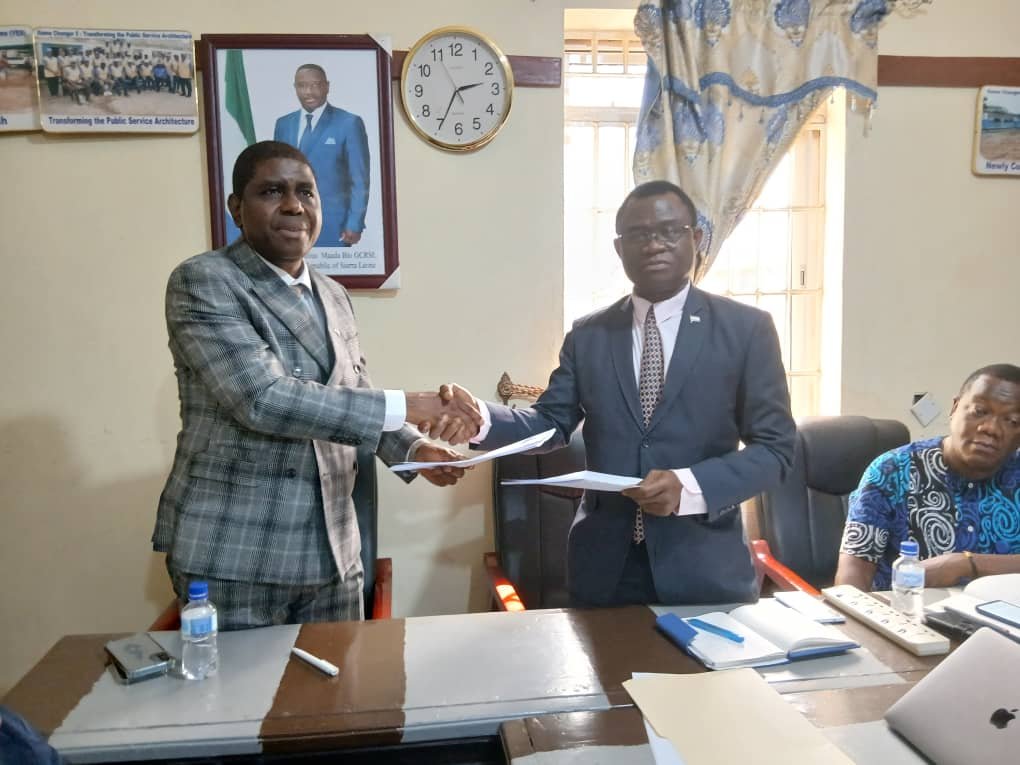
The Right to Access Information Commission (RAIC) and the National Monitoring and Evaluation Agency (NaMEA) have signed a Memorandum of Understanding (MoU) to promote and enforce transparency and accountability across public institutions. The signing took place on Thursday, 22nd January 2026, at NaMEA’s headquarters in Freetown.
Speaking during the ceremony, Dr. Ibrahim Seaga Shaw, Chairman and Information Commissioner of RAIC, highlighted the complementary mandates of both institutions. While NaMEA focuses on monitoring and evaluating programs and projects of public institutions, RAIC facilitates access to the information these institutions hold.
“Our mandates are different, but they share a common goal: ensuring transparency and accountability in public institutions. NaMEA and other public accountability bodies cannot effectively monitor and evaluate institutions without credible data or information. This is where RAIC’s mandate becomes essential,” Dr. Seaga Shaw said. He added that the MoU would foster sustained collaboration between the two institutions to enhance good governance, best practices, and overall national development.
Dr. Shaw emphasized that access to information is critical for empowering citizens to make informed decisions and hold institutions accountable. “The people should benefit from public funds. Value for money is essential. Access to information allows citizens to actively participate in public programs and provide data-informed feedback,” he noted.
He also urged public authorities to maintain functional and regularly updated websites, social media, and other platforms for proactive disclosure. Public authorities are also required to respond promptly and adequately to information requests, as mandated under the Right to Access Information Act 2013. Dr. Shaw encouraged public institutions to complete their Annual Compliance Reports and the Proactive Disclosure of Information Scheme, warning of consequences for non-compliance.
In his remarks, Dr. James Edwin, Director General of NaMEA, reinforced the synergy between RAIC and NaMEA, noting that the MoU would strengthen public trust and accountability. “The people of Sierra Leone deserve to know how public funds are used and how programs and projects are implemented. This collaboration ensures proper evaluation and scrutiny,” Dr. Edwin said.
He described the MoU as a pivotal initiative for the national interest, establishing a formal framework for sharing information, data, and best practices, while ensuring compliance with legal mandates on transparency, monitoring, and evaluation of government programs, policies, and projects.