

By: Aminata Sesay
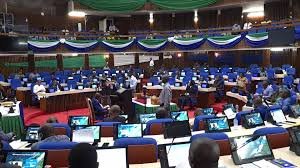
Parliament on Monday held a landmark pre-legislative hearing on the Constitution of Sierra Leone (Amendment) Bill, 2025, marking a significant step in the country’s ongoing constitutional reform process aimed at strengthening democracy, governance, and national cohesion.
The session, chaired by Hon. Abdul Sulaiman Marray-Conteh, Chairman of the Legislative Committee, brought together parliamentary leadership, members of parliament, representatives of political parties, civil society organizations, development partners, traditional authorities, and other key stakeholders.
Opening the hearing, Hon. Marray-Conteh explained that the engagement was intended to allow Parliament and the public to fully understand the bill before it proceeds to formal legislative debate. He noted that the Attorney General and Minister of Justice would present the bill’s merits, after which participants could ask questions, seek clarifications, and make recommendations.
Leader of Government Business, Hon. Nyuma, highlighted Parliament’s record of bipartisan cooperation in passing progressive legislation, including the repeal of the Public Order Act, electoral reforms, gender representation measures, and laws addressing sexual offences. He emphasized that the proposed constitutional amendment is still open to consultation, scrutiny, and improvement.
“This process is not about partisan interests but about strengthening democracy and transforming our country for future generations,” Hon. Nyuma said.
Delivering the keynote presentation, Attorney General and Minister of Justice, Alpha Sesay, described the bill as part of a historic constitutional renewal grounded in inclusivity, continuity, and national dialogue.
“This process is guided by one irreducible principle listening,” he said. “Not just to the powerful, but to the market woman in Waterloo, the youth activist in Bo, the traditional leader in Kono, and the young girl in Makeni yearning for fairness and equity. Their voices did not just inform the process they drove it.”
Mr. Sesay explained that the reforms aim to establish systems that inspire trust, amplify voices, and endure, aligning with President Julius Maada Bio’s vision to conclude the constitutional review process.
He traced the reform journey to the 1999 Lomé Peace Agreement, reinforced by recommendations of the Truth and Reconciliation Commission, and paid tribute to the late Justice Edmund Cowan, describing him as the architect of the constitutional review process, leading the gathering in a moment of silence.
According to the Attorney General, the Justice Cowan Constitutional Review Committee conducted one of the most extensive public consultation exercises in Sierra Leone’s history, including: over 10,000 nationwide consultations, 133 stakeholder engagements, consultations with 198 Ministries, Departments, and Agencies, over 150 position papers and extensive media outreach and thousands of public submissions.
He noted that the bill draws exclusively from two nationally agreed processes: the Justice Cowan Constitutional Review Committee Report and the Tripartite Committee recommendations, arising from post-election dialogue between government and opposition parties.
“The provisions in this bill are not the creation of government alone,” Mr. Sesay emphasized. “They are the product of years of national consensus-building.”
Speaking on behalf of the opposition, Hon. Abdul Kargbo described the engagement as one of the most important pre-legislative hearings of the Sixth Parliament, stressing that the Constitution belongs to the people and that meaningful participation is non-negotiable.
He noted that constitutional amendments require a two-thirds parliamentary majority and, in some cases, a national referendum. Hon. Kargbo warned that any failure to strictly comply with constitutional procedures could invalidate the process. While commending Parliament’s consultative approach, he also noted the presence of entrenched clauses in the bill and stressed that opposition support would depend on strict adherence to the Constitution.
The Clerk of Parliament, speaking on behalf of the Speaker, reassured participants that Parliament is committed to a lawful, transparent, peaceful, and inclusive process. He explained that the deliberate decision to proceed with the first reading while delaying the second reading was to allow for broader public participation, including input from political parties.
He encouraged citizens to submit their views in writing, assuring that all submissions would be documented, acknowledged, and shared with parliamentary leadership. For those unable to read or write, Parliament’s media team would assist in documenting their input.
Once the second reading is completed, the bill will be referred either to the Legislative Committee or a Committee of the Whole House, where proposed amendments including issues related to entrenched clauses will be thoroughly examined.
Closing the session, the Attorney General reiterated that consultations would continue in the days and weeks ahead.
“The constitution must outlive us. It must reflect the aspirations of the people of Sierra Leone and be owned by them,” he said.
The pre-legislative hearing underscores Parliament’s commitment to transparency, inclusivity, and participatory law-making as the constitutional amendment process continues.