

By: Saidu Jalloh
The National Public Health Agency (NPHA) on Tuesday formally closed the Shortening Outbreak Notification and Response (SONAR) Project and launched the Global Fund–supported COVID-19 Early Warning Surveillance Component, marking a significant milestone in strengthening Sierra Leone’s public health security system.
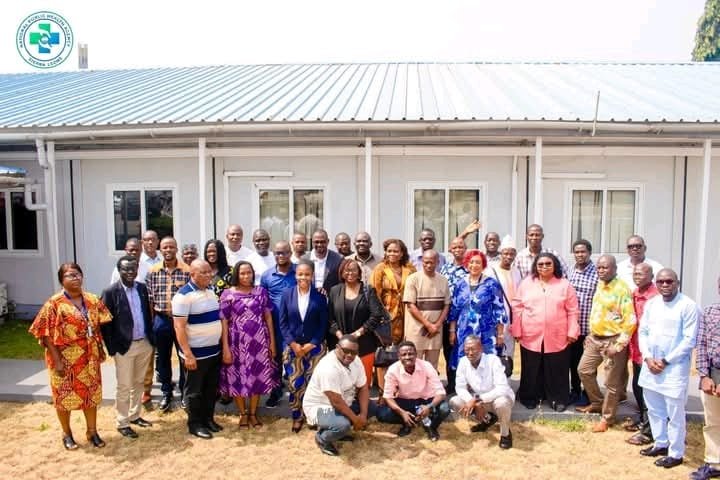
The ceremony, held at the Emergency Operations Center (EOC) in Freetown, brought together senior government officials, public health experts, and development partners to review achievements under the SONAR Project and outline the next phase of disease surveillance and emergency response in the country.
Speaking at the event, the Director of Surveillance and Epidemiology at NPHA, Dr. James Squire, said Sierra Leone is enhancing its capacity to detect, notify, and respond to public health threats through integrated and real-time surveillance systems. He introduced the internationally recognized 7-1-7 framework, which aims to detect outbreaks within seven days, notify authorities within one day, and initiate an effective response within seven days.
Dr. Squire explained that the framework is attainable through improved data systems, stronger cross-sector collaboration, and enhanced frontline response mechanisms. He also unveiled the electronic Event-Based Surveillance (EBS) Tracker, which is integrated into the District Health Information Software 2 (DHIS2) platform. The system consolidates human, animal, and environmental health data under a unified One Health approach.
“This is not just a tool, but a national asset that supports timely, evidence-based decision-making,” Dr. Squire said.
Development partners including the Global Fund, Task Force for Global Health, IPHAU, the Ministry of Agriculture and Food Security (MAFF), and the Environmental Protection Agency (EPA) commended the NPHA for translating donor support into sustainable national systems. They reaffirmed their commitment to coordinated efforts aimed at strengthening health security in Sierra Leone.
The SONAR Project recorded several notable achievements, including cross-sectoral EBS trainings conducted in Kailahun (83 participants), Kambia (74), Kenema (141), and Western Area Urban (112). A National Training of Trainers programme reached 67 participants across 12 districts, while 129 staff from private health facilities benefited from targeted training on electronic Integrated Disease Surveillance and Response (eIDSR). The project also featured live demonstrations of the DHIS2-based EBS platform and the NPHA Data Hub.
A formal handover of EBS documentation to the NPHA marked the transition from project-based implementation to full institutional ownership, underscoring sustainability and national leadership in disease surveillance.
In closing remarks, Dr. Joseph Sam Kanu noted that the true impact of the SONAR Project goes beyond technical achievements, highlighting the culture of preparedness, coordination, and transparency it has fostered within Sierra Leone’s public health system.
The NPHA described the project close-out not as an endpoint, but as a renewed commitment to building resilient, responsive, and people-centred public health systems across the country.