

By: Mohamed Sahr
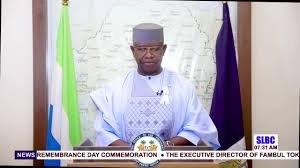
In a solemn moment of national reflection marking Sierra Leone’s eleven-year civil war, His Excellency President Julius Maada Bio has pledged to protect peace and uphold reconciliation. He made this commitment during his address at the first National Day of Remembrance, observed on Sunday, 18 January 2026.
Recalling the end of the war, which was officially declared over on 18 January 2002, President Bio said Sierra Leone chose to confront its painful past with honesty and courage. He noted that the government established the Truth and Reconciliation Commission (TRC) to document the events of the conflict, give victims a voice, and guide the nation toward lasting peace.
The Sierra Leone Civil War (1991–2001) was a devastating conflict marked by extreme violence and widespread human suffering. Rooted in long-standing grievances over corruption and poor governance following independence in 1961, the war was further fuelled by the country’s diamond resources, which became a source of conflict among rebel groups and government forces.
The conflict saw the emergence of the Revolutionary United Front (RUF), led by Foday Sankoh, and the Armed Forces Revolutionary Council (AFRC), composed of dissident soldiers. Throughout the war, both sides committed grave human rights abuses, including the recruitment of child soldiers and atrocities against civilians. An estimated 50,000 people were killed, and nearly half of the population was displaced.
In its final report, the Truth and Reconciliation Commission recommended that 18 January be observed as a National Day of Reconciliation and Remembrance, marking the official end of the civil war.
President Bio acknowledged that the recommendation took twenty-four years to be fulfilled, as the day passed for decades without formal national observance. However, he emphasized that what matters now is the nation’s decision to honour it.
“From this moment forward, January 18 is established, recognized, and honoured as the Republic of Sierra Leone’s National Day of Remembrance,” he declared.
The President said the nation now stands still to remember, honour, and reflect. For the first time in Sierra Leone’s history, citizens are united on a single day to remember the civil war and the heavy price paid for peace.
He described January 18 as a day that belongs to every Sierra Leonean a day of national memory, moral reflection, and shared responsibility. “We declare, with one voice: Never Again. Peace is a choice, and remembrance is how we keep it alive across generations,” President Bio said.
Speaking not only as Head of State but also as a survivor of the war, President Bio shared his personal experiences as a former soldier and as a son, brother, father, and friend who lost loved ones during the conflict.
He recalled that members of his family in Bonthe District endured the brutality of the war, and some lost their lives despite being ordinary civilians.
“Like thousands of families across our land, my family still carries that pain,” he said.
Addressing survivors, including those who were displaced and uprooted, President Bio acknowledged their suffering and resilience, affirming that their dignity remains a responsibility of the nation.
He also spoke candidly about the painful truth of the war. “As a nation, Sierra Leoneans hurt other Sierra Leoneans. Neighbours turned against neighbours. It was not only weapons that broke our trust, but fear, silence, and division.”
The President stressed that acknowledging this truth is not about blame but about healing and prevention.
“Healing requires forgiveness for what was done to us, for what we did to one another, and for the kind of forgiveness that frees us from being forever imprisoned by the darkest days of our history,” he concluded.