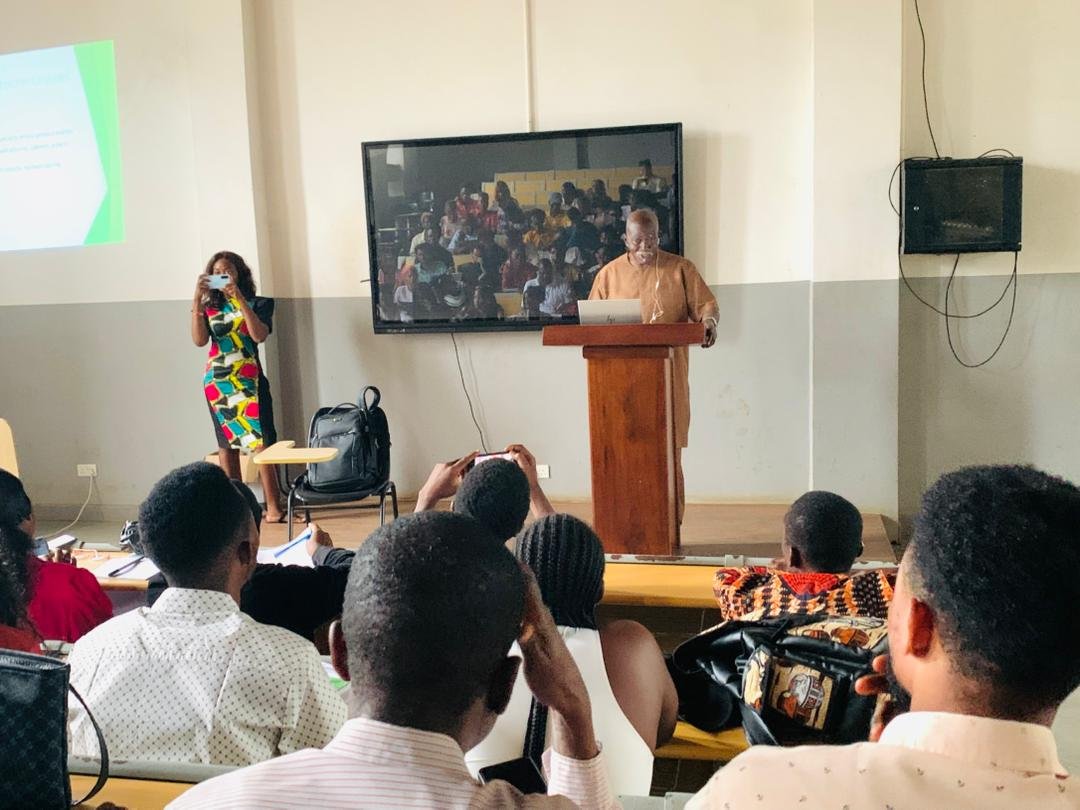
The Chairman of the Board of Directors of the Ballanta Academy of Music and Performing Arts and Chief Executive Officer of Premier Media Group Limited, Dr. Julius Spencer, has engaged students of the Mass Communication Department in a lecture on “Subjective Language Used by Journalists in Sierra Leone: Implications for Credibility, Ethics, and National Discourse.” The lecture was held on Monday, December 15, 2025.
Dr. Spencer delivered the lecture as a guest speaker at the invitation of Mr. Joseph Lamin Kamara, module lecturer for CMIS 311 Use of English, in the Faculty of Communication, Media and Information Studies at Fourah Bay College, University of Sierra Leone.
The interactive session was lively and engaging, featuring practical examples drawn from the daily use of subjective language on the front pages of newspapers in Sierra Leone. Dr. Spencer also shared personal experiences and testimonies from his long career in the media industry.
A former Minister of Information, Communication, Tourism, and Culture, Dr. Spencer structured his lecture around three key areas: the importance of language in shaping public perception; the distinction between objective and subjective language; and the relevance of these concepts within Sierra Leone’s media landscape.
He defined subjective language as reporting influenced by personal opinions or emotions, often characterized by loaded adjectives, judgments, praise, or attacks on individuals, institutions, or heads of Ministries, Departments, and Agencies (MDAs). He contrasted this with objective, fact-based reporting, which prioritizes neutrality and verifiable information.
Dr. Spencer noted that journalists may resort to subjective language due to factors such as political polarization, commercial pressures, inadequate professional training, cultural communication norms, and the influence of social media.
He explained that these influences often result in emotionally charged headlines on newspaper front pages, citing examples such as “Greedy Politicians Loot the Nation While Citizens Suffer.” According to him, terms like “greedy” and “loot” express judgment rather than verifiable facts. He suggested that a more objective alternative would be “Government Officials Accused of Misusing Public Funds.”
Addressing the students ahead of their professional careers, Dr. Spencer admonished them to uphold the principles and ethics of journalism after graduation, emphasizing that reporting must always be objective, balanced, and verifiable.
He warned that the continued use of subjective language could erode public trust, promote division or hate speech, damage professional integrity, mislead public perception, and ultimately weaken democratic processes.
Dr. Spencer encouraged journalists to adhere strictly to facts, use neutral vocabulary, properly attribute opinions, clearly separate news from opinion pieces, and pursue continuous training supported by strong editorial oversight.
In conclusion, he emphasized that objective language builds public trust, promotes responsible journalism, and contributes positively to strengthening democracy. He noted that a commitment to objective language reflects a journalist’s dedication to ethical and neutral reporting.
The lecture concluded with an interactive question-and-answer session, during which students sought further clarification on the use of subjective language in journalism and its implications for credibility, ethics, and national discourse in Sierra Leone.