

By: Saidu Jalloh
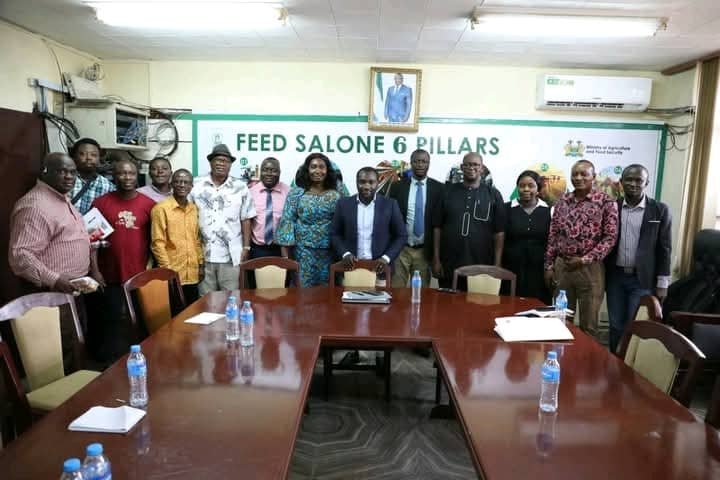
The National Steering Committee (NSC) of the Ministry of Agriculture and Food Security has begun reviewing the 2026 Annual Work Plan and Budget (AWPB) for major agricultural development projects in Sierra Leone. The NSC-comprising representatives from key Ministries, Departments, and Agencies (MDAs)-is the highest decision-making body responsible for providing strategic oversight and approving project work plans. The review sessions are taking place at the Ministry’s Conference Room on the 2nd Floor of the Youyi Building in Freetown.
Addressing project teams during the opening session, the Minister of Agriculture and Food Security, Dr. Henry Musa Kpaka, emphasized the crucial role of stakeholder involvement in planning and approving AWPBs. According to him, diverse perspectives help strengthen project delivery and ensure that interventions reach the targeted communities.
Furthermore, the Ministers of Agriculture and Youth commended the Agricultural Value Chain Development Project (AVDP) for its nationwide impact on farmers. Minister Kpaka referred to AVDP as a key driver of the government’s Feed Salone initiative, noting its successes in rehabilitating Inland Valley Swamps (IVS), supporting oil palm, cocoa, and vegetable production, and constructing feeder roads that improve rural access and trade. He urged all projects to adopt data-driven decision-making and enhance storytelling to better showcase achievements and attract new partners.
In addition, the Minister of Youth Affairs, Ibrahim Sannoh, encouraged the project teams to align their interventions with the national policy requiring at least 40 percent youth participation, stressing the critical contribution of young people to the Feed Salone agenda.
Commending the Rural Finance and Community Improvement Programme (RFCIP), Minister Kpaka said the project has significantly improved access to finance for smallholder farmers under Feed Salone’s Pillar 4 – Access to Finance. He urged deeper collaboration with the Bank of Sierra Leone to expand financial outreach. “If every farming household gets access to finance, we can sustain food production and household income,” he stated.
Moreover, he expressed appreciation to IFAD, the Islamic Development Bank (IsDB), OFID, and HEIFER International for their continued support. He reiterated that the Livestock Livelihoods Development Project (LLDP) must play a transformative role in the livestock sector by promoting smallholder animal farming, improving production infrastructure, and creating economic opportunities for women and youth in rural communities. “Feed Salone uses a multifaceted approach to improve food security and household income. We are therefore investing significantly in the livestock sector to ensure nutrition-sensitive, sustainable food production,” he added.
During the deliberations, project teams presented their 2026 AWPBs and received detailed feedback from committee members. RFCIP and LLDP received approval, while AVDP was instructed to incorporate key recommendations before its AWPB can be cleared.