

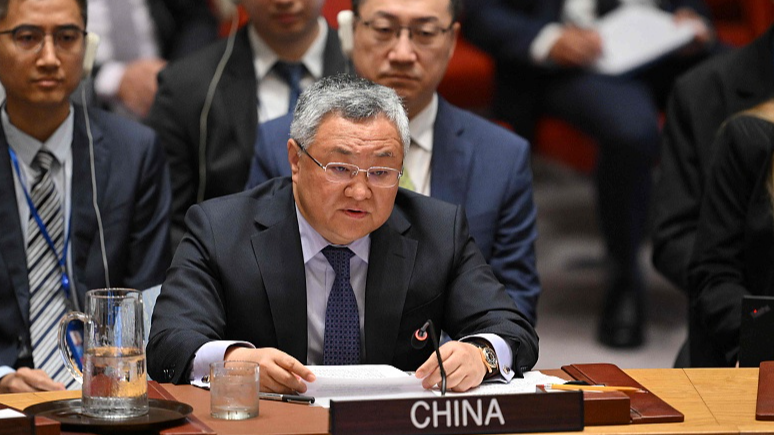
Fu Cong, China’s permanent representative to the United Nations, speaks at a meeting of the Security Council, New York, the U.S.
Fu Cong, China’s permanent representative to the United Nations, sent another letter to UN Secretary-General Antonio Guterres on Monday, firmly refuting what he said were unreasonable arguments made by Japan’s permanent representative to the UN, and elaborating on the position of the Chinese government.
In the letter, which will be circulated to all UN member states as an official document of the General Assembly, Fu said the Chinese side has noted that on November 24, Japan’s permanent representative to the UN sent a letter to the UN secretary-general making unreasonable arguments and dodging the key issues, while groundlessly accusing China and seeking to shift blame.
“China firmly opposes this,” said Fu, who further clarified China’s position in the letter.
First, the direct cause of the current serious differences between China and Japan is Japanese Prime Minister Sanae Takaichi’s provocative remarks during her Diet questioning on November 7, in which she irresponsibly claimed that a “Taiwan contingency” could constitute a “survival-threatening situation” for Japan, implying that Japan could militarily intervene in the Taiwan question.
“Such erroneous remarks openly challenge the victorious outcomes of World War II and the post-war international order, and constitute a serious violation of the purposes and principles of the Charter of the United Nations,” Fu said.
Second, the Japanese side claims to adhere to a “consistent position.” China has repeatedly and publicly asked: What exactly is this “consistent position?” The Japanese side has continued to evade the question and has yet to give China a direct answer.
“Can the Japanese side provide the international community with a complete and accurate explanation of its ‘consistent position’ on the Taiwan question?” asked Fu.
Fu said that international legal instruments such as the Cairo Declaration, the Potsdam Proclamation and the Japanese Instrument of Surrender have long ago confirmed China’s sovereignty over Taiwan, Japan’s obligation to return the stolen territories, including Taiwan, to China, and the principles for post-war arrangements concerning Japan. These documents form an integral part of the post-war international order.
The 1972 Sino-Japanese Joint Statement explicitly states that “the Government of Japan recognizes the Government of the People’s Republic of China as the sole legal Government of China” and that “the Government of the People’s Republic of China reiterates that Taiwan is an inalienable part of the territory of the People’s Republic of China. The Government of Japan fully understands and respects this stand of the Government of the People’s Republic of China, and it firmly maintains its stand under Article 8 of the Potsdam Proclamation,” Fu said.
Such a position has since been explicitly reaffirmed by the Japanese government in a series of treaties and statements between the two countries, Fu stressed. “With Takaichi’s erroneous remarks violating the commitments Japan has made to date, how can Japan expect to win the trust from the international community?”
Third, the Japanese representative claims in his letter that Japan adheres to a “passive defense strategy, which is exclusively defense-oriented,” and asserts that Takaichi’s remarks were grounded in this position. Taiwan is Chinese territory, yet Takaichi linked Japan’s “survival-threatening situation” with a “Taiwan contingency,” implying the use of force against China. This clearly goes beyond its claim of “passive defense strategy” that is “exclusively defense-oriented.”
“The Japanese side’s arguments are self-contradictory and are intended to mislead the international community,” Fu added.
With Takaichi’s erroneous remarks violating the purposes, principles and relevant provisions of the UN Charter, how can the Japanese side claim that it “has always respected and adhered to international law, including the UN Charter?”
Fourth, the Japanese representative’s letter also insinuates accusations regarding the defense development of other countries. Since Japan’s defeat, right-wing forces within Japan have never ceased attempts to whitewash its history of aggression; for years, Japan has continuously and significantly revised its security policies, increasing its defense budget for 13 consecutive years; Japan has revised the longstanding “three principles on arms exports,” and begun exporting lethal weapons; and Japan is even attempting to alter the “three non-nuclear principles,” thereby paving the way for the introduction of nuclear weapons.
“It is abundantly clear that Japan is breaking free from the exclusively defense-oriented principle and re-arming itself,” Fu said, adding that it is the Japanese side, not others, that has been “engaged in the prolonged expansion of military capabilities,” attempting “unilateral changes to the status quo despite opposition from neighboring countries,” and taking “coercive measures.”
“In light of Takaichi’s dangerous remarks, the international community must remain highly vigilant against Japan’s ambitions to expand its military capabilities and revive militarism, and jointly safeguard world peace,” the Chinese envoy warned.
Fifth, the Japanese representative’s letter states that efforts should be made to enhance understanding and cooperation. However, the greatest challenge at present is that Takaichi’s erroneous words and deeds have severely undermined the mutual trust between China and Japan and damaged the political foundation of China-Japan relations.
“If the Japanese side truly seeks to develop stable China-Japan relations, it should clearly reaffirm the one-China principle, faithfully uphold the spirit of the four political documents between the two countries and its political commitments, immediately retract the erroneous remarks, and take practical steps to honor its commitments to China,” Fu stated.
“Otherwise, the Japanese side should bear all the consequences arising therefrom,” he added.
SOURCE: CGTN News