

By: Saidu Jalloh
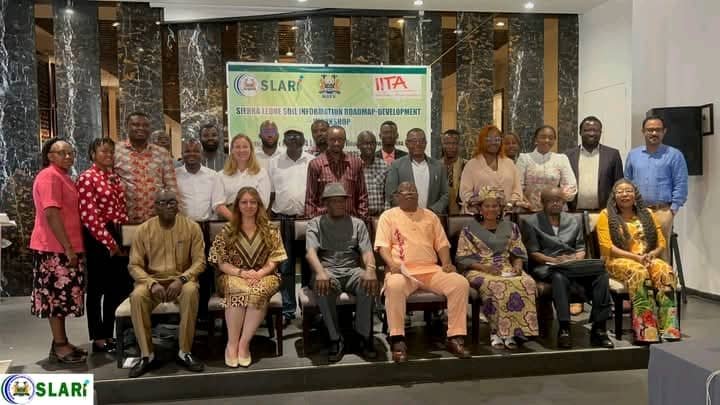
A three-day workshop organized by the Sierra Leone Agricultural Research Institute (SLARI), the International Institute of Tropical Agriculture (IITA), the Ministry of Agriculture and Food Security (MAFS), and the International Soil Reference and Information Centre (ISRIC) has successfully concluded with the development of a National Soil Information Roadmap aimed at strengthening the Feed Salone Initiative.
The workshop, held from October 13–15, 2025, at the Atlantic Hotel in Freetown, brought together leading soil scientists, agricultural researchers, policymakers, and international experts from IITA and ISRIC–World Soil Information in the Netherlands. The aim was to design a comprehensive framework for collecting, managing, and applying soil data to promote sustainable land use and boost agricultural productivity across Sierra Leone.
During the opening session, representatives from IITA, SLARI, and MAFS emphasized the importance of accurate soil information in ensuring food security and driving the government’s flagship Feed Salone Initiative. This initiative seeks to transform agriculture through science, innovation, and evidence-based planning.
Dr. Abdul Rahman Conteh, Acting Director General of SLARI, noted that the roadmap would serve as a strategic tool for harmonizing soil information across research institutions, universities, and ministries.
Similarly, Dr. Kepifri Lakoh, Programme Manager of the Food System Resilience Programme (FSRP–SL), commended the collaboration between IITA and national partners, stressing that reliable soil data would be crucial for transforming Sierra Leone’s agricultural landscape.
“Through this roadmap, we are building the evidence base that will enable farmers, researchers, and policymakers to work together more effectively to ensure food and nutrition security for every Sierra Leonean,” Dr. Lakoh remarked. “This initiative will allow us to make informed decisions about crop suitability, soil fertility, and land restoration. Reliable soil data is the foundation for achieving the Feed Salone goals of self-sufficiency and sustainable food systems.”
Technical sessions during the workshop were led by ISRIC experts from the Netherlands, who trained participants on modern soil information systems, digital mapping, and data management tools. Participants also identified national priorities for establishing a National Soil Information System (NaSIS), which will serve as a central repository for soil data and guide future agricultural interventions.
Dr. Alfred O. Dixon, IITA Country Representative, praised the collaborative spirit of Sierra Leonean institutions and reaffirmed IITA’s commitment to strengthening national research capacity.
“This effort marks a major milestone in Sierra Leone’s journey toward evidence-based agricultural transformation. With robust soil data, policymakers and farmers alike can make smarter, climate-resilient decisions,” Dr. Dixon stated.
Prof. Abdulai Jalloh, Chief Agriculture Officer at MAFS, added that the roadmap aligns with the government’s Feed Salone agenda by supporting site-specific fertilizer recommendations, promoting sustainable soil management, and equipping farmers with technologies that improve productivity while preserving natural resources.
At the close of the workshop, participants agreed on next steps, including finalizing the roadmap document, establishing a national soil data coordination platform, and mobilizing resources for the operationalization of the Soil Information System.
The Sierra Leone National Soil Information Roadmap is expected to serve as a guiding framework for research, policy, and investment decisions ensuring that every intervention under the Feed Salone Initiative is grounded in sound scientific evidence about the country’s land and soils.