

By: Aminata Sesay
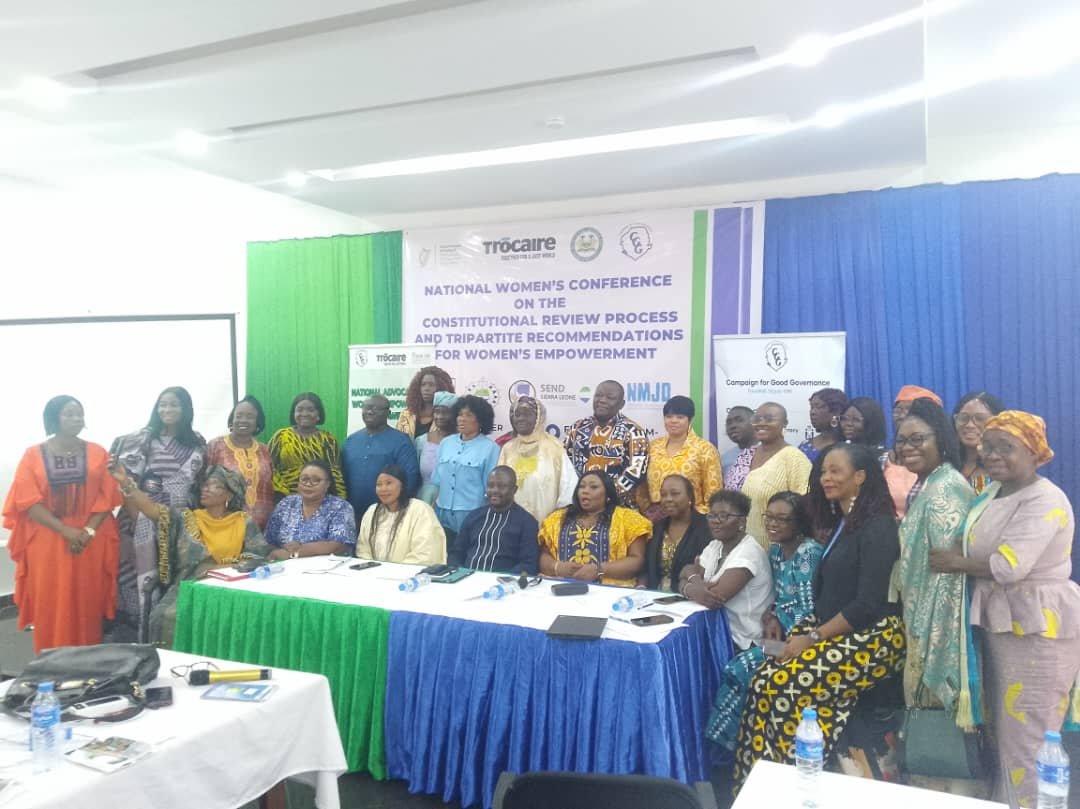
On Friday, 10th October 2025, the Campaign for Good Governance (CGG), supported by Trócaire, the Government of Ireland, and partner organizations—including SEND Sierra Leone, the Network Movement for Justice and Development (NMJD), and ABC Development hosted a National Women’s Conference on the Constitutional Review Process and Tripartite Recommendations for Women’s Empowerment at the Family Kingdom Resort in Aberdeen, Freetown.
The conference brought together women leaders, parliamentarians, civil society activists, government officials, and international partners to ensure that women’s priorities are fully incorporated into Sierra Leone’s ongoing constitutional review process.
In his keynote address, Hon. Alpha Sesay Esq., Attorney General and Minister of Justice, reaffirmed the government’s commitment to concluding the constitutional review process “inclusively and transparently.”
“The President has been very clear that he will not be on the ballot in 2028,” he emphasized. “This review is not about extending term limits or changing mandates; it is about completing a national process that began decades ago, starting with the 1999 Lome Peace Agreement, followed by the Truth and Reconciliation Commission and the Cowan Review Committee.”
Sesay revealed that of the 16 recommendations submitted by women’s groups under the Women’s Manifesto, 12 have already been accepted in the government’s White Paper. Further discussions have brought the total number of accepted proposals to 15.5.
“Government wants a gender-sensitive constitution,” he declared. “We are working together to ensure equality and non-discrimination, especially through the amendment of Section 27 of the 1991 Constitution and the inclusion of gender equality provisions in citizenship laws.”
He also assured attendees that socio-economic rights such as access to health and education would be made justiciable under the revised constitution, noting that “the right to universal free basic education and adequate health facilities will be enshrined.”
Opening the conference, Marcella Samba-Sesay, Chairperson of CGG, emphasized the critical role of women in shaping Sierra Leone’s supreme law.
“We cannot allow the constitutional review process to proceed without a gender-sensitive lens,” she asserted. “Women must be full stakeholders in this journey, not just observers.”
She commended the collaboration between the Ministry of Justice, the Tripartite Committee, and women’s organizations, urging continued public consultation and grassroots engagement.
“We need to ensure that every woman from Kambia to Pujehun understands what this process means for her rights.”
Dr. Fredline M’Cormack-Hale, President of the 50/50 Group, celebrated the achievements made so far but called for stronger implementation.
“This has been a 20-year journey of blood, sweat, and tears,” she remarked. “But progress on paper must translate into progress in practice. Laws must work for every woman in every corner of Sierra Leone.”
She urged the establishment of monitoring mechanisms to ensure that reforms are not only passed but actively enforced and understood by citizens.
Madam Emilia Kamara Jengo, Executive Director of WOFRAHD, echoed similar sentiments, describing the constitutional review process as “a long, costly journey that must now deliver tangible results.” She expressed optimism that remaining issues particularly those related to land rights and the Chieftaincy Act would soon be resolved.
“This is not only a legal issue but a moral one,” she emphasized. “Women’s rights are human rights.”
Representing Parliament, Hon. Catherine Zainab Tarawalie, Chairperson of the Parliamentary Committee on Gender and Children’s Affairs, reaffirmed her institution’s support for gender reforms.
“I have always said that the Chieftaincy Act must be reviewed it remains one of the most discriminatory laws against women,” she asserted. Tarawalie encouraged collaboration between the executive and opposition parties, adding, “Women in Parliament are not spectators. We are influencers and decision-makers.”
Fatima Duba, speaking on behalf of the All Political Parties Women’s Association (APPWA), delivered remarks from APPWA President Dr. Augusta James-Teima, reiterating political women’s solidarity.
“The constitutional review is a remedy for women,” she said. “No woman should be left behind. Our voices, ambitions, and political rights must be reflected in this new constitution.”
Madam Setcheme J. Mongbo, Representative of UN Women, praised the unity displayed by women’s groups.
“The women’s movement in Sierra Leone has often been accused of fragmentation,” she noted, “but this process shows how united we can be when it matters most. Coordination and inclusivity will be essential to our success.”
Mr. George Were, Country Director of Trócaire, underscored the importance of simplifying legal language so that ordinary citizens can understand the constitutional review process.
“Let us translate the constitution into a language that people understand,” he urged. “Only then will it truly be owned by the citizens.”
Charles Vandi, speaking on behalf of the Minister of Gender and Children’s Affairs, commended CGG and its partners for fostering inclusive dialogue.
“If we can integrate all 16 points of the Women’s Manifesto into the constitution, we will have achieved more for Sierra Leonean women than at any other time in our history,” he concluded. “This is the moment let’s seize it.”
The event concluded with a renewed call for unity, collaboration, and sustained advocacy to ensure that the revised constitution enshrines equality, justice, and empowerment for all Sierra Leoneans.