

By: Saidu Jalloh
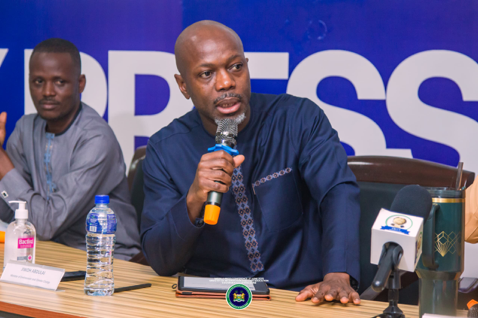
Sierra Leone is facing an environmental emergency that demands immediate action, Minister of Environment and Climate Change Abdulai Jiwoh warned during the Government’s Weekly Press Briefing held at the Youyi Building in Freetown. In a powerful and urgent address, he declared the situation to be “a real calamity,” not just a narrative one that threatens the nation’s ecosystems, public health, and future sustainability.
Minister Jiwoh referenced the Protect Salone for Nature initiative, launched on March 18, as a direct response to the urgent need to safeguard Sierra Leone’s natural resources. He highlighted rampant deforestation and river pollution as pressing issues already visible across the country and warned of worsening consequences without swift and decisive action.
“The deforestation happening across the country, the pollution of our rivers if we do not stop it now, there will be serious problems,” he stressed.
To tackle these challenges, the government convened a national environmental conference with Paramount Chiefs, civil society organizations, international partners, and government officials. Minister Jiwoh noted that widespread interest and participation signaled a shared urgency among stakeholders.
Following the launch, dedicated teams were established to develop an implementation plan based on stakeholder feedback. He affirmed that both local and international partners are working closely with the government to advance the initiative sustainably.
Addressing encroachment concerns at the Tacugama Chimpanzee Sanctuary, the Minister described the situation as dire after a personal site visit.
“The challenges are real, and many of the problems are caused by us the citizens,” he remarked.
While the Ministry has collaborated with Tacugama and the National Protected Area Authority (NPAA) which deploys rangers to protect the sanctuary—he acknowledged that overlapping mandates have hindered enforcement.
Nonetheless, Minister Jiwoh reaffirmed that protecting Sierra Leone’s natural heritage, especially the Western Area Peninsula National Park, remains a top priority. The park, he emphasized, is home to endangered species and also serves as the main water source for Freetown.
“When we talk about protecting the park, we are not just talking about chimpanzees; we are talking about our own lives. If the park is destroyed and there is no water, how can we live in Freetown?” he asked.
He used the Jui–Regent Highway as a cautionary example:
“On the left side, where part of the park was cleared in 2012, the water sources have dried up. On the right side, which remains protected, the forest is thriving. That is the difference. It is not a story it is a real calamity.”
Minister Jiwoh also issued a stern warning to those illegally encroaching on protected lands:
“People believe they are protected by their connections, but they’re putting everyone’s lives at risk, including their own. If the chimpanzees leave the sanctuary, who can protect themselves from them?”
He dismissed allegations that the government’s environmental initiatives are politically motivated, stating:
“We have a responsibility to protect lives and property. Citizens also have a duty to safeguard the environment and act responsibly.”
Reaffirming the Ministry’s commitment to preserve the Western Area Peninsula National Park, he pledged ongoing collaboration with Tacugama and other partners.
Turning to broader climate concerns, Minister Jiwoh addressed the upcoming Salone Coastal Resilience Project, which will tackle issues such as erratic rainfall and severe coastal erosion.
“Our farmers are confused. Rain no longer comes when expected, and harvests are disrupted. Along the coasts, the sea is eating into the land. We have already lost parts of our coastline, and in the next few years, we may lose more,” he warned.
Set to launch within six months, the project will use nature-based solutions and advanced technology to help vulnerable communities from Kambia to Bonthe adapt to rising sea levels.
“We aim to protect both people and ecosystems from the advancing threat of climate change,” he concluded.
The project is expected to benefit hundreds of thousands of Sierra Leoneans living in coastal areas, marking a major step toward national climate resilience.