

By: Mohamed Sahr
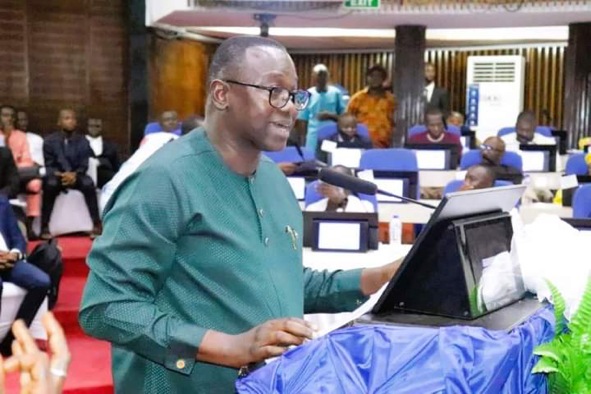
At the official proclamation of the Finance Year 2025 budget in the House of Parliament, Minister of Finance Sheku Fantamadi Bangura outlined strategies for overcoming the objections binding the entire budget structure for 2025.
The Minister of Finance started by highlighting key areas, including reducing inflation and rebuilding foreign exchange buffers. He mentioned that despite inflation trending downwards, it is still above the country’s medium-term objective of a single digit and, therefore, continues to weaken the purchasing power of our people.
Mr. Bangura stated that the government will, therefore, continue with ongoing efforts to further reduce inflation. That is to say, the Bank of Sierra Leone will strengthen its capacity and liquidity
management operations to contain money supply growth to levels consistent with the inflation objective.
“The Ministry of Finance will complement the Bank of Sierra Leone’s monetary policy stance by consolidating public finances to reduce the budget deficit and curtail Central Bank financing. The implementation of these measures is expected to lower inflationary pressures and support the rebuilding of foreign exchange buffers. In addition, the Government will invest in food production through the Feed Salone Programme to increase food supply and lower food inflation.
These, in turn, will enhance the purchasing power of households and improve their living conditions,” he said.
He alluded to the Members of Parliament that the exchange rate of the Leone to the US Dollar and other convertible currencies will remain market-determined to ensure the adjustment of the economy to external shocks. Additionally, beyond the implementation of prudent macroeconomic policies to stabilize the exchange rate, the Government will also pursue policies that will support the production of exportable and import-substitutable goods to earn and save foreign exchange, respectively.
Minister Bangura said the Government will continue to enforce the requirement for the repatriation of export proceeds. Affirming that the Government will also continue to mobilize external development finance in the form of grants and concessional loans to boost our foreign reserves and stabilize the value of the Leone. The Bank of Sierra Leone will also continue to improve the operations of the foreign exchange market through implementing reforms and removing any remaining restrictions.
He emphasized that the Bank of Sierra Leone commits to reforms to further strengthen resilience, prevent systemic risks, and ensure that the banking system supports the stability and growth of the economy.
Focusing on managing public finances to create fiscal space, the Minister of Finance underscored that limited fiscal space has constrained adequate investment in the social sectors and infrastructure necessary for promoting sustainable and inclusive growth. “This is mainly due to the mismatch between domestic revenues and Government expenditures, which has resulted in higher budget deficits and debt levels,” he added.
Mr. Bangura noted that high debt service payments consume most of the domestic revenues collected, crowding spending on priority areas such as education, health, agriculture, infrastructure, and social protection. He emphasized the need to rebuild fiscal buffers to make the economy more resilient to future shocks and to create fiscal space for the needed investment in infrastructure and other priority programs. This requires a mix of revenue mobilization and expenditure management measures to ensure fiscal and debt sustainability.
The Minister cited domestic revenue mobilization measures as one of the pillars guiding the Government of Sierra Leone’s Medium Term Revenue Strategy (MTRS) 2023-2027. He said the MTRS is a high-level five-year strategic document that contains tax policy and revenue administration measures. Mr. Bangura stated that the government will continue to implement these measures in the medium term. Several of the tax policy measures in the MTRS were frontloaded in the Finance Acts of 2023 and 2024, and most of these are being implemented.
He admitted that the focus in 2025 will be to broaden the tax base and strengthen tax compliance. Adding that in this context, the Government will implement the following tax policy measures in 2025, ranging from completing the implementation of the outstanding measures in the 2023 and 2024 Finance Acts, including configuring excise duties on imported alcoholic beverages, cigarettes, and other
excisable goods in the ASYCUDA and the Minimum Alternate Tax (MAT) in the Integrated Tax Administration System (ITAS).
He mentioned that the Ministry will amend the Income Tax Act, 2000, to extend the Minimum Alternate Tax (MAT) to all sectors, including mining, sustain the implementation of the revised full-pass through petroleum pricing formula, as well as review sectorial investment agreements to introduce sunset clauses for the reduced corporate tax rates granted to existing businesses beginning in 2025.
Mr. Bangura said the Ministry and Government of Sierra Leone plan to cease granting reduced corporate income tax rates for all new investments and reduced withholding tax rates for all suppliers. They will also continue to rationalize duty and tax exemptions by implementing the Duty and Tax Exemptions Act of 2023.
Stating that effective 2025, the Ministry will enforce the full implementation of the Extractive Industries Revenue Act (EIRA), 2018, and avoid negotiating new fiscal terms for mining projects outside of the EIRA parameters; implement a Safe Harbour Framework for establishing the prices of all minerals, beginning with iron ore in 2025; implement an ad valorem export duty on the export value of timber and timber products in addition to the current fixed charge, which will be retained as a minimum; and introduce royalty on the export of dimension stones which had for long been exported as samples with no revenue accruing to Government.