

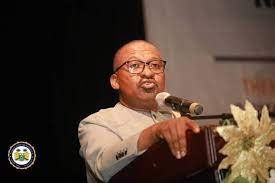
Dr Mohamed Juldeh Jalloh, the vice president of the republic of Sierra Leone has made a solemn commitment to the people of Kissi Teng chiefdom in Kailahun of solving the Yenga border dispute between Sierra Leone and the republic of Guinea.
The vice president assured the mammoth Kailahun gathering that the issue will be solved once and for all in an amicable manner that could not jeopardize the bilateral relationship between the two countries.
He said there should not be acrimony between the two countries as according to him Guinea and Sierra Leone are two countries with the same people.
Dr Jalloh said the Yenga issue is partly created by colonialism to divide and rule the people of the two countries who share the same surnames through intermarriages and Biological relationships.
He noted that relatives are living side by side across the border and there are commercial exchanges taking place on a daily basis across the Makona/Moa River.
Dr Jalloh who is a former international crisis group expert urged the people of Kangama in Guinea and the people of Kissi Teng to see themselves as one and the same people.
He revealed that the African Development Bank has approved the funding of the Kailahun-Boidu road and from Boidu – Koidu where a bridge will be constructed across the Moa/Makona River as a way of permanently demarcating the boundary between the two sister countries.
The vice president categorically revealed to paramount chiefs, stakeholders and the people of Kailahun that the year 2023 is for them to enjoy the socio economic benefits lined up for Kailahun District.
He assured further of government plans to reopen the Koindu market in order to allow citizens from the Mano river union(Guinea, Liberia, Sierra Leone, Cote d`Voire) to trade amongst one another.
Dr Jalloh went further to guarantee the people of Kailahun of development in the form of paved roads, provision of electricity and water supply and the construction of more schools to support the country`s free and quality education programme.
“We would never neglect you as it happened with other previous governments”, he vowed to the people of Kailahun.
He concluded by urging the people of Kailahun to collect their voter identity cards and vote for president come June 24th 2023 general elections.
It should be noted that the vice president is in Kailahun to open a gigantic mosque built by stakeholders in the district.
Below is a brief history of Yenga
Yenga is a village in Kissi Teng Chiefdom, Kailahun District in the Eastern province of Sierra Leone. The village is at the international border between Sierra Leone and Guinea.
Yenga is located on a hill above the south side of the confluence of the Mafissia River and the Makona River (Moa River), where that river forms the border between the two countries.
The area is inhabited by the Kissi people. In July 2012 Sierra Leone and Guinea declared the demilitarization of the Yenga area.The large majority of the inhabitants of Yenga are members of the Kissi ethnic group.
Prior to the late 1990s Yenga was a small fishing village. However, after occupation by the Revolutionary United Front (RUF), alluvial diamonds were discovered in the Makona River.
Mining and agriculture have replaced fishing as the major economic activity.
In 2001, during Sierra Leone’s civil war, the Republic of Guinea sent troops into Yenga to help the army of Sierra Leone suppress the rebel RUF.
After the rebels were quashed, the Guinean soldiers remained in Yenga. Prior to the civil war Yenga was administered by the Kailahun District of Sierra Leone.
In 2002 Sierra Leone and Guinea signed an agreement than Yenga would be returned to Sierra Leone, as soon as Guinea’s border could be secured.
In 2005 Sierra Leone and Guinea signed an agreement that Yenga belonged to Sierra Leone.
The dispute was officially “resolved” in 2005 when President Ahmad Tejan Kabbah announced that “Conakry has now affirmed that Yenga is a part of Sierra Leone”.
However, in early 2021, President Julius Maada Bio reported to the 58th Ecowas summit that “The issue remains unresolved and our Guinean counterparts have continued to encroach on Sierra Leone’s land and sea borders”.