By: James Kamara-Manneh
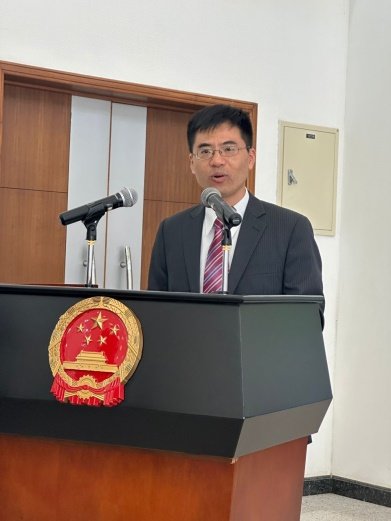
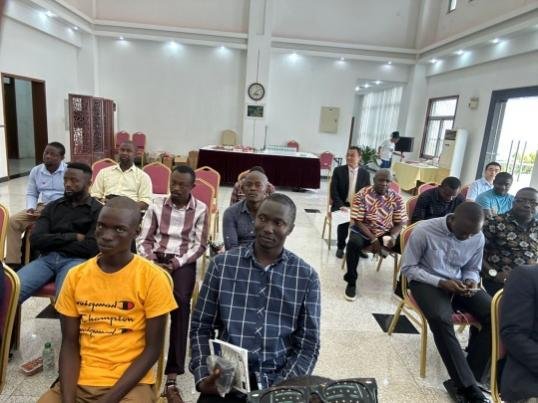
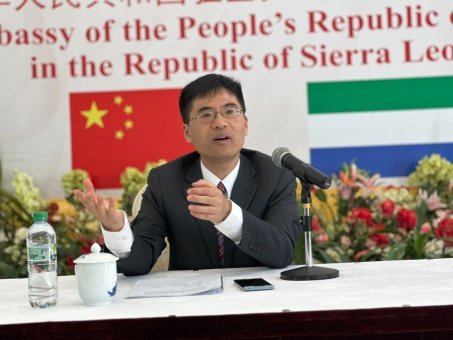
The new Chinese Ambassador to Sierra Leone H.E. Ambassador Wang Qing had the opportunity of meeting with local journalists at the Chinese Embassy yesterday during the first Face-Face interactive session held this year. The Ambassador drilled the audience on the strong bilateral relationship between Sierra Leone-China friendship and pinned four cardinal points for understanding China’s developmental strides.
Amb. Wang said at the time of his arrival he noticed that Sierra Leoneans are interested in knowing more about China’s growth, they are also interested to know how China has been able to eradicate poverty from 1.4 billion people and risen to become the World’s second-largest economy; the code behind China’s success and whether it can be replicated by African countries. They also want to know what the realities of China are about the “democracy versus authoritarianism” narrative which is often peddled by some Western media.
On the perspectives on understanding China, to start the Ambassador said an individual needs to understand the Communist Party of China (CPC). He said since the existence of the CPC party it has been able to lead China out of being bullied and abused to national independence, from national incompleteness to rejuvenation, from poverty and weakness to prosperity and strength. The key to the success is that the CPC represents the overall interests of the Chinese people.
“It upholds the fundamental purpose of wholeheartedly serving the people and practices a people-centered philosophy of development”, he said.
Amb. Wang said from recent research conducted on the CPC leadership over 90 per cent of the Chinese public is satisfied with the Chinese government. It clearly shows that the leadership of the CPC is the choice of history and the choice of the people. Respect for China requires respect for the leading position of the CPC and the path of socialism with Chinese characteristics chosen by the Chinese people.
Furthermore, he said to understand China you need to understand Chinese Modernization. He elaborated by saying copying western modernization, many developing countries have not only failed to modernize but also fallen into a “strange circle” of stagnant economic development, severe social contradictions and continuous political instability. The West is only a pioneer of modernization, but not a model for modernization, and not the only criterion for measuring other countries’ modernization. Based on our decades of exploration and practice since the founding of the People’s Republic of China in 1949, especially since the launch of reform and opening up in 1978, as well as the breakthroughs made in theory and practice over the past 10 years, we have succeeded in advancing and expanding Chinese modernization.
Whereas Chinese modernization contains elements that are common to the modernization processes of all countries, it is more characterized by features that are unique to the Chinese context. He added that it is the modernization of a huge population, of common prosperity for all, of material and cultural-ethical advancement, of harmony between humanity and nature, and peaceful development.
“… exploration and achievements of the Chinese people have proved that there is no one-size-fits-all model or standard of modernization in the world. Chinese modernization presents another picture of modernization, expands the channels for developing countries to achieve modernization, and provides a Chinese solution to aid the exploration of a better social system for humanity,” the Amb explained.
He said to understand China one needs to understand China’s national condition with a comprehensive and objective view.
That many Sierra Leonean friends are talking about China’s fight against poverty. At the end of 2020, through 8 years of hard work, about 100 million Chinese people got rid of poverty and China achieved the goal of eliminating absolute poverty.
This means China achieves the poverty reduction goal of the United Nations 2030 Agenda for Sustainable Development 10 years ahead of schedule. It is a milestone in the history of the Chinese nation and the history of humankind, making an important contribution to the cause of global poverty alleviation.
He revealed according to research that China’s GDP is 18 trillion US dollars in 2022 with a population of over 1.4 billion. Its GDP per capita is only about 12,000 US dollars, which is one-sixth of that of the US.
However, China is still facing a lot of severe challenges, said the Ambassador. For example, imbalances and inadequacies in development remain prominent problems. There are still wide gaps in development and income distribution between urban and rural areas and between regions.
Finally, in comprehending the development of China in perspective, Ambassador Wang saidyou need to understand how China sees the world.
He said the 20th CPC National Congress tells the world that China is committed to upholding world peace and promoting common development, and is dedicated to building a community with a shared future for mankind.
China holds the view that the human race is an integral community and planet Earth its homeland. In the face of common challenges, no person or country can remain insulated. The only way out is to work together.
China is the only country among the five nuclear-weapon countries that promises not to use nuclear weapons first. We reject the idea of “a strong country must seek hegemony” and believes that “hegemony leads to decline”.
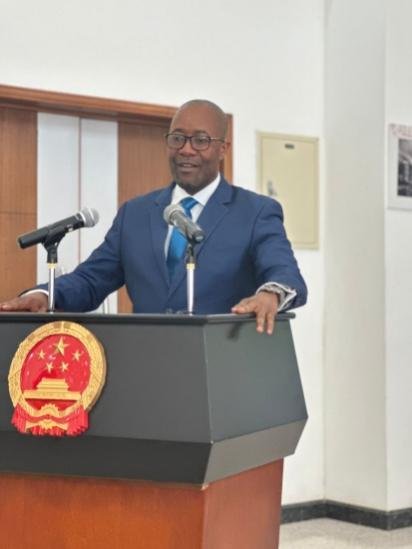
However, the Minister of Information and Communications, Mohamed Rado Swaray applauded the beautiful relationship between both countries and reiterated the developmental contributions Sierra Leone is enjoying from China.
He said Sierra Leone has been through thick and thin, but China has been there as a true friend. The Minister highlighted some tangible evidence of development undertaken by the Chinese in Sierra Leone and their swift contributions to the two recent pandemics (Covid-19, and Ebola) that affected our country and the world at large.
He further called on the Chinese government to aid right-minded journalists to experience an interchange of cultural exchange for both countries. He pleaded with the Ambassador to create opportunities for young people to pay a visit to China to learn its beliefs and culture so that they can serve as ambassadors for China.
Minister Swaray further pleaded with the Chinese government to focus on strengthening the communication sector, agriculture and education to help support the political agenda of President Bio.
The program climaxed with a question and answer session.