

March 19, 2021
By Mohamed M. Sesay
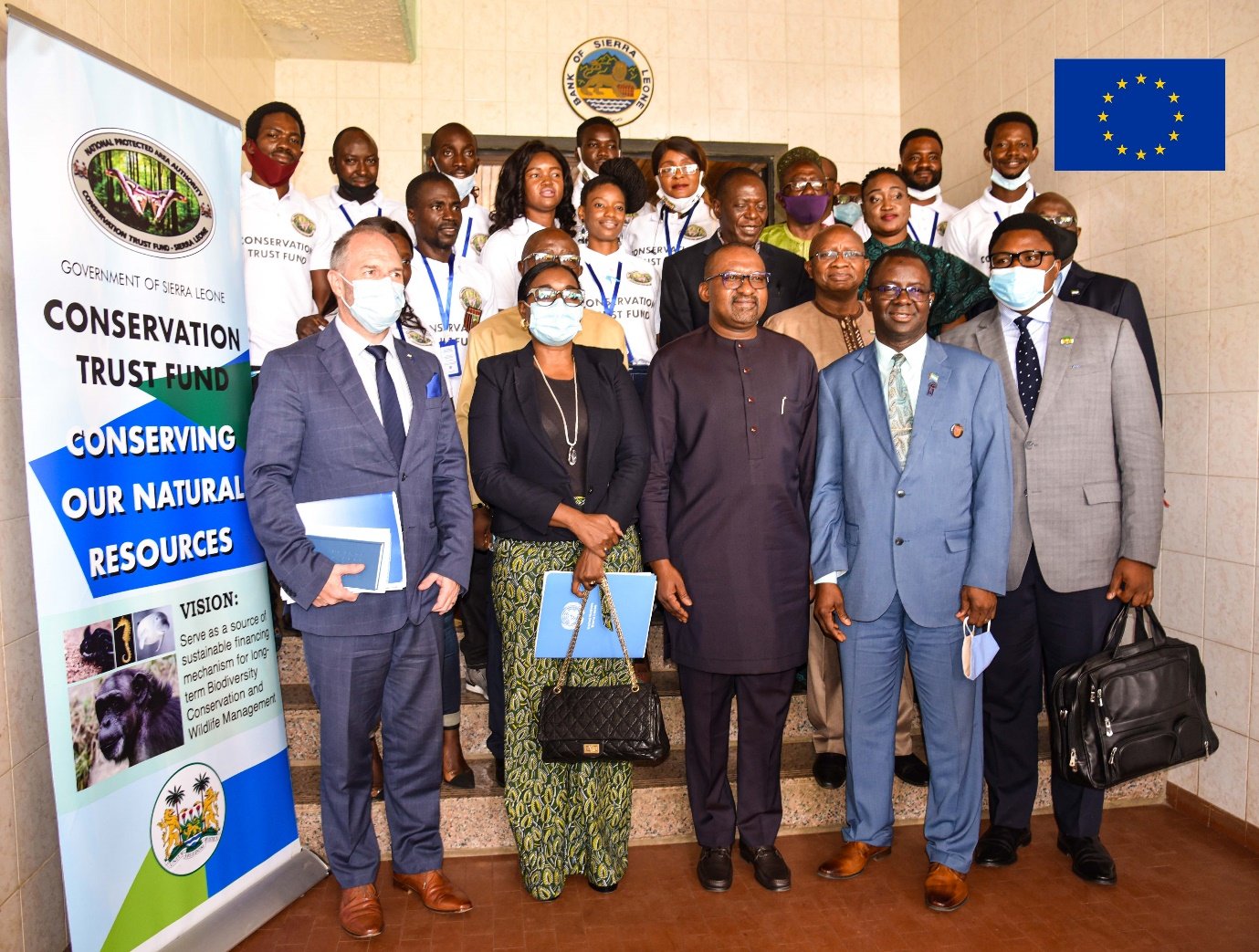
In a Ceremony for the launching of the Conservation Trust Fund’s Strategic Plan 2021-2025, the European Union Ambassador Tom VENS, yesterday requested Government Authorities to ensure that the legal framework for environmental protection is reviewed, updated and adequately enforced.
Ambassador Tom VENS added that with the reference to the deforestation that is taking place in the Western Peninsula Park, he said it is plausible that if illegal and unregulated housing is prevented, the demand by the construction industry for poles and saw timber would be reduced and also tree harvesting from the national park would also decrease.
He cited another challenge in terms of legal and regulatory framework which is to ensure that all relevant institutions have clear roles and responsibilities around environmental issues, without overlapping mandates. He noted that, Law enforcement should not be blind to the different roles played by the various actors along the supply chain, from logging to processing, transportation and final marketing, and in a way that is proportionate to the economic gains from illegal activities by the actors.
He furthered that, Law enforcement on its own may not be sufficient. He therefore stated that they also need to ensure that local communities in and around the National Parks and Protected Areas have access to sources of income that are alternative to the unsustainable use of natural resources. He added that it is also essential that all relevant authorities closely collaborate with civil society organisations, especially at grassroots level, in order to mainstream environmental issues and make the population better aware that a forest that is preserved and well managed can provide much more benefits, in the medium and long term, compared that a forest that is cut down and destroyed. This message is very important, especially to the young generations, and should be disseminated at very early stage of the educational cycle.
He acknowledged that, the effect of rising sea levels on the coastal communities of Sierra Leone could be catastrophic, should the destruction of the mangrove forests continue at the same rate the country is experiencing today. He added that Sierra Leone has approximately 600,000 hectares of land designated as National Park or other forms of protected areas while describing it as a remarkable 9% of the total land area of the country.
He also noted that the forest cover is a direct indicator of the health status of natural landscapes, and a good proxy indicator of the human management of ecosystems.
He lamented that it is unfortunate that the Tree Cover index for Sierra Leone has sharply decreased over the past years. In 2018, he said the Director of Environment informed the public that less than 5% of the original forests is left in the country, mainly in isolated reserves on top of mountains and hillside.
He observed that Sierra Leone’s approach to biodiversity and environmental protection is well aligned with the European Green Deal, which lays the foundation of the external cooperation policy, constituting one of the main pillars of the future partnership with Sierra Leone. He added that the design and implementation of a future European Green Deal with Sierra Leone will offer clear opportunities for a renewed dialogue and actions on environment, biodiversity and climate change.
He assured that the European Union is therefore ready to work together with Sierra Leone on a clear road map of interventions and a set of tangible results that could be used by all Ministries and Agencies that have the authority and responsibility over the protection of the environment, in close collaboration with civil society organisations and other development partners.
He referenced some of the EU’s first contributions to environmental protection in Sierra Leone made several years ago to what today has become the Tacugama Chimpanzee Sanctuary, followed by a project for the Gola Forest in 2007 and more recently, the institutional support to the Environmental Protection Agency, to the National Protected Areas Authority and the Forestry Division in the Ministry of Agriculture, and equally supported the Reduction of Emissions from Deforestation and forest degradation programme called REDD+.
He continued that the EU support to the Tacugama sanctuary and the Gola National Park can be considered as success stories, and provide a model for elsewhere adding that, the Gola National Park in particular is probably the first and only initiative in Sierra Leone that is able to raise funds from its ecosystem services by selling carbon credits to the market.
“I am now happy to announce that our engagement will increase in the days to come, as we are planning to award a grant contract from a regional programme in support to Sierra Leone and Guinea for the trans-frontier park of Outamba Kilimi. We are also ready to collaborate with you on your quest for securing a reliable flow of financial resources, which is much needed for all the environmental programmes to be implemented successfully and in a sustainable way”, he concluded.