

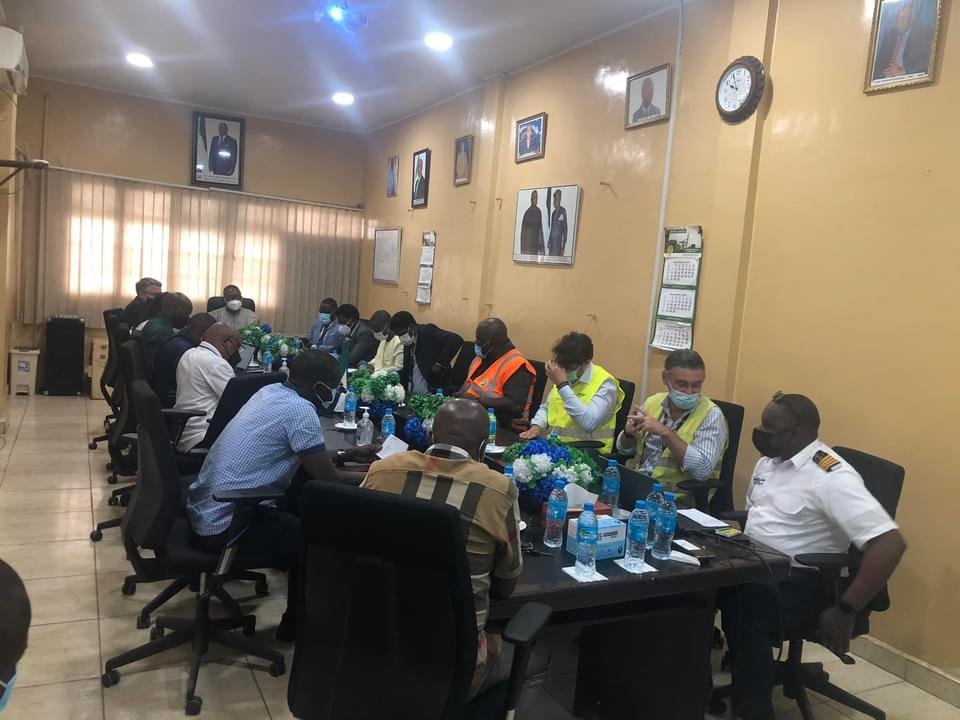
United States Ambassador Extraordinary and Plenipotentiary to the Republic of Sierra Leone David Reimer has on the 3rd February,2022 engaged stakeholders at the Freetown Port, Queen Elizabeth II Quay, Cline Town, Freetown.
Ambassador Reimer said his visit at the Freetown Port and engagement with stakeholders is to familiarize himself with the operations of the port-being a key player in the economy of the Country.
He said his engagement with stakeholders would explain the port operational processes, including the challenges.
In welcoming Ambassador Reimer, the Chairman of the occasion Martin Maada George, Esq. who also doubles as the Company Secretary of the Sierra Leone Ports Authority said the doors of the Sierra Leones Ports Authority are opened for such engagement bordering on investment and economic growth, mainly when the Port is now operating on a public-private partnership venture.
The General Manager of the Sierra Leone Ports Authority, Dr. Abdulai Fofana, said the Sierra Leone Ports Authority had been transformed from a Service Port to a Landlord Port wherein private operators are now performing core port functions.
He said this development had ushered in many reforms as the port operational and maritime safety and security aspects have improved considerably.
Dr. Fofana further informed the engagement that he assumed office three years back and inherited many challenges he is working to address every day.
SLPA Deputy General Manager, Mr. Yankuba Askia Bio said The Authority has a close relationship with the US government, referencing SLPA working relationship with the United States Coast Guards in the implementation of the International Ship and Ports Facilities (ISPS) Codes at the Freetown Port and other network Ports of Sierra Leone. He furthered that The Authority a few years back under the Fofana-Bio led administration, was given a pass mark by the United States Coast Guards for international Port safety and security compliance.
Mr. Bio commented on introducing the single window system that allows and makes easy clients involved in trade and transport to lodge standardized information and documents with a single-entry point to fulfill all import, export, and transit-related regulatory requirements.
“If information is electronic, then individual data elements should only be used to ease doing business”, he maintained.
The Deputy General Manager further informed the visiting guests that the Port and other Ports around the sub region are working assiduously to implement the single window system to eliminate the burden of human contact in the clearing process.
The visiting delegation was further intimated about a committee headed by the Chief Minister to look into the port’s environmental issues. He said the Committee made a tour to ensure that illegal mining of clay, garbage and oil disposal at sea should stop immediately.
A PowerPoint presentation was delivered on behalf of SLPA by the Harbour Master and Port Facility Security Officer (PFSO), Alpha Yayah Bangura. The highlights of his presentation were:
• The Sierra Leone Ports Authority (SLPA) was established by the Ports Act of 1964 (as amended). At inception, its primary responsibilities include controlling all ports and marine activities in Sierra Leone and operating the Port of Freetown. This consists of the Freetown port and the Kissy Oil Jetty to oversee the Ports of Nitti and Pepel, managed and used by private mining companies.
• The Port has a protected anchorage on the Rokel River with an average depth of 18 meters and an overall berth length of 1132.49 meters with an available depth ranging from 9–13 meters.
• The Port has 7 berths, 4 large warehouses and a paved container stacking area of over 50,000 sq. meters. The Port has probably the finest natural harbor (being sheltered) in West Africa which can be seen as a competitive advantage.
• That Private Port Operators were granted License/Concessions to operate, manage and develop specific areas assigned to them.
• That Bollore/FTL handles the container terminal (berths 3-7) since 2011 with 100% exclusivity to handle containers and in 2015 license was issued to them to handle 20% of bulk and break-bulk cargo.
• That NSBT- English Company secured a License in 2015 to operate and handle bulk and break-bulk cargo at berths 1 & 2. By the end of 2017, NSBT’s License was upgraded to a concession and the sharing between NSBT and Bollore automatically changed to 80/20% on bulk and break-bulk cargo.
• That Holland Shipyard- formerly Marine Slipway, is in charge of the repair of sea crafts
• That Dangote was leased a portion of land to manufacture bulk cement
• That Indigenous Labour Companies provide labor services to the operators in cargo handling
Challenges
• Changes with our ecosystem, resulting from increasing siltation at the Port.
• Ingress of seaweeds from the West Coast of Africa affecting Vessels in Port.
• Piracy and other forms of attack to vessels along the Gulf of Guinea stretching up to 50miles to the Sierra Leonean Coast.
• Additional safety requirements by Vessels Owners and Operators regarding health safety for Crew and boarding parties. (Covid 19)
Other stakeholders, including representatives from the National Revenue Authority (NRA), Freetown Terminal Limited (FTL), and Indigenous Transport Owners Association (ITOA), clearing and Forwarding Agencies (ACFA) and the Scanning Department made statements.
Mr. Tennyson, Bio of Customs of the National Revenue Authority, said NRA-Customs has brought in a lot of reforms in the clearance processes, which have helped to ease business transactions at the Port. He said the reforms include reducing the steps in the clearance process, improving communication with taxpayers, etc.
Bollore Country Manager, Bertrand Kerguelen said the Freetown Terminal Limited went into entire operations in 2011 following an agreement with the Government of Sierra Leone to operate the Freetown Port Container Terminal in 2010.
He further informed the visitors that FT has constructed a new multipurpose terminal worth over $120m United States Dollars with sophisticated modern equipment that has eased doing business at the Port. He said the new terminal with a length of 270 meters long and depth of 13.5 can now boast of mobile and sea-to-shore cranes and reefer ridges to power reefer containers of perishable goods.