

November 18, 2021
By: Mohamed Jalloh
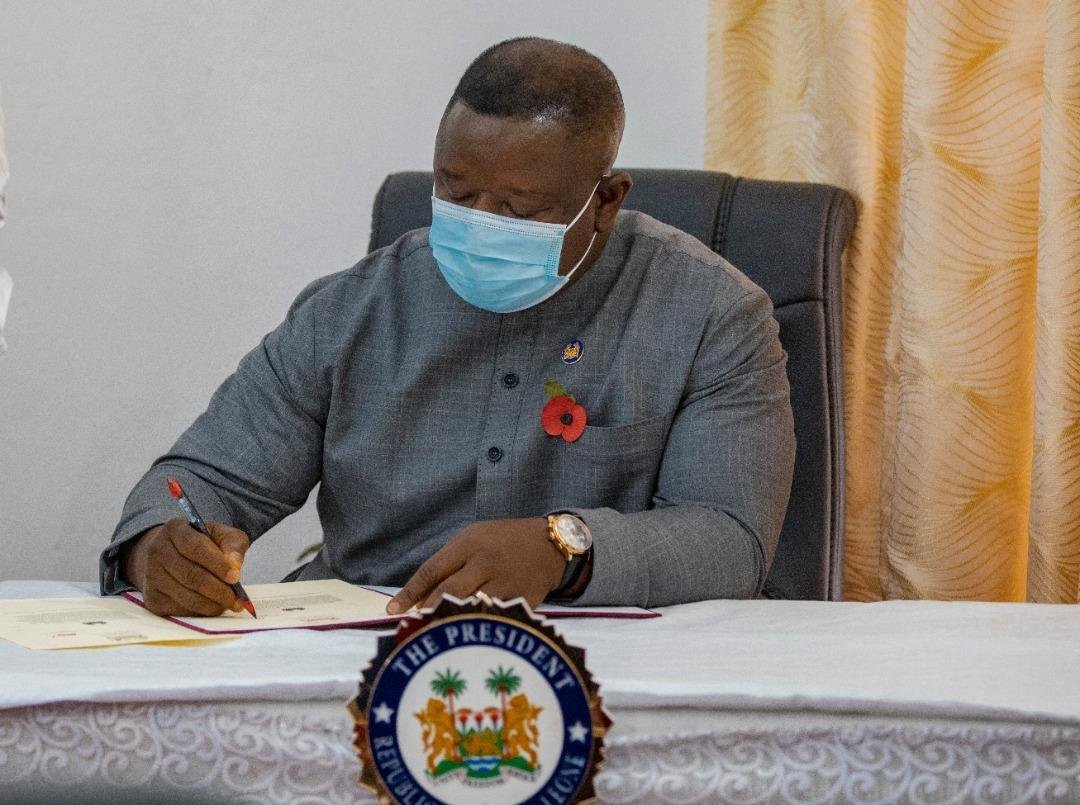
President Bio has finally assented to the cyber security and crime bill at state house on the 17th November 2021.
He started by underscoring the recognition that digital technologies are to the 21st century what the steam engine was to the industrial revolution.
He also praised the leadership and Members of Parliament for their inordinate bi-partisan support to the process.
The president said when one looks at the spectrum of crisis across the world; one could recognize the ubiquitous and transformative impact of digital technologies in identifying, mitigating and innovatively tackling these new global challenges.
He noted how greater digital connectivity, digital automation technologies, and the harnessing and analysis of big data are driving everything from innovation to research, to education, health care, entrepreneurship, economy, governance and more.
“I also see digital technologies as enablers that will accelerate and drive the achievement of the sustainable development goals, depending on how international we are about introducing them, how we scale their impact and how accessible and inclusive those digital technologies are to our population”, president Bio explained.
To that end, Sierra Leone has associated with the UN Secretary General`s call for developing a “storefront” for digital public goods across the SDG`s, for more connectivity and for greater international cooperation in defining governance and cooperation. At the local level Sierra Leone has focused on developing digital technologies and expanding access to those technologies.
“Our young population and our investment in the free quality education as well as in science, technology and innovation underline the strong aspiration that we will not be at the receiving end of the fourth industrial revolution”, he noted.
Since 2018 also Sierra Leone has wider mobile telephone coverage, more use of mobile technologies, more internet connectivity, and more access to digital communication apps and content.
The President praised civil society organizations, the press, citizens, for their immense contributions to shaping the final product of the bill and thanked them for their ideas, thoughts, and perspectives.
“Sierra Leone also thanks partners for not only supporting the development of our nation’s cybersecurity capabilities but also for assuring us of future cooperation in mitigating cyber threats and cybercrime.
“At the sub-regional level, I agree with the ECOWAS representative that we need a holistic and coordinated approach to develop and secure our cyberspace, augment our cyber-hygiene, strengthen our cybersecurity, and thus build our cyber-resilience in the sub-region,” he said.
President Maada Bio also noted that the general cooperation was a demonstration of the collective and shared global interest in working on cybersecurity and crime.
“Sierra Leone looks forward to more cooperation, more capacity development, more resource and technical support, and more experience-sharing in the years ahead. It is, therefore, a great moment of honour to sign into law, the Cybersecurity and Crime Act 2021,” he closed.
Head of the European Union Delegation to Sierra Leone, Ambassador Manuel Alexander Muller, said he was delighted to join the signing ceremony, adding that the event translated into action of a commitment made by President Julius Maada Bio to strengthen governance and endow Sierra Leone with a sound legal framework to mitigate cybersecurity threats and eradicate cybercrime.
Ambassador Muller further stated that the new law would go a long way to harmonize the domestic legal framework of Sierra Leone with the Budapest Convention on Cybercrime and other international agreements. He said the presidential assent was also an important signal to the region and the international community of the country’s commitment to fighting cybercrime.
“I congratulate Sierra Leone on the adoption of the Cybersecurity and Crime Act 2021, and I also convey the strongest sentiment of appreciation on behalf of the European Union and the Council of Europe,” he said.
Attorney General and Minister of Justice, Anthony Brewah Esq, said he was happy to have witnessed the occasion, adding that the advent of computers and the internet had changed the ways individuals behaved in some form of fashion, which had significantly amounted to money laundering, human trafficking, to online identity theft or credit card theft.
“The law will help reform Sierra Leone’s criminal justice system in many ways. The powers and procedures in the new law will address unauthorized access to protected systems, unauthorized data interception or interference, computer-related forgery, identity theft and impersonation,” he noted.
He further noted that the law would help address online child sexual abuse, the safety and security of every Sierra Leonean, their personal and corporate data system. He assured that the Law Officers’ Department stood ready to work with other law enforcement agencies to implement and harness the benefits of the Act.
Minister of Information and Communication, Mohamed Rahman Swaray, said they utilized a multi-stakeholders’ approach to ensure that contributions of all relevant stakeholders were captured and reflected in various stages of the bill.
He recalled that in 2019 and with support from the ECOWAS Commission, a credible firm was recruited to carry out a thorough desk review of the drafted cybersecurity and crime legislation, adding that it turned out that the drafted bill was in compliance with both international and regional standards like the Budapest Convention, Malabo Convention and ECOWAS Directives on Cybersecurity and Data Protection.
“Your Excellency, ladies and gentlemen, with 87 percent of our citizens connected by mobile voice and 27 percent connected on various social media platforms, the need for cybercrime legislation has never been more urgent than now,” he noted.
Minister Swaray further disclosed that the new law would strengthen the country’s capacity to apply legislation on cybercrime in a fulfilled commitment to the Malabo and ECOWAS convention on cybercrime, the EU and Budapest convention, all of which guaranteed human rights, privacy, and freedom of speech.